The AI Threatscape

A new report Brave New World? – Justice for creators in the age of Gen AI sheds light on the alarming and rapid damage being wrought upon the creative industries and asks how we can protect ourselves and our national culture against this onslaught. It lays out clear evidence detailing the negative impact of Gen AI on individual creators and the UK economy and offers solutions to redress the balance of power. It is thorough and detailed, but is mainly concerned with the immediate threat to creative sector jobs.

This is not a criticism of the report, which is excellent and essential reading. However in this blog post I want to expand the view little wider to look at some of the less-obvious issues which need to be mapped as this new technology advances.

Please don’t assume that in highlighting these issues I am not concerned about the impact on artists’ incomes or the degradation of copyright. I’m also not belittling the environmental impact of Gen AI* services (through their development and their use), or indeed the huge risk of the AI bubble bursting and crashing what’s left of the economy. All of these issues are massively important and they are all deeply troubling, but I also think it’s vital that we take a look at some of the less-mentioned problems which will (already are) the result of a shift into an AI-driven world.

Naturally this article will focus on the plight of photographers, but I’ll be looking a bit beyond the immediate financial concerns faced by those making a living from photography. Some of the points I raise will also have similar effects in other professional creative areas; I’ll leave others to comment specifically on industries in which I am not an expert. Some of my concerns go far beyond the economic and creative culture harms threatened by Gen AI.

There’s No Business Like No Business

The corporate or business photographer relies on a regular stream of client commissions. Taking photos for the company website, LinkedIn and other social media and printed material is this photographer’s bread and butter, but AI is already allowing the plagiarising of specific photographers’ styles in a way which is damaging their ability to make a living. More widely, it’s already possible for anyone to ‘spruce up’ an un-flattering ‘selfie’ using an AI service, again in preference to hiring a professional.

However, let’s not forget that the people who are using these AI services today could well be in the firing line as AI replaces traditional service sector roles. The very people who might want a decent photo for their LinkedIn profile or the About Us section of a business website could well be a disappearing market for the professional photographer.

To my mind, this is one of the greatest uncertainties and un-knowables of the advance of AI services. It’s certainly going to leave many photographers scrabbling to chase a dwindling number of viable clients. It’ll be a pincer movement of decline.

Who’s Afraid of AI?

Even before that day arrives, there could be a cultural shift which makes the online posting of portraits a less comfortable proposition for many people.

GenAI services are already being used by fraudsters and people with ill intentions. A profile photo you post online can be scraped by an AI service and used elsewhere, possibly innocuously, or it could be used to try to defraud or blackmail you. Elon Musk’s Grok service was quickly employed in the rendering of innocent images of women into sexualised content. Sexual abuse images and deep fakes are a genuinely terrifying aspect of the generative AI industry. The GenAI corporates are either unwilling or unable to prevent abusive and criminal use of their services and people are already becoming more wary of having their photo taken and used online where it will be vulnerable to being repurposed.

One of the key problems with how Gen AI models are trained is that they scrape content regardless of copyright (on the creator’s side) or usage restrictions (on both the creator’s and the subject’s side). Images which were destined only to be used in a single or restricted context can easily be scraped and repurposed for uses as-yet unimagined.

Will the About Us sections of corporate websites disappear in favour of anonymity?

Vanishing Culture

The natural wariness this generates in the minds of the general public extends beyond the question of allowing (or not) the use of one’s image in a professional setting. It’s already quite challenging to document news events or even everyday culture as people have become more inclined to say no to anything which might be used in ways they cannot imagine. If AI can be used to repurpose images for uses which have yet to be invented, I believe people will become increasingly hostile to having their likeness recorded in almost any setting.

It has felt for some time as though there was a golden age when photographers could document a street scene and, if not always welcomed, were at least mostly tolerated or ignored. We have a rich archive of historical photos showing people in everyday situations. From beach holidays to Sunday fairs, or simply out shopping, eating, drinking, entertaining or being entertained.

Photographing children in public spaces is an especially dangerous occupation now. The late Martin Parr and other documentarians covering everyday life simply couldn’t do today what they did until 20, 30 or 40 years ago.

The internet has already made people more sensitive to anyone taking pictures in these situations, but add the potential threat of AI abuse and I can see a time when not only will it not be possible to record public life at any level, but public life itself could start to withdraw into purely private spaces.

Where could all of this lead?

I could be wrong and I hope I am, but where social media has already caused harm to the traditional organs of democracy (I’m thinking specifically here of the demise of newspapers and professional journalism), the very hint of a threat of AI being at the service of criminals or government controls could very easily freeze the future expressions of our society and culture; both the ‘performative’ culture, such as public activities, protests and the like, and the documenting of these activities by photographers.

It’s not as if the warning signs aren’t already there, with journalists, and photo-journalists in particular, being targeted by states, the military, police and even citizens wishing not to be documented for any reason.

Conclusion

It’s tempting to only consider the immediate threats posed by Gen AI on one’s ability to earn a living. The Brave New World report also touches on the threat to UK culture and the future viability of the creative industries, and I won’t say anything to diminish the importance of the message contained in the report. The UK government would be unforgivably foolish to believe Gen AI can create sufficient jobs to replace those displaced by AI, but I wanted to set out a handful of other areas we must also be deeply concerned about. It’s not even an exhaustive list, but I’d exhaust myself if I tried to list and examine them all. Perhaps I’ll come back to this subject to take a further look at those issues.

If you think this article went awful dark awful fast, it’s probably not a bad metaphor for how AI could turn society and culture awful dark, awful fast.

*Gen AI refers to Generative Artificial Intelligence which requires continuous training on fresh data (words, photos, illustrations, music and so on) in order to be able to ‘create’ new ‘works’. I dislike the term ‘data’ in this context and the output of Gen AI services cannot be described as ‘creative works’.
Looking Back, Looking Forward

Yes, it’s that time of year when we all take a look in the rearview mirror to see what we’re leaving behind, simultaneously stepping on the gas, and accelerating into the year ahead. Or maybe we’re just trying to get away from zombies!

Assuming we’re not being chased out of town by the undead, I am of course building up (in a rather clumsy way) to my annual look at what has been and what is to come.

Except I’m not going to do that this time around, or at least not in quite as much depth as I normally would. I’m just going to say that 2023 had its highs and lows, and I have plans for 2024 which will evolve as I go.

At this point, I could sign off, wish you a merry Christmas and a happy New Year, and be done, but that wouldn’t be particularly satisfactory, would it? Maybe it would, but tough; you’re here now.

No, for this post I’m going to use broad brush strokes which I hope will also stimulate some thoughts within you, my current or potential clients.

Looking Back – 2023

While my stills work held up remarkably well, video demand seemed to drop off sharply. Instinct tells me clients are struggling to decide whether video is worth the investment. My advice is, talk to me! I’ll be happy to discuss your ideas and will be honest about your best options.

All too often I have clients come to me with only the vaguest idea that they want ‘some video of a thing’. But rather than allow me to guide them further, they either kill the project or go to someone who will happily turn their half-baked plans into a massive invoice. Don’t fall into that trap.

Even the stills work was a bit up and down this year. I’ve done pretty well, but I can tell businesses are struggling to see through the fog of wars, climate crisis, cost of living, and so on. Some are taking positive steps to keep their marketing on track, while others see marketing as a cost (bizarrely).

If you can’t stretch to video, keep using stills to keep your brand fresh and alive. They’re far more cost-effective than video and more adaptable, but they also need a clear direction (purpose and brief). Again, talk to me if you want to develop the germ of an idea.

Overall, 2023 has been ok. Its school report would read, “Could do better”.

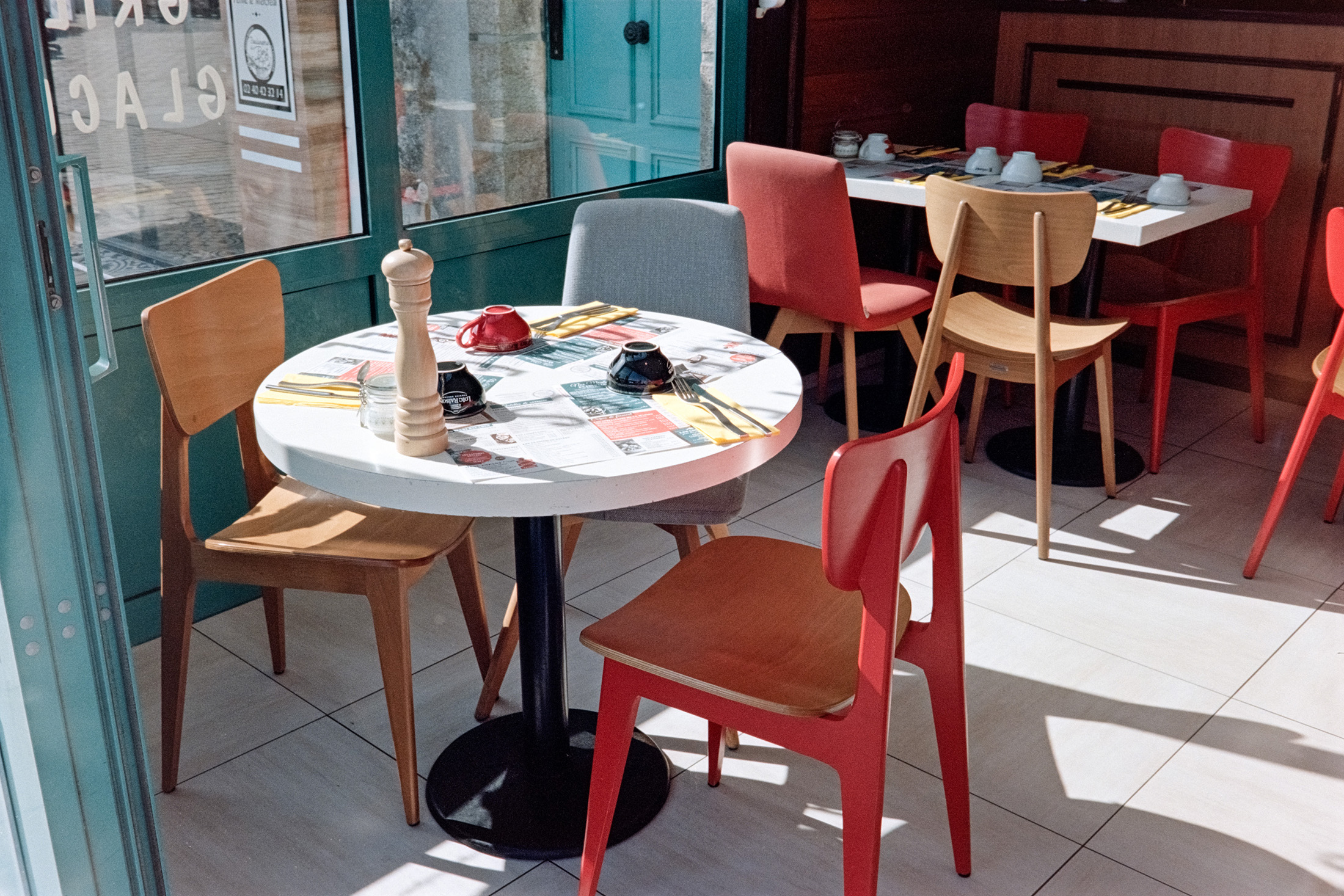
A highlight of 2023 was a trip by rail and bike to Côte Sauvage, Brittany.

Looking Forward – 2024

So let’s gaze into the crystal ball.

I predict it’s going to be more of the same because the uncertainties that have troubled businesses since (to put it frankly) the Brexit vote of 2016 are not going to be resolved in the next few weeks or even months. Domestically we’re going to have a general election, so there will be plenty of people waiting to see how that shakes out. Which is frustrating because it could be yet another year of bumpiness. And who’s to say something else won’t come along in the meantime to create more market jitters?

My advice is, if you want to do something, do it. If you don’t, someone else will and they’ll steal all the credit (and potentially your clients).

Moving on from the pure business aspects of the year ahead, I’ve decided to have another look at something rather more ephemeral; the ethics of my business.

That isn’t to say that for the past 25 years as a freelance photographer, I’ve operated unethically but I feel we’re at a juncture where it’s not a bad idea to have a fresh think about how we all work and how we treat each other.

Towards the end of this year, I finally managed to update my Terms and Conditions (something I’d planned to do last Christmas!) and in 2024 I plan to add an Ethical Statement that will cover a wide range of aspects, from use of AI in images, to how I approach my personal project work.

This isn’t going to be easy as I don’t want to just put up a bunch of warm, fuzzy words and say job done. This will, in effect, put into text the moral rules by which I already work, but will also tie in some new issues which have emerged more recently.

There’s no harm in any business or organisation, however ethical they already say they are, spending a little time having a deep think about whether their ethical practices are up-to-date and whether they genuinely implement them. Perhaps every business should have an Ethical Statement against which their actions can be measured.

So look, I’m not going to make great proclamations about how I see the year ahead. It’s all too up in the air for that, but I have set out a couple of road signs.

At the risk of labouring my metaphors, I’m going to pull up at the side of the road to stretch my legs, before getting back in the car, stepping on the non-greenhouse-gas-emitting accelerator peddle and zooming off into the bright new dawn of 2024.

Thank you to every one of my clients, suppliers, friends, and colleagues who’ve made 2023 bearable. Let’s do the same, but more and better, in 2024.

Happy Christmas!

Tim

The Local Proposition

Are you buying anything from Amazon this Christmas? The campaign to shop local seems to have gained ground, even if the orange behemoth with the A to Z smile is still gaining sales.

The pandemic will have put many in a quandary; desperate to get their Christmas shopping done, but still unable to leave home, it can seem as if there is only one choice, when even online there are many great independent traders now.

However, the shop local/support independents movement is definitely finding new followers. Buying on the high street is beneficial to local economies and communities, while buying online from local, independent businesses is certainly helpful too.

Buy Local for Your Business

So this week I’d like to extend this notion: If buying local for personal reasons is beneficial to the local economy and jobs, please also consider buying ethically-sourced professional services for your business too.

Not just photography, but other creative industries have struggled against the big players for many years now, yet none of the disruptive sites offering creative services has benefitted the wider economy. They might seem to be the cool, new and exciting way to do business, but they dis-benefit independent creatives disproportionately.

Of course as a business owner you probably want to find the best value for money for all the goods and services you need, but have you ever thought about how this might impact the economy in which you’re trying to function?

It might help you in the short term if you can populate your website with images and graphics bought in at below cost of production, but when this process replicates across an entire business economy, who is left with any money to buy your services?

Value vs Cost

Likewise, if you’re unwilling to pay fair rates for the goods and services supplied by others, why should anyone pay your rates for the goods and services you supply? And let’s set aside the impact of using suppliers who pay little (if any) tax back into the society in which you operate.

So undertake a pledge, make it company policy if you like, that from January 2021 you will start the process of making your business more sustainable by helping to sustain others. It might make you very slightly less profitable in the short term, but it will make your business more sustainable in the longer term.

You’ll almost certainly have a more robust business come the next economic upset.

Until 2021…

I’m taking a break from writing blog posts here until January 2021, so I’ll just take this opportunity to thank you for all your kind support through this monumentally challenging year.

If in the meantime you would like to keep up with all my goings on, you can follow me on Instagram (@takeagander) or sign up to my newsletter for very occasional updates on my personal projects and new fine art print offerings.

Thank you, have a happy Christmas and a new, improved 2021.

Tim

The Beat Goes On

While the news seems unrelentingly gloomy at the moment, I’m pleased to say I’ve had some positives to focus on.

I’ve had bits of work in the last couple of weeks and enquiries have also increased. People are looking to promote their businesses once again!

This doesn’t mean a flood of work is about to engulf me, but it’s encouraging to know I still have clients. I also have some great supporters helping me via my ko-fi account*. They’re keeping me funded for the non-client projects I’m engaged in. *HINT: You can do the same from as little as £3.00 one-off payment!

What is especially encouraging is that in an atmosphere of debate about what counts as a viable job, my job – the job I love, which has been put under this particular spotlight for many years now, continues to be considered viable; invaluable, even.

There are many out there who believe professional photography is dead and that every photo ever needed has been taken already. And if it doesn’t already exist, well there’s always that professional photographer in your pocket. They are, of course, quite wrong.

We know automation and technology cannot replace certain needs. Technology still can’t make a decent loaf of bread, so we can’t expect it to make pictures with the right tone and impact. This only comes about through human interaction.

Try to imagine a world without human interaction, how much fun would that be? How creative? We’re experiencing a taste of it now, so we know the answer already.

So while there will be some very difficult times ahead, I’m going to stay focussed and positive. No one is telling me I’m not viable.

Storms Now, but Storms Ahead Too?

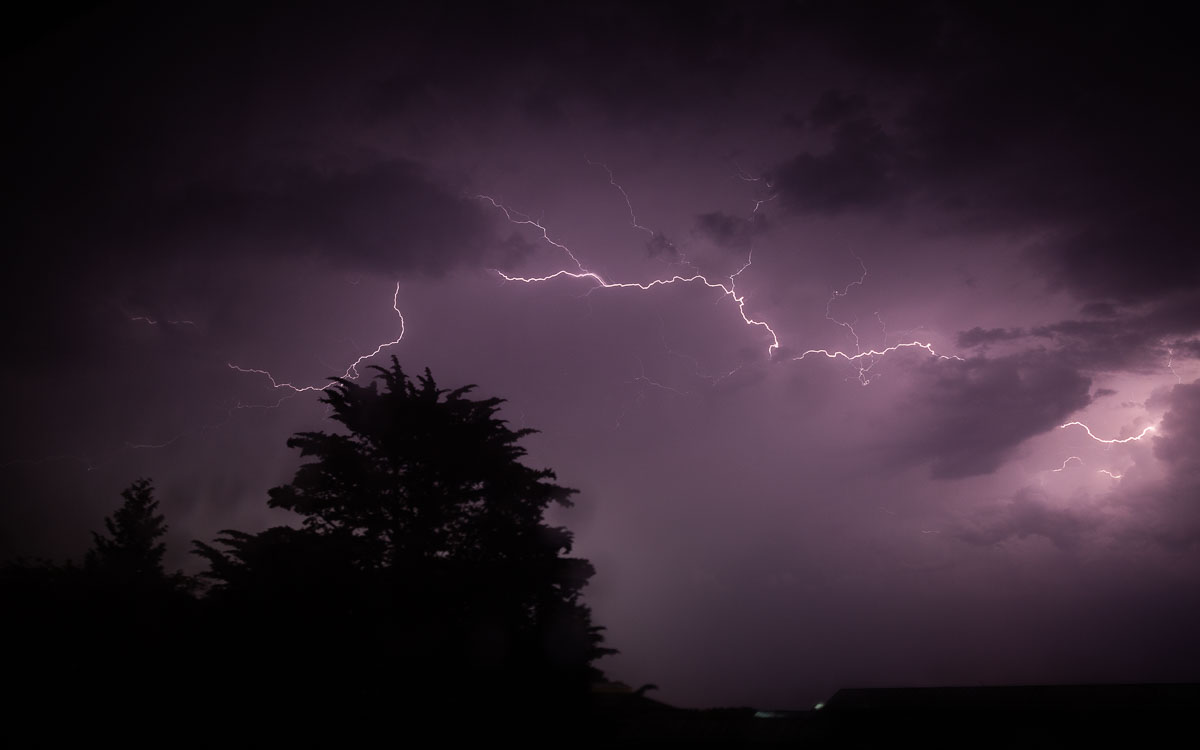
Two nights ago we experienced the weirdest lightning storm anyone seems to remember witnessing. I had only seen something similar once, about 30 years ago in Germany, but even that was nothing compared to this more recent event.

Accompanied with Biblical rain, for almost an hour lightning lit up the night sky with astonishing frequency with BBC Weather reporting some 48,000 strikes nationally. It never struck Earth in my bit of Somerset, it was all cloud-to-cloud, which is what made it and its accompanying Hollywood thunder noise all the more eerie.

It happened to be the day we learned Boris Johnson was to be our new prime minister, and some speculated that the Four Horsemen of the Apocalypse were about to burst through the clouds and lay waste to all that lay before them.

Of course politics and the weather are not so closely related. Setting aside political decisions which might cause or reduce global warming over generations, we can safely say this lightning storm and Bojo’s appointment are not that intertwined. However, as metaphors go its timing could not have been better.

So what of this new political future? Are we moving to the sunny uplands? Or hurtling towards a terrible storm? Anyone who knows my politics will be aware that I happen to believe Brexit is a very bad idea (putting it both mildly and diplomatically). However, it seems that’s where we are headed and whether we are inners or outers, we’re going to have to deal with whatever Brexit means.

It’s practically impossible to know how Brexit will affect my business. I know it will affect a great many people whose work takes them regularly in and out of the EU and their futures more than mine will rely on a sensible deal being reached about freedom of travel. For my part, looking back at my books over the period during which we were meant to leave, I’d say the uncertainty has definitely affected the willingness of businesses to press ahead with new projects. It’s been a real stop/start year so far.

Perhaps with a definite date in mind clients will feel better able to plan for October 31st and freer to make investment or expansion decisions. Sadly I suspect there is still a great deal of doubt about what Brexit will ACTUALLY mean. For all Mr Johnson’s energetic promises, he still has to deliver what Theresa May couldn’t and it still might not be the Brexit some people had in mind (while still managing to be the Brexit many never wanted).

I worry about the effect Brexit will have on those who have less control over their lives and fewer resources to deal with any negative consequences. I also know business will carry on one way or another. What is absolutely certain though is that nobody, not even Boris Johnson, has any real idea what to expect on the other side of all this. I think we can assume Boris will be ok, but beyond that, not much can be said with any certainty.

Possibly the most inconclusive conclusion I have ever written.

Marketing Smarter

While my lovely Pentax S1a is off for a rebuild, I’ll return my attention to things more corporate photography related.

With doom and gloom headlines about the state and future prospects of the UK economy all over our news channels it might be tempting to think it’s time to tighten belts and hunker down for the long haul.

Often the first casualty of financial difficulty is marketing, and perhaps more specifically photography, but if that’s your plan you might want to hold fire because done right, good marketing and good photography, even on a reduced annual budget, can keep your company name in the frame and help you survive the economic Winter.

This week’s message is simple: If you’re going to market less, you’d better market smarter. What does this mean in practice?

Of course I speak from the perspective of a photographer in this corporate world and what I occasionally see is businesses devoting a lot of resource to cutting corners. Not only is this a waste of their valuable time, it also leads to results which don’t hold the client in the best light, or images which have little real impact. It might look like the cheaper option, but at what cost to the business?

I know I’m not the cheapest photographer in my market, but then I wouldn’t want to be. Because quite apart from the quality I strive for in my photography, when a client approaches me I’m there for them from the word go until well after the project has been delivered.

The difference I offer starts with the helping hand and sounding board at the concept stage. Even corporate portraits or the “humble” press release require a level of creative input and the right photographer will be able to guide the project from the earliest stages, ensuring the end-result has maximum impact.

The other aspect you’ll want to consider when hiring a photographer on the sole parameter of cost is, will they help, guide and assist during and after the photo session?

All this help and input, from concept stage to post-delivery assistance, requires time, knowledge and experience, all of which have a value which should be factored into the cost of hiring. Of course this means a cost above and beyond simply that of producing photographs, but since you’re spending the money anyway (and almost certainly taking up your and your colleagues’ time doing so) you may as well get the best results possible.

And when the job is over, the photos delivered, is your photographer still there to help if you need it? I’m not just talking about up to the point they’ve sent the invoice. I’m often helping clients with follow-up assistance months, even years after the job was shot, delivered and paid for.

So, who’s the smart marketer now?


The Stupid Economy

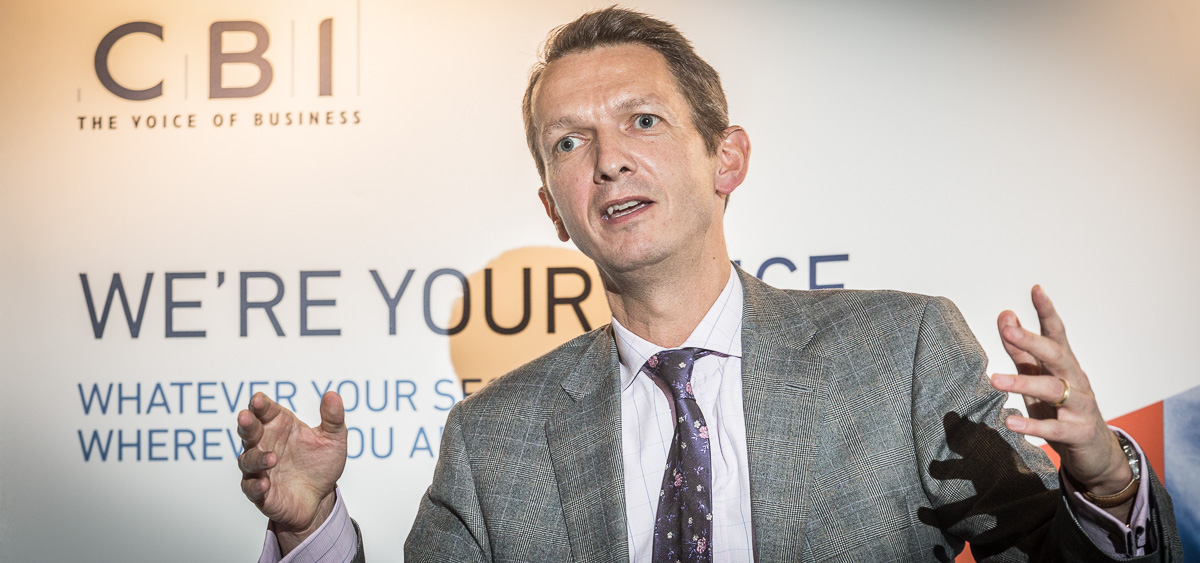
Yes, that’s a misquote of the often used “the economy, stupid,” but I thought I’d throw a few thoughts out there about the economy because I covered an “economic dinner” last week (it was a dinner for economists, not a low-budget supper) at which one of the guest speakers was Andy Haldane of the Bank of England.

There was much talk of the economy, interest rates, access to finance and so on, and while I don’t hear everything at these kinds of events on account of I’m busy concentrating on camera and flash settings, angles, focus, and composition, I do get the gist of what’s being said.

But why should anyone care what I, a mere photographer, think is happening with the economy? Why indeed, though it’s fair to say most economists seem to be equally ill-equipped to understand all the statistics about employment, productivity and forecasts on where the economy is headed, so I may as well give it a shot.

Andy Haldane of Bank of England speaks at a lectern at a function in Bath

Andy Haldane of the Bank of England gives an economic forecast at an event in Bath

I was at another function earlier in the year and was approached by a representative of the Bank of England who I thought was going to ask me something to do with photography. Instead he asked me how my business was doing because, he said, “I suspect someone in your line of work feels the ups and downs of the economy rather more immediately than many others.”

I think he’s probably right. Commercial photographers often feel the start of a bust almost before it’s happened because while companies might feel they’re working in isolation and cutting their marketing budgets ahead of an expected downturn, when enough of them do this the photographer feels the downturn before it officially hits. I experienced this in 2008 not long after Northern Rock hit the rocks.

So where are we now and where are we going? Well for a start I’m happy to report that things have picked up over the last two or three years. My turnover is back to where it was pre-crash, and actually marginally up, but it all still feels rather delicate.

Company budgets are still very much under constant revision and my turnover is up because I’ve had more bookings, not because I’ve put my fees up. In fact my fees haven’t changed significantly in about four years.

What can be hard to separate out is whether businesses are booking more photography because they’re feeling more confident or because they’re trying to make up for lost ground having slashed marketing budgets in 2008. I can only speak anecdotally, but I’d say it’s a mixture with a tilt in favour of the latter.

Businesses which have held back spending on photography for more than a couple of years often find that when they come back to review their marketing plans, they’re lacking in pertinent pictures and often have to restart their picture library from scratch. This can be an expensive process, and might force some to further delay commissioning new work. It can become a bit of a vicious cycle.

Then when the decision is made to give the go-ahead on new imagery, because so much is required to recover lost ground it’s understandable that there is some pressure to keep costs down. The end result is, I get more work but I can’t charge any more than I was a few years ago. Many businesses find themselves in a bit of a limbo situation like this.

It really doesn’t require an economist to tell you that the “recovery” is going to be slow and vulnerable. The debt bubble is still in the economy. It was with the banks, now it’s been spread amongst us all, but it is still there and getting worse. This is keeping everyone, businesses and individuals alike, nervous. Of course my best advice would be to not slash your marketing budget (I would say that, wouldn’t I) because it’ll harm your chances of finding new business and retaining existing clients and it’ll cost more to re-start it later.

Now my thoughts on the economy might not be detailed and in-depth, but like any astrologer, if I remain vague I can’t be accused of being wrong can I? Famous last words.

Electile Dysfunction Problems – what’s next?

We may have just had the most exciting election since Blair took power from the Tories in 1997, but the result has been somewhat surreal and indecisive. At least now David Dimbleby can finally take a nap and Gordon Brown can finally switch his smile off for good. No more face-strain for Gordon, no more wincing for us.

I suppose we have to accept that the most pressing job of the new government will be to sort out the dog’s breakfast we laughingly call our economy, though to be fair to Gordon and Labour, it really wasn’t their fault. The problem is, as it’s not the Government’s fault, by logical extension there also isn’t a great deal any government can do to correct it apart from push some debt around until it pops up somewhere else, like a fiscal version of whack-a-mole.

I don’t wish to dwell too much on the economy though. I’m happy to leave it to others with far larger brains than mine to make an even bigger mess of it at the expense of those of us least able to cope with the consequences. What I’m really interested in for the purpose of this blog is what a Tory/Lib Dem government will do about copyright, orphan works and extended collective licensing.

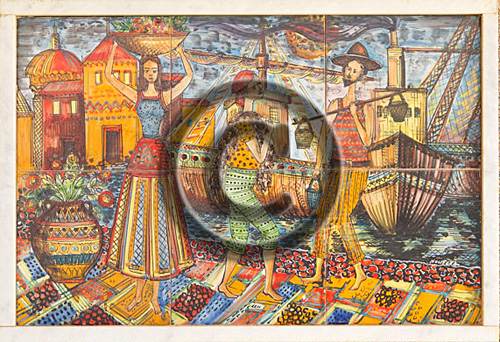
photo of tile mural in sicily protected by copyright watermark.

Will all photos on the net have to be disfigured just to protect them?

Yes, I know it’s not a major issue right this minute, but it will become one very quickly and we can’t be sure when it will sit up and slap us in the face, so we need to be prepared.

Let’s look back first to those halcyon days when a Parliament wasn’t hung and prime ministers weren’t a double act. When the Digital Economy Bill was passed into law (the DEB almost certainly will be revisited soon) and the orphan works clause was debated, albeit briefly, in the Commons.

What happened then, just to recap, was that under lobbying pressure from photographers and the Stop43 campaign, Conservatives (with an eye on the electoral prize) agreed to drop Clause 43, while Labour (perhaps thinking they had more chance of a majority than they actually did) decided they didn’t need to drop Clause 43 – or perhaps it was their bargaining chip for getting the rest of the DEB through all along, whatever. Meanwhile, Don Foster for the Lib Dems argued to amend the clause, but keep it. This despite the fact he’d been told in great detail why this was a bad idea.

So now that we have a Tory/Lib Dem coalition government, do we really know where the parties stand? The Conservatives said at the time of the DEB debate that there would need to be a proper review of copyright, OW and ECL after the election, and it would appear that at face value they have some sympathy with photographers and other creators of original content. But then we have the Lib Dems, who clearly don’t understand the issues.

With some luck the Lib Dems will see the light, and the Tories won’t be lobbied so mercilessly by publishers, aggregators and content thieves that they lose sight of the fact that photographers generate a great deal of wealth for business and the country. It’s part of our industry and our culture. It’s our heritage too. Without professional photographers, all users of images would suffer and visual innovation would stall.

It’s going to require a mammoth effort from core groups of photographers to draw up required minimum standards for any review and subsequent legislation, but it will also require the effort of individuals who claim to care about photography. They will need to keep in close contact with local groups, who in turn should keep an eye on developments at national level so that when the time comes, our voices won’t be drowned out by big business and freetards.

The Fat Lady has sung…

YES to victory over DEB

Professional and amateur photographers can celebrate this morning!

And what a sweet song of victory it was. Thanks to Editorial Photographers UK (EPUK), stop43 and thousands of individual photographers, clause 43 of the Digital Economy Bill was dropped (proof here if you scroll down to Enforcement Obligations) last night, and the bill was passed without it.

I wish I could add my thanks for the support of organisations like the British Association of Picture Libraries and Agencies (BAPLA) and the Royal Photographic Society (RPS), but instead they chose to opt for having their tummies tickled by Government perhaps (though presumably not in the case of the RPS) with a view to becoming licensors of orphan works themselves once the bill was passed. Instead they’ve left themselves damaged for having tried to sell copyright for a fistful of beans.

But let’s not be too proud in victory. All these organisations took views which they thought were correct. They operate in an unfamiliar environment now, and we will need to work with them over future legislation which will surely be tabled by the next Government. Copyright laws do need reform, photographers want it, and individuals and “representative” organisations will need to work alongside each other to achieve a fair balance between creator and consumer. All we ask is that our work, and the work of countless creative amateurs, isn’t stolen from us and sold to all takers, and that we have a statutory right to be identified as the authors of our work. There are other issues which need to be sorted out, but all in good time.

Perhaps the next important battle is the proposed changes to the Data Protection Act, which will see much photojournalism and street photography outlawed or rendered impossible. One thing at a time, though eh?

It ain’t Orphan ’till the fat lady sings…

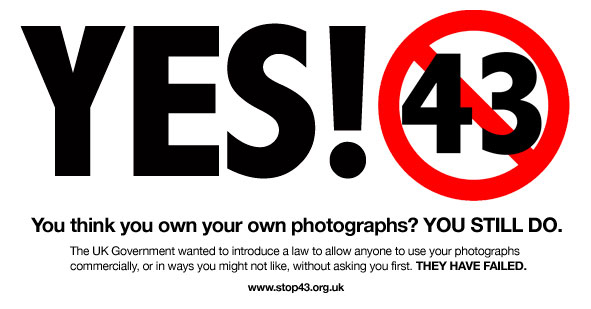
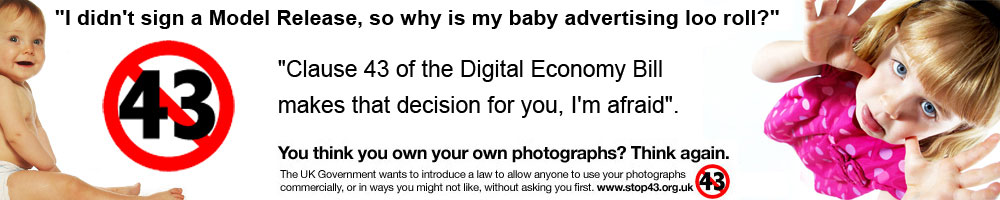
stop43 viral image

If the DEB becomes law with S43 in tact, your photos become fair game.

Today’s the day. Not only will Gordon Brown pay a little visit to Buckingham Palace to ask if he can dissolve Parliament (yes please!), and give us our chance to vote for the frying pan or the fire, the blunt axe or the sharp one, but it’s also the day the Digital Economy Bill gets its Parliamentary debate (such as it will be) and will either be voted through in the wash-up, or dropped. If it goes through, it may or may not include Section 43 which deals with orphan works.

In the Parliamentary equivalent of a smoke-filled room, all the horse trading between vested interests, and personal ambitions of departing politicians with an eye on their post-political careers, will come into play. Forget democracy, this is a seedy little private auction for business and career interests.

There is hope though, even at this late stage. A couple of days ago, the conservatives announced they would oppose Section 43. But of course there is still a risk of a last-minute change of mind (they are politicians after all), and we’re still not entirely sure which way the Lib Dems want to go. They’ve made encouraging noises about how Section 43 should be changed, but no clear commitment to oppose it at this stage. Personally, I hope they have the integrity to oppose the entire DEB on the basis that one afternoon isn’t enough time to debate anything as complicated and contentious as this bill. If they do that, and the Conservatives stick to their announced opposition, the bill would fail to be passed.

We have to believe that at the very least, Section 43 will get dropped. The amount of time and effort expended by my colleague photographers in fighting this ridiculous bill could have been better spent doing our jobs or completing VAT returns and getting our books up together for the end of the financial year. But no, some daft politician somewhere managed to come up with a system of dealing with orphan works which was so insanely un-balanced and damaging to our profession that we had to pour all our efforts into this.

And before you start playing your violins for us, remember that even if you are not a professional photographer, even if you are not based in the UK and even if you only take photos of your drunk pals on a Friday night, if some commercial or political organisation thinks your pictures are worth stealing and using without payment or permission, the orphan works legislation would affect you. If you’re in a photo taken by someone else that gets used without payment or permission, this legislation would affect you.

So let’s wish Gordon a nice trip to the Palace and hope all this effort has paid off.

Read more and keep up with latest developments here: copyrightaction and here: stop43

Jeremy Nicholl’s excellent blog continues to inform on the developments. Click here for more.