The Non Camera Review Camera Review

I’m going to kick off this article with a couple of apologies; firstly that it’s been quite a while since I posted anything (did you miss me? No? oh well…), and secondly for the somewhat oblique title of the piece. I always struggle with titles, and this was no exception.

What I’m trying to get to in this one is that while I am going to talk about the cameras I use, this is not a camera review. Think of it more as a personal review of how my kit has performed since I updated it around a year ago.

To start with a little bit of background. I switched from Canon (who I’d been with for more than 20 years) to Panasonic Lumix just as we were emerging from the Covid pandemic. There were multiple reasons for this which I won’t go into here, but just to say I was suitably impressed with the Lumix S5 and found myself selling off my Canon bodies and lenses piece by piece to help fund the transition.

The S5 wasn’t perfect by any stretch (autofocus being its weakest point) but the Lumix bodies are solid and the lenses incredibly sharp and well designed. So I was satisfied with my new commitment.

Keeping a long story short, the S5 was superseded by the S5ii and S5iix bodies, but I held off updating to those preferring instead to stick with what I had until the S1Rii came out. Unlike with the S5ii cameras, it was enough of an upgrade to justify the outlay.

What the S1Rii gave me was a much higher-resolution sensor and solid autofocus. A few other nice-to-have features also swayed me, but this camera has what the original S5 lacked – reliable autofocus, even in tricky situations.

A month or two after purchasing the S1Rii, I upgraded my second S5 body with a S1iiE. Another apology is due here, this time for all the model numbers, but I’ll try to clarify what’s going on here.

So by this time last year I had upgraded both my Lumix S5 bodies. One with a high-resolution body (S1Rii is 44 megapixels), the other with a body with the same resolution as the previous cameras I had (S1iiE is 24 megapixels), but with vastly improved autofocus and handling.

Now here is where I really have to applaud the Lumix design team. With almost any other manufacturer, if you have two different camera bodies (one perhaps cheaper than the other) the handling and controls will always differ too. I always have two cameras for work since only having one is a liability, but the problem with this arrangement is that having different muscle memory for each camera body gets in the way of seamless operation.

The beauty of the Lumix S1Rii and S1iiE is that in looks, handling and controls, they are completely identical. So much so that I’ve put a little red sticker on my S1iiE so I know at a glance which one is which without having to look at the model number on the camera front. The single difference between the two cameras is in the file sizes they spit out.
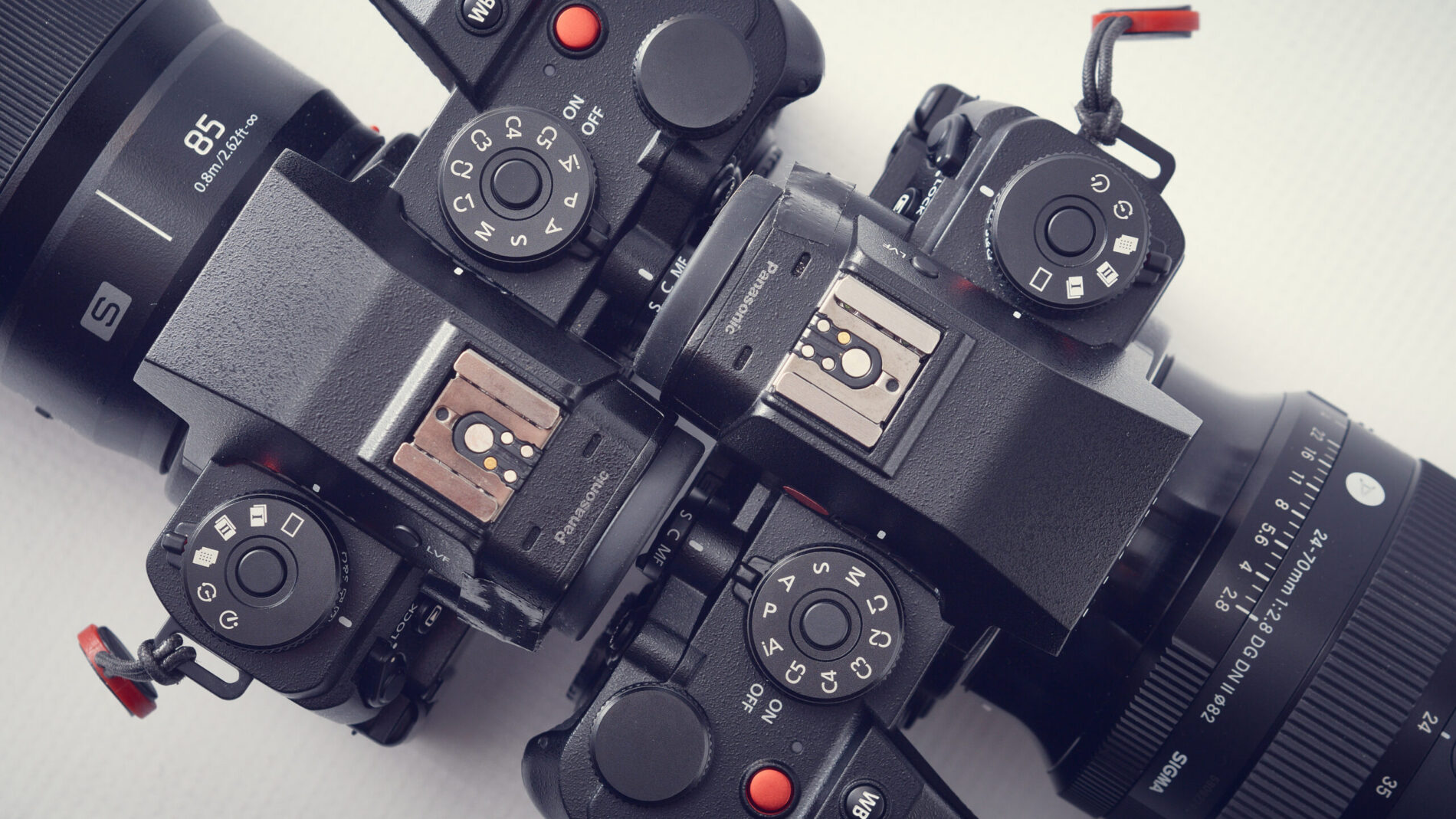
You might ask why I didn’t just get two S1Rii cameras in the first place; a fair question and the answer is both twofold and simple: 1. cost and 2. file size.

Tackling point 1 first, I could have afforded to buy two S1Rii bodies, but as a freelance I always have to watch I don’t go mad just buying whatever I want. The S1Rii body retails at circa £2,600.00 where the S1iiE is £1,900.00. That’s quite a chunk of money.

Point 2. I didn’t want a 44 megapixel camera for absolutely everything I do. 24 megapixels is pretty much always more than sufficient and is lighter on storage needs, while 44 megapixels is great when I need to crop or for images destined for large print display such as pop-up banners and posters.

In practice I often use both bodies side-by-side on jobs, reducing the need to swap lenses. I like to keep an 85mm lens with its longer reach on the S1Rii and use the S1iiE with wider lenses, the reason being that with 44mp to play with, I can crop to make that 85mm lens more like a 200mm lens without having the attendant bulk, but still retaining image quality.

If I’d stayed with Canon, the R5ii being their closest equivalent (as far as I know) to the S1Rii, costs around £4,000.00 body only. So I’d have to shell out £8,000.00 to have two bodies. Also the R5 is still just 24mp.

So why are Lumix cameras so (relatively) cheap? I might flip that question to ask why the likes of Canon and Sony or Nikon are so expensive. I have to concede that for all Lumix has done to improve autofocus performance, Canon, Sony and to some extent, Nikon, are reckoned to have the edge in this regard. In practice though, I rarely have problems with focusing. The main reason I believe there is such a price disparity is in brand recognition.

Lumix are very highly regarded cameras to those who’ve used them, but the other three have a much larger market share each and can exploit the loyalty they’ve built up. Lumix has often been dismissed as a video-centric brand, but I’d say their stills performance is incredibly compelling.

One other issue could be down to the range of available lenses. Canon, Nikon and Sony all have very extensive choices of lenses, but Lumix is part of a lens mount alliance with Sigma and Leica, and though they are a little lacking in the longer telephoto ranges, I no longer shoot sport so this doesn’t affect me. In all other respects I feel well-catered for when it comes to lens choice.

To conclude: One year after upgrading to my current camera bodies, and around four years since switching to Lumix, am I happy with my decisions? Absolutely. Could Panasonic do more to improve the cameras? Yes of course, but frankly there isn’t much that they lack, so I can see myself continuing with my current pair of bodies for some years to come.

The Camera Does Matter (it just depends…)

There are many photographic clichés and my least favourites one goes “the best camera is the one you have with you.”

You’ll see it on so many camera forums trotted out by those who like to make themselves look “expert” in some way. Now, while clearly you can’t take a photo without a camera, I have to challenge the thinking behind this particular cliché which is that you can take a prize-winning photo on a pinhole camera and you can take a dreadful snapshot on the most expensive camera money can buy.

While it’s true there are many ghastly photos taken every day on cameras costing many thousands of Pounds, it’s incredibly unlikely you’ll get a prize-winning photo on a pinhole camera or cameraphone.

blurred, colourful photo of fairground waltzers ride

When I take personal photos like this the camera is less important

I’m sure someone somewhere has taken a photo with a cheap camera or on a smartphone which they’ve managed to sell to a newspaper or won a prize with somewhere, but this is to ignore the fact that the world is vast and the “infinite monkey” theory will disprove any sweeping statement. Except it doesn’t disprove anything, because I’m talking about likelihood. I’m also talking about context in which a photo is taken and the context in which it is to be published.

Of course if you get a nice colourful snap on your phone it’ll look lovely on the internet, which will prove you didn’t need a big fancy camera to take that photo. Try to sell that photo to a stock library and it’ll get rejected on the grounds that it won’t come up to client requirements for image size and quality.

Take a photo of Lord Lucan riding Shergar through the lost city of Atlantis, and no newspaper or magazine will give a stuff about the quality, they’ll be tearing your arm off at the elbow to get hold of the image. They might even offer some money to publish that snap. It wouldn’t even need to be particularly sharp.

Now if I turned up at a client’s job with nothing more than my iPhone I think the client would be rightly upset. Replying “but this is the camera I have with me, therefore it is the best camera” would go down like a lead balloon.

And so I’ve re-written this cliché. It goes “the best camera is the one you have with because it’s the best camera you own and because you’re being paid to use it.” There, that’s fixed now so I can go after my new least favourite cliché. Just as soon as I’ve worked out what it is.

When the chips are down, measure them.

Camera Chip Size Chart

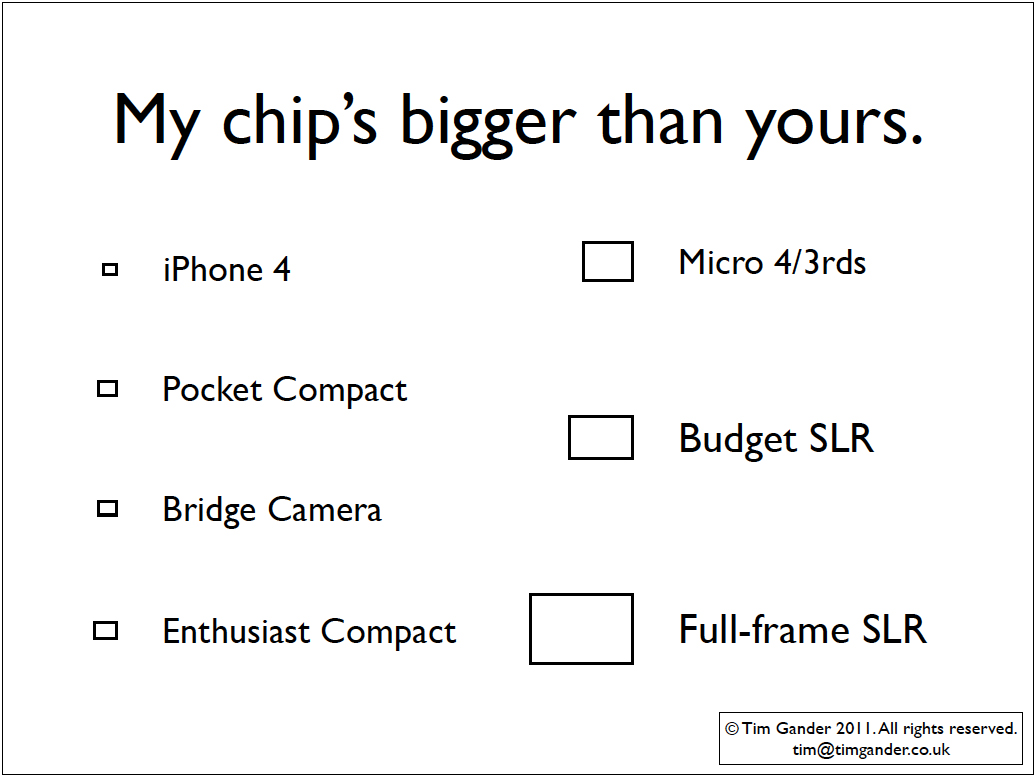
Comparative chart of imaging chip sizes.

A bit of a frivolous posting this, but I was putting a presentation together based around the camera systems that are available, the pros and cons of various options, and what some of the technical jargon means (geek speak, if you like).

As an exercise to demonstrate difference at the heart of various cameras, I made a chart comparing the imaging chip sizes of various types of camera. The boxes you see in the graphic are to scale relative to each other, so don’t go measuring them with a ruler and then complain that they’re not the right sizes. I make no claims to absolute accuracy, but they give some idea of the difference between (say) the iPhone 4 chip and the chip in the Canon 5D MKII (the full-frame example).

What surprised me was that the enthusiast compact (my measurement taken from the spec of the Canon G12) is actually larger than the chip found in a typical bridge camera. This might explain why the enthusiast compact is around £175 dearer than the bridge camera.

The chart also points up that although micro 4/3rds (MFT) camera manufacturers like to claim that you can now take pictures like a pro with their cute, retro-styled, interchangeable lens cameras (my measurement is based on the Olympus Pen), the chip size is still some way off the full-frame DSLR and remains smaller than the chip found in the average budget DSLR. And that same DSLR chip is found in more expensive SLRs too, like the Canon 7D.

It’s probably testament to quality of the chip found in budget DSLRs, aka APS-C size, that it is good enough to go into cameras like the Canon 7D which costs around £1,130. Personally I’ve been a little underwhelmed by the test images I’ve seen from the MFT cameras, and with the body and basic lens costing well over £700 it makes you wonder if you’re not paying as much for the retro cuteness as for the camera itself.

Panasonic also make MFT cameras without all the chic charms of the Olympus Pen, and their equivalent to the Pen, the GF2, is around £460. That’s quite a saving for eschewing the chic, and it’s not an ugly camera either.

But what the exercise drew my attention to, in looking at cameras like the Pen, was that photographers risk being lured not by what a camera is capable of, but how cool it looks around your neck. You only have to hear the starry-eyed droolings of photographers who lust after the Fuji X-100 to know what I mean. I should know; I’d like to try one too!

To me though, a camera is a tool which is necessary in the process of taking pictures. It’s obviously at the heart of what I do, but provided I can hold it properly and all the buttons are in sensible places, I’m not too concerned about what it looks like. The world would be a duller place without nicely designed objects, but I do think camera manufacturers risk luring people more with cute and clever design than with basic photographic quality.

Inflated Claims

Here’s an interesting statistic (sorry, I meant to say “here’s a statistic” since statistics cannot, by definition, ever be interesting); while the Retail Price Index shows inflation to be up to 3.7 in December, on camera and video camera equipment it’s dropped by 17.8% (according to the BBC).

Interesting, in a cure for insomnia sort of way, but bear with me. This is going somewhere.

Prices did rise in 2009/2010 due to the strong Yen, or weak Pound, I’m not sure how these things work, but even if the currency markets reversed, that’s a heck of a difference. And while other luxury electricals also suffered deflation, none of them came close to this figure.

So what’s going on? Professionals hurting so bad they’re making their kit last longer? Amateurs getting fed up with shelling out for more pixels every 9 months? Micro-stockers finally realising they can never recoup the cost of their kit?

I doubt if any of these factors could have this kind of effect in isolation, but put the professionals, amateurs and wannabe micro-stock photographers together and they account for the entire market.

The figure reported by the BBC doesn’t separate video camera prices from SLR/compact camera prices, and I’ve no idea what’s happening in the video market so let’s pretend it doesn’t exist.

But if prices have tumbled, and may still be tumbling, what are camera manufacturers doing to fight back? Personally I think their tactic is to use advertising to mine peoples’ gullibility to new depths.

This example is a quote from a Samsung press release regarding some new lenses, “These are products that a professional photographer would be proud to use, but we make them so easy to use that a novice could get amazing results every time.” No matter what the lens is pointed at? Wow!

From various Olympus blurbs for the Pen series of cameras, I quote: “Loved by pros, Made for you” and “Itching to take professional photos but intimidated by SLRS?”

If you haven’t detected a trend yet, here’s the strap-line for the Sony NEX-5: “Performs like a pro, feels like a compact.”

What the manufacturers are trying to say is that with their latest piece of electronic wizardry you too can take photos like a pro. I can’t recall which manufacturer used the strap-line “Take pictures like a pro, but without the hassle” but it struck me that there was a new shift in emphasis here. Trying to convince people that it’s the camera, not the photographer, that takes the picture. If you just have the right tool. If I had the right piano, I’d be composing like Beethoven. Doesn’t matter that I don’t know one end of a keyboard from another.

But it isn’t just the public that are being wooed with ever more ludicrous promises. Note this nonsense from Zeiss’s press release for one of their lenses:

OBERKOCHEN/Germany, 01.09.2010. : A woman is sitting at the bar of a dimly-lit cafe. Lost in thoughts, she doesn’t notice the glass of wine the bartender places before her. From a distance, a photographer tries to capture her mood. He brings her face, which is leaning toward her phone, into focus. Everything around her becomes a blur, and the lights in the background coalesce into a wild “dance” of diffuse shapes.

This shot will only work with a fast lens with short focal length and harmonious bokeh. Carl Zeiss introduces a new lens for just such images: the Distagon T* 1,4/35.”

The press release should continue, “shortly after taking the shot, the photographer is wrestled to the ground and kicked senseless by undercover security officers mistaking him for a terrorist/pervert.”

Oberkochen? Overcooked more like. My tip, don’t believe the hype.

man wrestled to ground by police

Bob knew he shouldn’t have tested the new Zeiss lens in the ladies’ changing room.

Boys’ toys and PIXEL POWER!

How to make a photographer drool.

I can’t say I’m a fan of Top Gear, but there’s something about it that draws me back, resentfully, to watch each week. Usually on catch-up TV because every week I tell myself I won’t watch it and then crumble by Wednesday and sit there chortling like a.. a Mexican with jumping beans in his sombrero. Is that suitably non-PC?

It’s so stupid. The cars they review are far beyond the means of all but the most disastrously failed banking CEO. The humour is laddish and xenophobic (I’m half German and one more joke about BMW satnavs only being able to find Poland and I’ll be writing a stiff letter to the BBC).

The photography can be brilliant, but usually it has a Photoshop-on-acid look which I think has become self-mocking and clichéd. In fact, why do I watch it at all?

But I digress. The reason for my mentioning TG at all (oh look! same initials as me. I only just noticed that) is that I sometimes wonder if a similar format could work for a TV-based camera review show. It could still be called Top Gear, though I think the BBC might have a lawyer look into that, but it would also share other values of the motoring show.

Boys toys with eye-watering price tags being reviewed by paunchy middle-aged men trying to be laddish. Overuse of colour filters and vignettes. Shiny things. They could have the star with the reasonably-priced SLR to see how quickly they can shoot around a track(tor). Sorry about that joke, it physically hurt to write it.

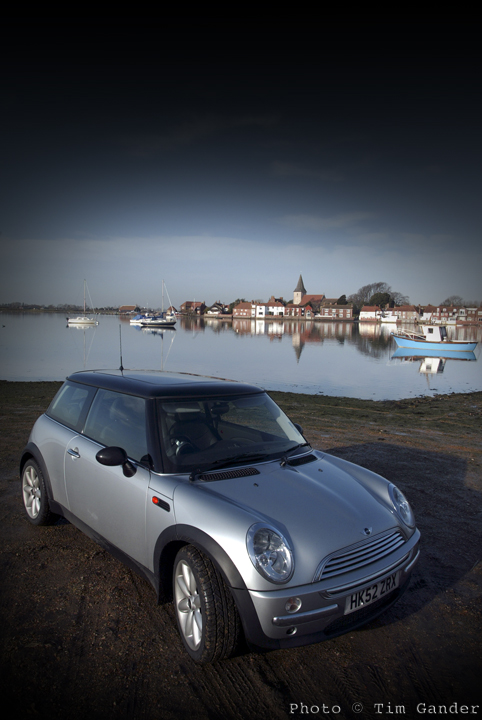
BMW mini cooper

Cars and ham-fisted vignettes would still feature strong in new show.

Then there’s The Stig: “Some say he can view a photo on flickr without commenting on the bokeh; others that he once ate memory cards with milk for breakfast.”

Three presenters, all male of course because just as women don’t drive they also don’t take pictures. They’d be boorish and full of themselves, though quite where we would find such personalities among British photographers, I’m not too sure.

And of course the real stars of the show would be the cameras. The reviewers would mostly concern themselves with testing the difference between the likes of a Hasselblad H4D-60 with 50-110 zoom lens at just over £35,000 and a Leica S2-P with 70mm lens bundled in at £20,500 (and some spare change). Provided you have to be royalty or a dictator to own the gear, they’d review it.

Naturally they would review more modest cameras, but anything much under £1,000 (no kit lenses included) would get a brief and patronizing mention during the news section, except for the Fuji X100, which would have them drooling over its Leica-like shape and handling. Oh yes, handling would definitely be mentioned. As would power, drive and manual control. “MORE PIXELS!” shouts a presenter as he presses hard on the shutter release button.

Quite how you spin a Canon 1D MKIV until smoke comes out the back I haven’t quite worked out yet, but I know it would be fun to watch. Damn it. I’m a fan of Top Gear, aren’t I…