
The public are getting wise, proceed with caution…

Friday Thought.

Commercial and public organisations are constantly on the lookout for new ways to engage with customers and the general public. This is understandable and very easy to do now that the internet is highly interactive. Done properly, it can work very well.

However, not all such campaigns are successful in attracting positive PR. One popular idea is to engage with your public by asking them to give you free stuff. Most often, for obvious reasons, photos.

A classic example is when some bright PR spark decides that it would be “cool” if customers sent in their best photos for the company to use for free in its web site, advertising and publications. The conditions for giving the business this free stuff will normally be couched in very legalistic terms, with conditions so harsh, unforgiving and one-sided that only the clinically insane would take part in such a scheme. The bigger problem perhaps is that many customers will ignore the T&Cs because they don’t expect their big, cuddly corporate to do anything underhand or greedy, so they tick the “I have read and understood” bit, having neither read nor understood what they were committing to.

If your organisation is looking into trying this kind of customer interaction, let me sound a word of caution. Amateur photographers are getting wise to this kind of exercise. They’re beginning to understand that if somebody wants their photos, their photos must have a monetary value. Just as if you asked them for the keys to their car, or for a few hours free graft, they understand that while any idiot can give something away for free, it takes a special kind of idiot to do it willingly. And amateur photographers aren’t idiots.

Several organisations and businesses have already bought themselves some negative publicity trying this kind of exercise. The UK’s Environment Agency recently put out a call for graduates, keen on photography, to become free labour suppliers of photos. The BJP wrote an article about it, the EA had to take their Facebook page down at one point, and then finished with a spectacular U-Turn.

Other organisations currently fighting a backlash from photographers include the publisher Archant with their Great British Life photo competition, and Greater London Authority wanting free photos for their new web site. I know there are many more examples, but you get the picture (for free!)
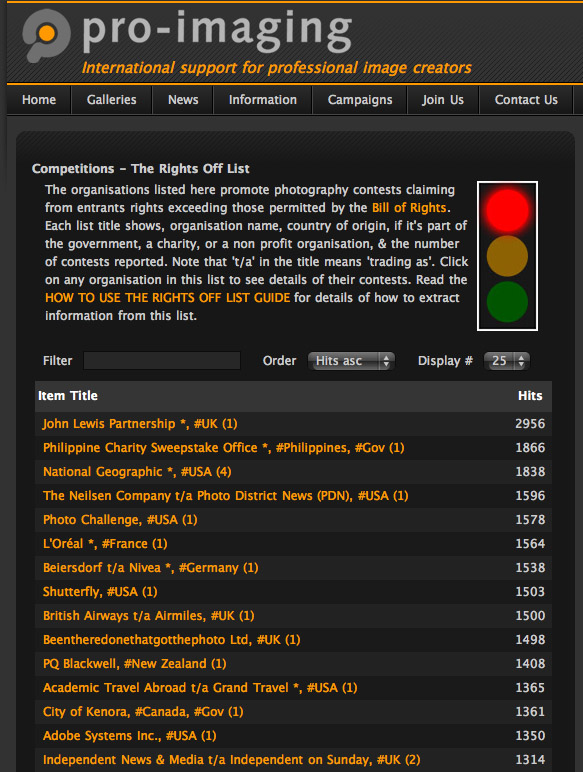
pro-imaging website screen shot

Pro-Imaging advertise competitions as Rights On or Rights Off. Click to see the full list.

Photo competitions which hide rights grabs are another example where photographers, both amateur and professional, have forced a change of terms and conditions, but only after much negative publicity.

The examples of companies which have attempted this particular wheeze and then had to change their T&Cs to be more like a photo competition than a phishing trip is too long to list here, but you can check out the Pro-Imaging web site to see what makes a competition fair, and see which organisers have adhered to the Bill of Rights which has been drawn up through industry-wide consultation.

These schemes and scams keep popping up, and most get battered down by hobbyists and professionals working together for the better ineterests of photography. Why companies and organisations continue to make the same mistakes time after time is a mystery, but I do see the tide turning against this trend for what has been described by others as “loser-generated content”.

So use the internet to interact with your clients and your audience, but don’t ask too much because your clients can quickly swamp the message you intended to broadcast with the ugly sound of protest at unfair practices.
When is photo manipulation too much?

I’ll start by apologizing that this subject is so dry, it makes a very dry thing look wetter than a very wet thing. I never was much good at similes. Which brings me not very smoothly to the follow up article on post production (see here) with a few words on photo manipulation.

The question is, when it comes to images shot for your business, when does post production become photo manipulation? At what point does it become unacceptable?

To make better sense of this, I had better define the terms “photo manipulation” and “post production”.

Post production is generally accepted as the process of making an image taken straight from the camera suitable for reproduction in whatever medium it is destined for, as outlined in that previous article.

Carried out within acceptable boundaries, post production won’t change the meaning or intention of the original photo. It’s much the same as the good old days when you had a photo negative printed at the local lab. They would make sure your negative was clean, and they would also make adjustments for exposure, colour cast etc.

It goes without saying, though I’ll say it anyway, that image manipulation in any news, sport or feature photo is unacceptable. For businesses issuing press releases, the simple rule is don’t manipulate. You can damage your reputation and attract negative press and blog comment (remember this?), which will never go away and will take a long time to repair.

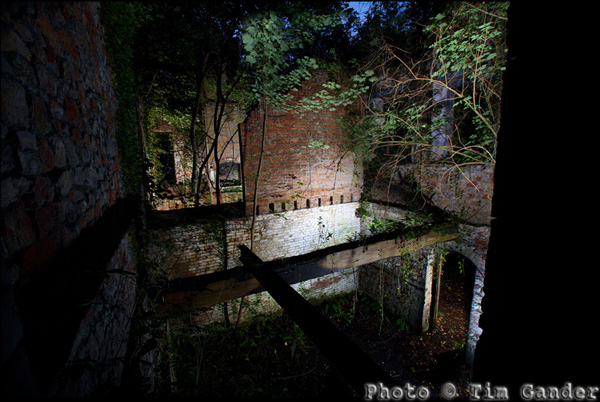
photo of Mells Iron Works at night

Made up of 8 image layers, this was a personal project not destined for commercial or press use.

Photo manipulation would cover things like adding to, or removing elements from an image, distorting people to make them look slimmer, taking an ugly sign or street furniture out of a background, adding a logo which wasn’t in the original.

A clear example of over-manipulation would be if I changed a self portrait to make it look as though I had humanoid ears. That would just be ridiculous, and those who know me would never stop laughing.

As wonderful as digital is, and for all Photoshop can do, it’s still extremely important to get the shot right in the camera. Not take any old snap, and hope for a technical fix later.

I do think the rules can shift a little when it comes to a corporate photo for a web site, but I still advise caution. For example, I will happily remove pimples or other non-permanent blemishes, but permanent ones stay. The person in the photo needs to be recognisable.

Dropping people or objects into a commercial image, or removing them from a scene, could cause problems of misrepresentation. If done sensitively and with appropriate captioning, it may not cause a major problem, though it’s important to take context into account, and that’s too much to cover here.

Maybe the best way to avoid disasters is to ask yourself the question: Is this a dishonest representation? What would my mother think? That last question alone should put you on the straight and narrow.

Article and photo © Tim Gander. All rights reserved. The articles in this blog may only be reproduced for non-commercial purposes.

The growing clamour from web designers!

My Friday Thought – A new feature which will rapidly become a rod for my own back, but let’s see how it goes.

There’s been an interesting, and very noticeable shift in the nature of the conversations I’ve been having with designers recently, especially webby ones.

In the past, whenever I asked web designers about the photography needs of their clients the reply came back, as if transmitted by mental osmosis from one designer to the other, “Oh they don’t have a budget for photography so we use cheap stock photos.” Always different web designers, always the same line.

The fact is, no client has a budget for anything until somebody explains to them why they need a budget for it (ie improved sales!); in this case, original photography which sets them apart from their competitors and communicates more honestly with their clients. After all, my clients have a budget for photography so what do they know that so many web designers’ clients don’t?

Part of the problem has been a misunderstanding of how budgets work. In the case of photography, it isn’t part of the web budget because the images are used in more than just the web site; it comes out of the marketing budget, of which the web site is a part, but many web designers will look at the photography fearing it will reduce their budget to do the design work. It shouldn’t.

I know selling photography isn’t easy. While every business now understands they have to have a web presence of some sort, beyond that it’s not easy to explain that apart from what the web site does in purely technical terms, it also needs good content to convince the viewer of the value of the product or service on offer. It’s the content, in harmony with the structure, which ultimately makes the sale.

And this is where web designers are starting to wake up and smell the cappuccino. There’s a growing realisation that good photography, as well as good copy and design, helps the site to pull together and deliver the message the client wants to transmit. Photos need to be more than just eye-candy on the page. They carry valuable information and can also be used to direct the viewer’s eye to key texts and links.

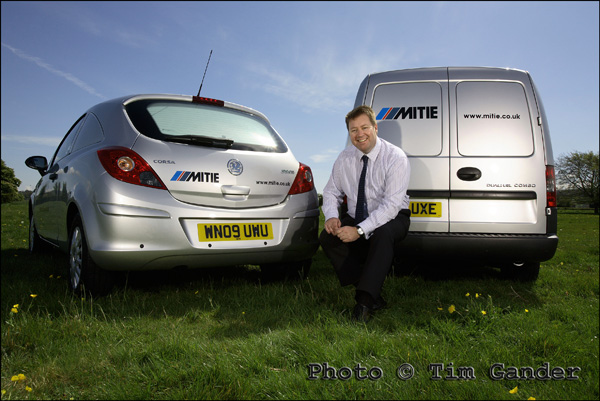
mitie services vehicles in a field

No Californian models posing here, just a real person representing a real business.

What kind of business in the UK needs a photo of a chisel-jawed American male in a suit clutching a laptop in a steel and glass office with angelic lighting and a patronizing smile? How many more generic stock images of non-people in non-places does the internet really need? And what do these images say about a business any more? Stock images used to be far more expensive, so a business using them tended to look more polished. They’re too cheap and ubiquitous now, and the shine has come off the novelty.

And the cry I’m now hearing from every designer I speak to is, “I am so sick and tired of having to use stock imagery.” Designers want to be proud of the results of the hours and days they spend designing a top-notch site, but having expended blood, sweat and weeks on the site, they are then forced to ruin the entire project either with photos the MD’s wife took, or with stock pictures of someone they’ve never met, taken in a  place they’ve never been to, that has little or nothing to do with the business they’re meant to be promoting.

I’m encouraged by this change of voice, and I’m helping web designers by explaining to their clients how real, unique photography can work for them, doesn’t need to cost the earth, and yet will contribute to the growth of their business.

So designers everywhere! Talk to me, I’ll talk to your clients, and before you know it there will be a budget for photography, and the web site you designed will look as good as you know it should.

I thangyou.