The Rise (and Downsides) of LEDs

On a ‘lighter’ note from my previous post, this week I wanted to bring up one of the daily scourges of the working photographer; that of LED lighting.

Of course I’m a huge fan of energy-saving devices, and I appreciate the part LED lighting plays in this (though I do have some questions around that – perhaps best saved for another day), but they can cause issues for photographers.

What most people don’t realise is that LEDs are not constant lights in the way halogen lamps are/were. LEDs have a frequency, that is to say they pulse on and off. For the most part the human eye cannot detect this, but cameras, because of the way they work, can.

Each frame is 1/800th of a second, but slowed down here so you can see the changes more easily.

The Invisible Flicker

If you look at the video above, it shows a sequence of images taken at high speed over the course of a few seconds. This is not a light being dimmed up and down, it’s the LED effect. The camera settings haven’t changed from one frame to the next, but you can see how the light dims on a cycle. You wouldn’t see this when you look at the light, but the camera’s sensor is recording the variable output of this light source.

What you’ll also notice is that the ‘bulb’ isn’t changing all at once. That’s because these LED bulbs consist of clusters of LEDs, each with their own frequency. If they’re not in sync with each other you get this wave effect of light brightening and dimming.

The issue this can cause to photographers is seen as banding in images (see image below) where horizontal strips of the image are darker than the rest of the picture. It looks horrible and can’t be corrected in post-production, at least not easily. The effect in the example here is exacerbated by my use of the electronic shutter function of the camera.*


Note how the banding affects the background wall, the seats and bench in front of the students. It’s less visible in the subjects, even so I rejected it.

LEDs Everywhere

LEDs are now ubiquitous in our everyday lives. They’re in all our workplaces, shops, homes, cars; basically, they light our lives. Better quality LED lamps will cause fewer problems than cheaper ones. However, even expensive LEDs can cause issues, especially if they’re dim-able.

When an LED light is dimmed, it isn’t actually dimmed, so much as its frequency is extended. In other words, the moments when the LED is off are extended. We’re talking microsecond differences here, which is why the human eye doesn’t see more flicker, just a dimmer light.

As of writing this article, I believe there is still only one photo-centric (not video-centric) camera with a sensor design which eliminates this issue completely, and that costs almost £6,000.00 just for the body. Other slightly cheaper cameras use faster processors to try to mitigate the effect, but it’s still an issue to be aware of.

My cameras don’t show banding when I’m using the default Mechanical Shutter mode. In some situations it would be preferable to have the camera operating completely silently (by using the Electronic Shutter setting), but if banding is ruining the photo then there’s no choice but to allow the shutter to click. It’s not exactly loud, but can be noticeable in certain situations.

LEDs Triggering Issues

The flicker of LEDs can have other detrimental effects too. If I’m setting up portable studio lighting for a photo session, I’ll often use a handheld flash meter to set the output (brightness) of my flash units. To do this, I press a button on my flash meter which is then waiting for my flash to fire so it can measure the intensity of the flash. But the flicker of an LED light is often enough to fool the meter into thinking it’s detected the flash, when all it’s detected is the pulse of an LED light.

This can make it incredibly difficult to get an accurate flash meter reading. I can try shielding the flash meter from the LED light source, or I can plug the flash meter into the flash unit and not use the non-cabled setting (apologies if this is getting technical!) Unfortunately, not all modern flash units have a flash cable socket, so this often rules that option out. It’s also not always possible or desirable to switch off all the LED lights in a space to prevent the interference.

There have been occasions where I’ve just had to set the flash output by taking a series of test shots until I’ve got the correct exposure. It’s not ideal, but it gets job done eventually.

Irritation and Mitigation

I say the human eye can’t detect the flicker of LEDs, but that isn’t always true. I used to work in an office which had LED strip lights, and they irritated my vision and fatigued my eyes. Some people are more sensitive than others and you can even buy special glasses to counteract LED lighting.

The trickiest thing about LEDs is you can’t easily predict when they’ll be a problem. I’ll take test shots or look through the electronic viewfinder of my camera, but neither of these is a 100% reliable predictor of when banding will wreck a photo. A different angle, moving from one location to another or someone making changes to the lighting can all have an impact.

Many audio visual engineers have moved to LED stage lighting and this can be brilliant or a disaster depending on their system.

So next time you’re at an event and the photographer’s camera is clicking away, even if you know they have a silent function on their camera, perhaps now you’ll understand why they might not be using it.

Sorry about the length of this article, but I do hope it’s shed some light (see what I did there?) on a mostly invisible issue.

*Electronic shutter setting means the camera is completely silent, however the imaging chip is more prone to recording banding because it exposes the sensor by scanning in lines from top to bottom. The example photo I’ve used was shot at 1/200th of a second which shows just how fast the frequency of the LED cycles is.

The AI Threatscape

A new report Brave New World? – Justice for creators in the age of Gen AI sheds light on the alarming and rapid damage being wrought upon the creative industries and asks how we can protect ourselves and our national culture against this onslaught. It lays out clear evidence detailing the negative impact of Gen AI on individual creators and the UK economy and offers solutions to redress the balance of power. It is thorough and detailed, but is mainly concerned with the immediate threat to creative sector jobs.

This is not a criticism of the report, which is excellent and essential reading. However in this blog post I want to expand the view little wider to look at some of the less-obvious issues which need to be mapped as this new technology advances.

Please don’t assume that in highlighting these issues I am not concerned about the impact on artists’ incomes or the degradation of copyright. I’m also not belittling the environmental impact of Gen AI* services (through their development and their use), or indeed the huge risk of the AI bubble bursting and crashing what’s left of the economy. All of these issues are massively important and they are all deeply troubling, but I also think it’s vital that we take a look at some of the less-mentioned problems which will (already are) the result of a shift into an AI-driven world.

Naturally this article will focus on the plight of photographers, but I’ll be looking a bit beyond the immediate financial concerns faced by those making a living from photography. Some of the points I raise will also have similar effects in other professional creative areas; I’ll leave others to comment specifically on industries in which I am not an expert. Some of my concerns go far beyond the economic and creative culture harms threatened by Gen AI.

There’s No Business Like No Business

The corporate or business photographer relies on a regular stream of client commissions. Taking photos for the company website, LinkedIn and other social media and printed material is this photographer’s bread and butter, but AI is already allowing the plagiarising of specific photographers’ styles in a way which is damaging their ability to make a living. More widely, it’s already possible for anyone to ‘spruce up’ an un-flattering ‘selfie’ using an AI service, again in preference to hiring a professional.

However, let’s not forget that the people who are using these AI services today could well be in the firing line as AI replaces traditional service sector roles. The very people who might want a decent photo for their LinkedIn profile or the About Us section of a business website could well be a disappearing market for the professional photographer.

To my mind, this is one of the greatest uncertainties and un-knowables of the advance of AI services. It’s certainly going to leave many photographers scrabbling to chase a dwindling number of viable clients. It’ll be a pincer movement of decline.

Who’s Afraid of AI?

Even before that day arrives, there could be a cultural shift which makes the online posting of portraits a less comfortable proposition for many people.

GenAI services are already being used by fraudsters and people with ill intentions. A profile photo you post online can be scraped by an AI service and used elsewhere, possibly innocuously, or it could be used to try to defraud or blackmail you. Elon Musk’s Grok service was quickly employed in the rendering of innocent images of women into sexualised content. Sexual abuse images and deep fakes are a genuinely terrifying aspect of the generative AI industry. The GenAI corporates are either unwilling or unable to prevent abusive and criminal use of their services and people are already becoming more wary of having their photo taken and used online where it will be vulnerable to being repurposed.

One of the key problems with how Gen AI models are trained is that they scrape content regardless of copyright (on the creator’s side) or usage restrictions (on both the creator’s and the subject’s side). Images which were destined only to be used in a single or restricted context can easily be scraped and repurposed for uses as-yet unimagined.

Will the About Us sections of corporate websites disappear in favour of anonymity?

Vanishing Culture

The natural wariness this generates in the minds of the general public extends beyond the question of allowing (or not) the use of one’s image in a professional setting. It’s already quite challenging to document news events or even everyday culture as people have become more inclined to say no to anything which might be used in ways they cannot imagine. If AI can be used to repurpose images for uses which have yet to be invented, I believe people will become increasingly hostile to having their likeness recorded in almost any setting.

It has felt for some time as though there was a golden age when photographers could document a street scene and, if not always welcomed, were at least mostly tolerated or ignored. We have a rich archive of historical photos showing people in everyday situations. From beach holidays to Sunday fairs, or simply out shopping, eating, drinking, entertaining or being entertained.

Photographing children in public spaces is an especially dangerous occupation now. The late Martin Parr and other documentarians covering everyday life simply couldn’t do today what they did until 20, 30 or 40 years ago.

The internet has already made people more sensitive to anyone taking pictures in these situations, but add the potential threat of AI abuse and I can see a time when not only will it not be possible to record public life at any level, but public life itself could start to withdraw into purely private spaces.

Where could all of this lead?

I could be wrong and I hope I am, but where social media has already caused harm to the traditional organs of democracy (I’m thinking specifically here of the demise of newspapers and professional journalism), the very hint of a threat of AI being at the service of criminals or government controls could very easily freeze the future expressions of our society and culture; both the ‘performative’ culture, such as public activities, protests and the like, and the documenting of these activities by photographers.

It’s not as if the warning signs aren’t already there, with journalists, and photo-journalists in particular, being targeted by states, the military, police and even citizens wishing not to be documented for any reason.

Conclusion

It’s tempting to only consider the immediate threats posed by Gen AI on one’s ability to earn a living. The Brave New World report also touches on the threat to UK culture and the future viability of the creative industries, and I won’t say anything to diminish the importance of the message contained in the report. The UK government would be unforgivably foolish to believe Gen AI can create sufficient jobs to replace those displaced by AI, but I wanted to set out a handful of other areas we must also be deeply concerned about. It’s not even an exhaustive list, but I’d exhaust myself if I tried to list and examine them all. Perhaps I’ll come back to this subject to take a further look at those issues.

If you think this article went awful dark awful fast, it’s probably not a bad metaphor for how AI could turn society and culture awful dark, awful fast.

*Gen AI refers to Generative Artificial Intelligence which requires continuous training on fresh data (words, photos, illustrations, music and so on) in order to be able to ‘create’ new ‘works’. I dislike the term ‘data’ in this context and the output of Gen AI services cannot be described as ‘creative works’.

Happy New Year!

How was your Christmas and New Year? Are you all re-invigorated, set and ready to take 2026 by the chestnuts and give it a good twist?

Well if not, don’t worry; there is no law which says you have to be a new you just because it’s a new year. Don’t put that pressure on yourself. Maybe spend a little time putting together your short term, medium term and long term to-do list, then stick it in a drawer and wing it like you always do! It works for me!

Being a little more serious for a moment, I know I have some challenges to face and some tricky decisions to wrestle with this year, and I will be working through them in my usual, slightly random way. However, I did at least end 2025 and start 2026 with some relaxing family time followed by a fun adventure in wildest West Wales.

And as always, my camera was with me.

So to kick off the year nice and gently, here’s a handful of random images from the Wales trip.

It was a fun start to the year and it gave me a little time to reflect and consider what goals I might actually have. Here’s the thing though; I didn’t have any revelatory moments during the couple of weeks I was away, but I know thoughts were churning in the back of my mind.

Now that I’m back, some of those thoughts have turned into outline plans which have floated to the surface like messages in a Magic 8 Ball. I’m determined to get some of them out of my brain and into reality.

So here goes 2026! I hope your plans emerge too and that you manage to make them tangible.

Happy New Year!


When Life Gives You Plums…

The past couple of weeks have been blessedly quiet after what has been a somewhat ‘complex’ period.

A mixture of heavy workload, personal development plans and a bereavement (see previous blog) had left me feeling a little bit broken. No major breakdown, just like I’d been rinsed through and needed to refresh and reset.

However, one of the absolute pleasures of the freelance/work-from-home life is the ability to take a break, step into your garden and pick fruit. Or even just to sit in the garden and ponder the great imponderables.

So it was that yesterday, one of the hottest days of the year, I spent a precious few minutes picking plums in the garden. There is something about fruit picking that I find incredibly mindful. Like my other passion, swimming, I can just immerse myself as I check which fruit are ripe, which need more time and which have gone over and need to be composted.

And when you’re married to someone who enjoys making jam, I mean it just doesn’t get any better than that, does it? In fact we had more plums than jam sugar, so I made compote too.

So this very brief post is to remind you to take those little moments when you can. Simple pleasures bring great rewards. They’re the times when you can recharge your batteries, let your mind freewheel in the background, and maybe come up with some ideas and solutions to problems you thought intractible.

I still have some way to go before I’m on the other side of all the admin which follows a death, but at least I have the ability to recognise when I need to take a pause, and in turn this is allowing me to see the proverbial light at the end of the tunnel.

So whatever fruit life gives you, use it to make something positive. Preferably something you can spread on toast and enjoy with a nice cup of tea.

YouTubes and Rabbit Holes

A question often asked of professional photographers, myself included, is “what camera can you recommend?”

Spoiler alert, I don’t know every model of camera available (there are MANY) and I don’t know what your end use will be, but in the spirit of the YouTube generation I suggest you stick around to the end of this article and I’ll attempt to offer some pointers.

Going Down The Tube

Speaking of Youtube, it’s become apparent that if you watch video content about all the latest cameras and lenses, the gear (to many people) has become more important than photography itself.

How do I know this? Well because in my quest to update my work cameras, I fell down multiple rabbit holes and watched a lot of waffle about the specifications of this camera verses that camera and a lot of “STOP BEFORE YOU EVEN THINK TO BUY THE LATEST *insert camera make and model here*” -style nonsense.

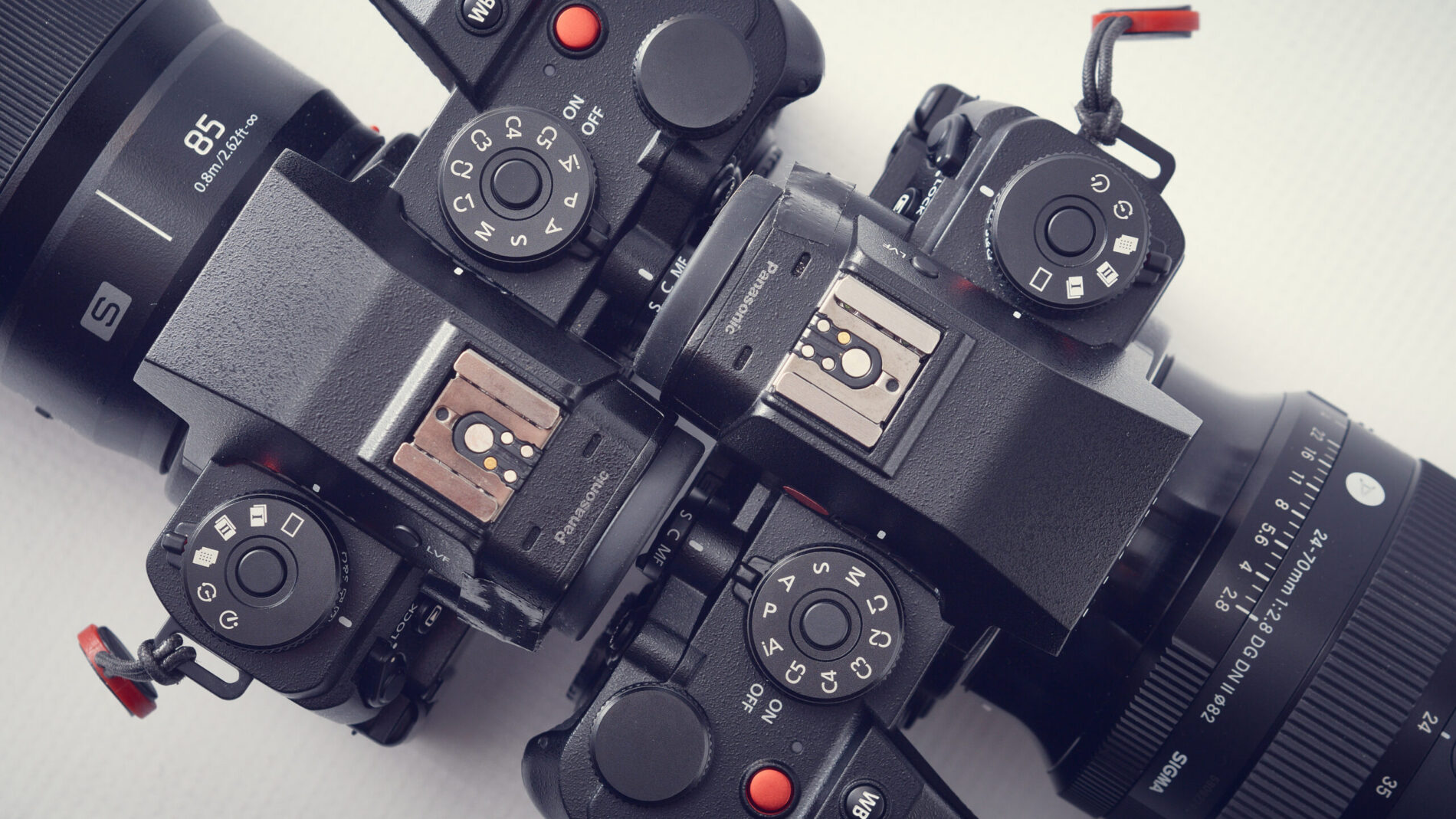
Luckily for me I only needed to check a few models because I’m now a pretty committed user of Panasonic cameras. For anyone starting from scratch, the choice is bewildering.

Finding genuinely useful information isn’t as easy as you would hope it to be. Often the specifications of various models are reeled off at breakneck speed like they’re comparing the abilities of a range of F1 racing cars. Everything comes down to specs and speed, while very little ‘air time’ is given to the real-world performance or picture quality of any given make or model.

Useful info for me is to know how the image quality holds up under a variety of conditions, but if you do find sample photos taken with a specific camera, they’re usually pretty random and uninformative. There will be a flower, a rusty car, a sunset, a neon sign, some graffiti. There’s certainly never a properly-lit, well-composed portrait, for example, so comparing skin tones or fine hair detail is pretty tricky.

Of course I don’t expect a YouTuber to go out and photograph a set of corporate images for a client website just so I can see how the camera performs in the situations I’m normally covering. That would be unrealistic, but it’d be helpful to see more in the way of portraits and interiors. It would help to know how the autofocus performs in sub-optimal conditions (ie a portrait taken against a bright background). The problem is, YouTube photographers are only photographers on YouTube. Very few take pictures for a living and they have to cater for the single largest group, hobby photographers. And hobby photographers are usually more interested in speed and specifications than photography itself.

Achievement Unlocked

Regardless of these niggles, I have come through the ordeal and updated both of my camera bodies. To be honest, I could have eked out a few more years’ use from my existing gear, but it’s not a bad idea to sell it while it has some residual value and the new versions definitely added one or two really useful benefits for the work I do.

The primary benefit has been the upgrade in autofocus performance. My existing cameras weren’t as bad as YouTube reviewers would have you believe, but I always had to be aware of situations in which it might struggle. The new kit is certainly more reliable and accurate in that regard.

Another feature which I’m going to find very useful is rather niche; I can now back up images directly from my cameras onto a portable hard drive. This negates lugging a laptop around if I just want to keep files secure while I’m on the go. If there is one thing I’m a bit paranoid about it’s that camera cards can become corrupt, or physically broken, lost or stolen.

I’ve gone with two versions of the same model; one is high-resolution for when that’s useful (pictures to be used for large displays) and the other is standard resolution and a bit more nimble in terms of moving files around.

“What’s Your Recommendation, Tim?!”

Ok, those aren’t necessarily features you’ll be looking for when choosing a camera, so what should you be looking for? Like anything, that depends on many factors. Mainly that will be budget and usage.

My main advice would be to check out the used market. Secondhand camera prices are incredibly reasonable for what you can get. The same goes for lenses, and I often hunt out used options where possible. As long as a lens has been looked after, there’s no need to shell out for a new one.

Most cameras manufactured in the past 10 or more years will do everything you need and more, so think about size and weight as much as about budget. A camera that is too heavy to cary long distances will end up left at home.

Think Format First

In this regard, think about the camera format – full-frame cameras are larger and heavier than those of a smaller format such as APSC or Micro 4/3rds (sometimes labelled M4/3 or MFT). In fact I have a Panasonic MFT format camera which is great for traveling with and lots of MFT cameras and lenses are available new and used. Look for Panasonic and Olympus for this format.

For general purpose, family snaps or travel, maybe an APSC camera will suit you; Canon and Fuji tend to lead in this field. The cameras will be marginally larger than with MFT format gear, but pixel-level quality will be a small step up too.

If sports action or wildlife are your thing, be prepared to carry a beast of a kit bag around because you’ll need longer telephoto lenses and a camera body that can keep up with the pace. You might also need a camera that has a level of weather-sealing. Canon, Nikon and Sony all have excellent models to choose from, and some of the discontinued professional bodies are incredible bargains now.

Say Hello To Woundwort For Me

The bad news is that having homed in on a lens/camera combo that you think might suit you, you’re bound to end up researching it on YouTube, and only rabbit holes and despair live there. Just don’t forget to click Like and subscribe!


25 Years of Digital (almost)

A few days ago I ventured into our attic where I came across the storage cases for my early digital work; 340 CDs and DVDs dating from November 2000.

It didn’t immediately register that this means I’ve been shooting digitally for almost 25 years! I reckon I only shot film for about the first 10 years of my career, which is another sobering thought on multiple levels.

The Time Had Finally Come

But seeing those cases of CDs for the umpteenth *damn* time, I finally decided to bring them down and start transferring them to a hard drive. The discs won’t last forever, especially being alternately boiled and frozen in the attic. Eventually the hard drive too will die and my archive will be landfill.

Brief side-note; apart from properly (expensively) stored negatives, transparencies or prints, no photographic format is immune from decay over time. I’m convinced that no amount of care can preserve digital images indefinitely, and analogue formats will always be more robust. But that’s a separate discussion.

Old Tech to the Rescue

Anyway, back to the plot. I’ve rigged up an older MacBook Pro with the DVD reader/writer I used to use, and connected a spare external hard drive. It’ll be my archiving station until the project is done.

Your job now is to rejoice as I share some of those early digital images. Don’t worry, you won’t have to suffer this until the 50th anniversary, when I’ll be in my early 80s. I doubt my nurse will let me near a computer by then.

Enjoy!

Notes on the photos:

Millennium Dome press conference 30th December 2000 – P-Y Gerbeau was credited with rescuing the flailing Millennium Dome project and appeared for a press conference on the roof of the structure alongside Deputy PM John Prescott, who couldn’t have been more miserable if he’d tried.

Zoe and Fat Boy Slim 29th December 2000 – I’d been sent to assist a News of the World reporter tasked with finding celebrities and asking them general knowledge questions to see how bright they were. While the reporter got his s**t together having had a bit too much fun in his hotel room the night before, I toddled off and got a fun spread of pictures of Zoe Ball and Norman Cook (aka Fatboy Slim) walking on Brighton Pier. When the reporter finally turned up and asked Zoe and Mr Slim to answer some questions, he was told to eff off and that was that. My images made a double page spread in NotW and Heat Magazine.

Princess Margaret leaving King George VII Hospital 20th January 2001 – I was sent along by News of the World to catch a photo of Princess Margaret leaving hospital. I knew two other NotW staffers were already there, but I also knew they were using film cameras. By shooting digital, I was able to file from the scene and my shots made the paper just because they arrived at the desk first.

Martine McCutcheon book signing at Harrods 25th November 2000 – My first digital SLR, a Canon D30, was pretty dreadful in low-light conditions. The autofocus just couldn’t keep up, so my shots from this press call are soft to say the least. I include this image to air my shame.

Worst. Tourist. Ever.

I just can’t do it. Send me on a nice break, and I’m constantly looking for the gritty photo, or at least something with a bit of a story to it.

At the end of January my wife and I took the Eurostar to Paris to visit friends who live just outside the city. It was nothing more than a long weekend, so we packed extremely light which meant I wasn’t especially interested in taking a film camera, lenses and film. Besides, I’ve fallen a little bit in love with my Lumix GX9…

mmmmcheese

What we couldn’t resist during our trip, apart from the astonishingly good cheeses and cakes, was a visit to the newly-restored Notre Dame Cathedral. I can honestly say, it is well worth getting there if you can, but be prepared; prepared for crowds, queues and smartphones in every view.

The last time we visited Notre Dame was in 2014, and although there would have been tourists taking photos then, it wasn’t an impression which was stamped on my memory. This time around it felt like the smartphone-wielding had gone a bit OTT.

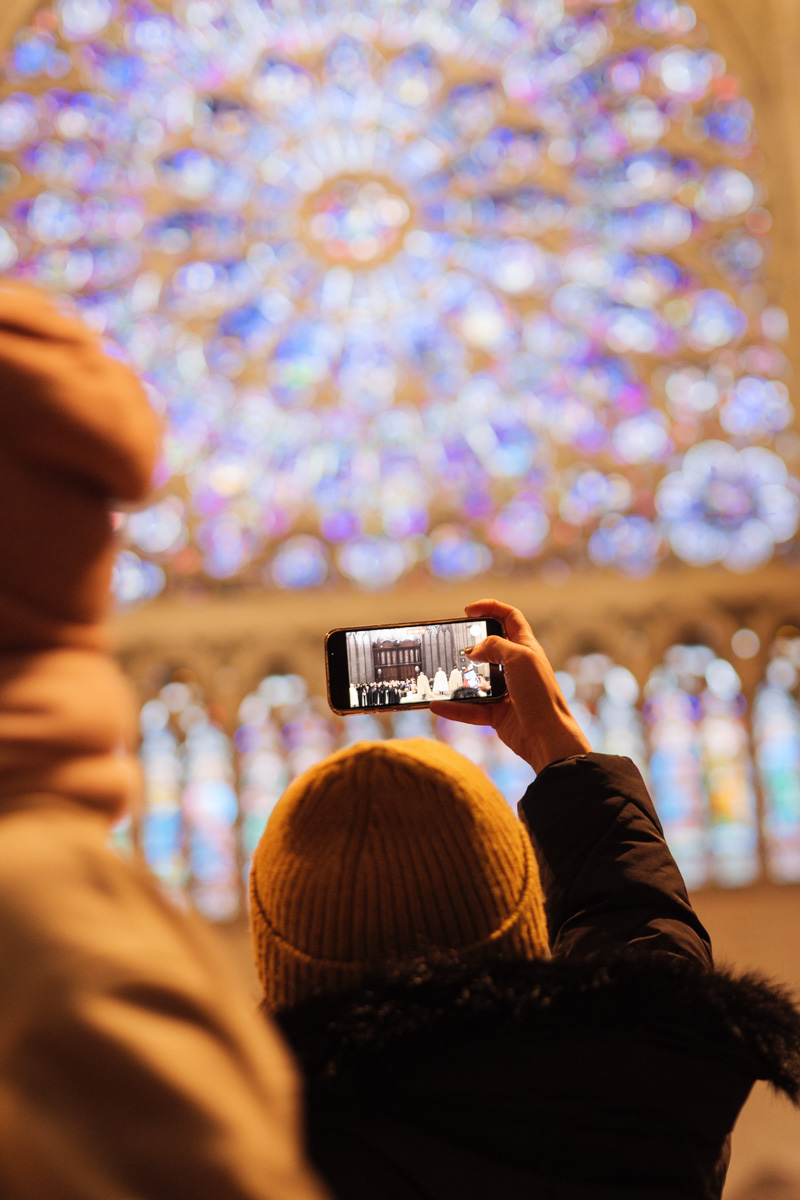
Rear view of a female tourist in an orange knitted hat raising her iPhone to take a photo of a holy mass underway in Notre Dame Cathedral, Paris, with one of the beautifully restored circular stained glass windows visible out of focus beyond.

Tourist captures Holy Mass on her iPhone in Notre Dame Cathedral

I’m not a religious person, but if I visit someone’s holy place, I hope I tread carefully and with consideration of where I am. At Notre Dame there were people poking their phones through railings, taking pictures in places with ‘No Photography” signs right next to their elbows. Maybe this is nothing new, maybe I should mind my own beeswax.

Maybe it seemed worse because it was incredibly busy – perhaps unsurprising as it’s only been open a few weeks, but when a Holy Mass got underway, there were people filming the service with phones on selfie sticks, small gimbal cameras and the like. Is this normal? Maybe it is.

While I wasn’t there to pass judgement (as I seem to have done, whether I like it or not), and not there to gather a story, rather than poke my camera into every nook and cranny of the cathedral I focussed on the visitors around me and tried to get a sense of what it was like to be there, more than what the space looks like*.

The result you see here is the best of a handful of photos I took during the visit to Notre Dame. In a single image I’ve tried to bring together the iPhone experience so many people have of places now with how such use can feel a little insensitive. At the same time, I wanted to make it fairly obvious where the image was taken to give it context.

A Dame Good Photo?

I’m not sure how successful I was in this. Perhaps if I’d had more time I might have managed to capture a sea of phones-type shot, but filling the background with a single spectacular rose window would have been impossible, and here I feel it helps add impact to the image. And on the tourist’s phone you can clearly see she’s lining up for a photo or video of the Mass, rather than an architectural aspect of the space. If I’d got multiple phones in-shot, you wouldn’t see what was on any single one of them, and this would have diluted the impact further.

Either way, however successful/impactful/useful it is, the shot scratched my itch to make a different kind of image that day, so I’ll settle for that.

Having had this semi rant, maybe I’m the worst tourist ever. While other people go to places and do their thing, I feel compelled to document them doing their thing rather than going to a place and minding my own business. And doesn’t that make me slightly hypocritical?! Or perhaps it’s healthy to take a step back from the crowd and show what society looks like, rather than copy what everyone else sees. It’s certainly a minefield, and one I’ll probably spend the rest of my life picking my way through.

For the camera nerds, here are the image specs:

Camera – Lumix GX9

Lens – Olympus 45mm f/1.8

Exposure – 650iso, 50th sec @ f/1.8

*It is incredible. The restoration has been done with astonishing care and attention to detail. There is far more lighting than was evident in the pre-fire cathedral, but this means you can now see all the beautiful carving, all the way up to the beautiful vaulted roof. Just go, you’ll love it.