25 Years of Digital (almost)

A few days ago I ventured into our attic where I came across the storage cases for my early digital work; 340 CDs and DVDs dating from November 2000.

It didn’t immediately register that this means I’ve been shooting digitally for almost 25 years! I reckon I only shot film for about the first 10 years of my career, which is another sobering thought on multiple levels.

The Time Had Finally Come

But seeing those cases of CDs for the umpteenth *damn* time, I finally decided to bring them down and start transferring them to a hard drive. The discs won’t last forever, especially being alternately boiled and frozen in the attic. Eventually the hard drive too will die and my archive will be landfill.

Brief side-note; apart from properly (expensively) stored negatives, transparencies or prints, no photographic format is immune from decay over time. I’m convinced that no amount of care can preserve digital images indefinitely, and analogue formats will always be more robust. But that’s a separate discussion.

Old Tech to the Rescue

Anyway, back to the plot. I’ve rigged up an older MacBook Pro with the DVD reader/writer I used to use, and connected a spare external hard drive. It’ll be my archiving station until the project is done.

Your job now is to rejoice as I share some of those early digital images. Don’t worry, you won’t have to suffer this until the 50th anniversary, when I’ll be in my early 80s. I doubt my nurse will let me near a computer by then.

Enjoy!

Notes on the photos:

Millennium Dome press conference 30th December 2000 – P-Y Gerbeau was credited with rescuing the flailing Millennium Dome project and appeared for a press conference on the roof of the structure alongside Deputy PM John Prescott, who couldn’t have been more miserable if he’d tried.

Zoe and Fat Boy Slim 29th December 2000 – I’d been sent to assist a News of the World reporter tasked with finding celebrities and asking them general knowledge questions to see how bright they were. While the reporter got his s**t together having had a bit too much fun in his hotel room the night before, I toddled off and got a fun spread of pictures of Zoe Ball and Norman Cook (aka Fatboy Slim) walking on Brighton Pier. When the reporter finally turned up and asked Zoe and Mr Slim to answer some questions, he was told to eff off and that was that. My images made a double page spread in NotW and Heat Magazine.

Princess Margaret leaving King George VII Hospital 20th January 2001 – I was sent along by News of the World to catch a photo of Princess Margaret leaving hospital. I knew two other NotW staffers were already there, but I also knew they were using film cameras. By shooting digital, I was able to file from the scene and my shots made the paper just because they arrived at the desk first.

Martine McCutcheon book signing at Harrods 25th November 2000 – My first digital SLR, a Canon D30, was pretty dreadful in low-light conditions. The autofocus just couldn’t keep up, so my shots from this press call are soft to say the least. I include this image to air my shame.

My Latest Camera

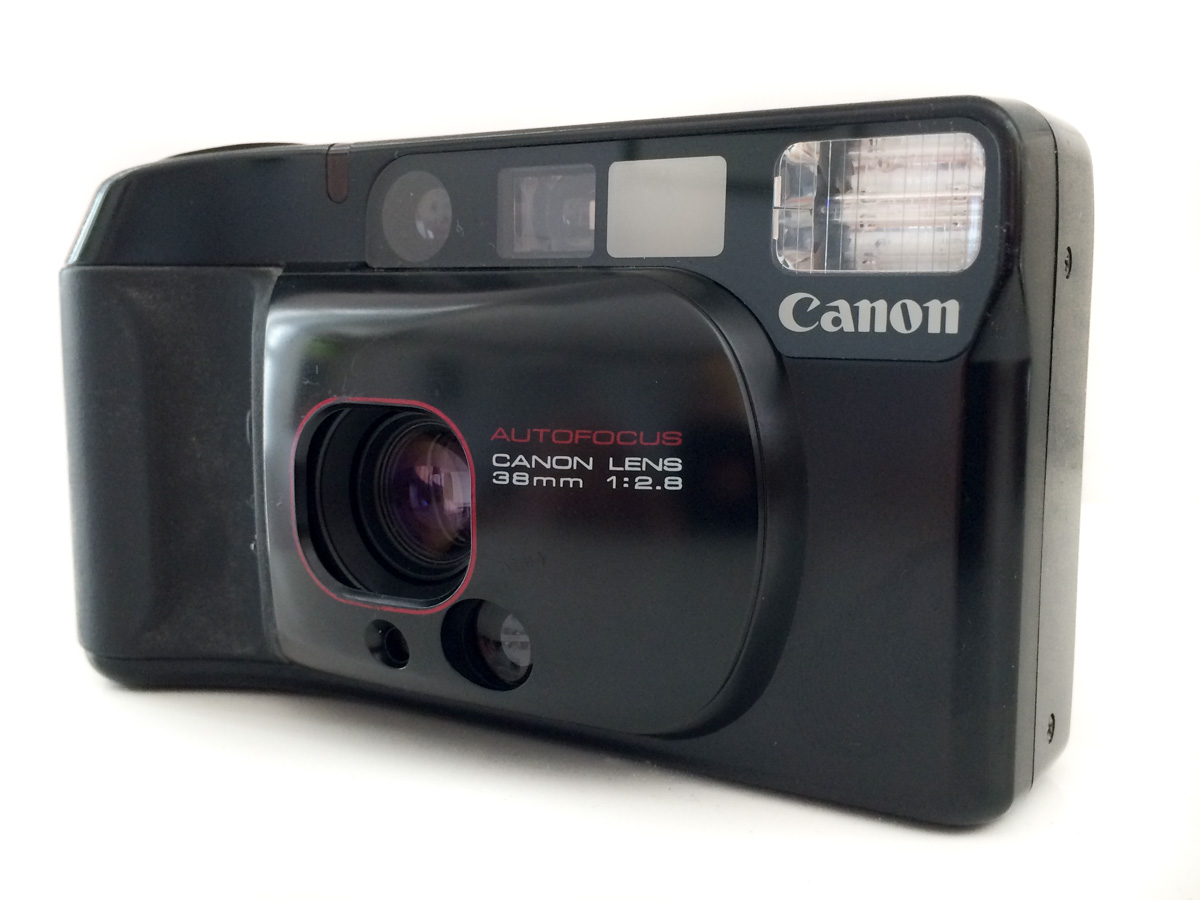
Regular clients will be delighted to learn I haven’t stopped investing in camera equipment, though they may be surprised that my latest Canon purchase cost me exactly two whole British Pounds. Yes, £2.00.

On Sunday I paid a visit to the Frome Wessex Camera Fair at the Cheese and Grain venue (where The Foo Fighters recently and very famously played a surprise gig).

There were no superstars on this occasion, but the entry fee was a mere £3.00 which I happily paid. So let’s pretend a portion of that should be considered part of the cost of the camera, but since I also bought a cable release (£3.00) and a handheld light meter (£4.00), at worst the camera cost me £3.00.

My reason for this particular purchase, a Canon Sureshot Supreme, is that this was a camera which came out in the 1980s when I was working at London Camera Exchange in Bath. It caused quite a stir at the time for its modern styling and fast, accurate automation of focus and exposure settings. There was a huge advertising campaign behind it, and though it wasn’t a budget model of its day, retailing as it did at around £120, we sold bucket loads of them.

I spotted this particular one on a table at the fair, but when I looked at it more closely I thought it might be dead (the battery level showed good, but the shutter wasn’t firing). So I negotiated £2.00 for it, took it home, popped a fresh battery in and BINGO! it worked. Clearly the battery level indicator is a die-hard optimist.

So then I thought, what can I do with this? Would it be possible to shoot a set of pictures which might present an interesting project? Does the camera actually work as a photographic tool, or might some part of the electronics or optical system be so old as to be non-functioning? Only one way to find out.

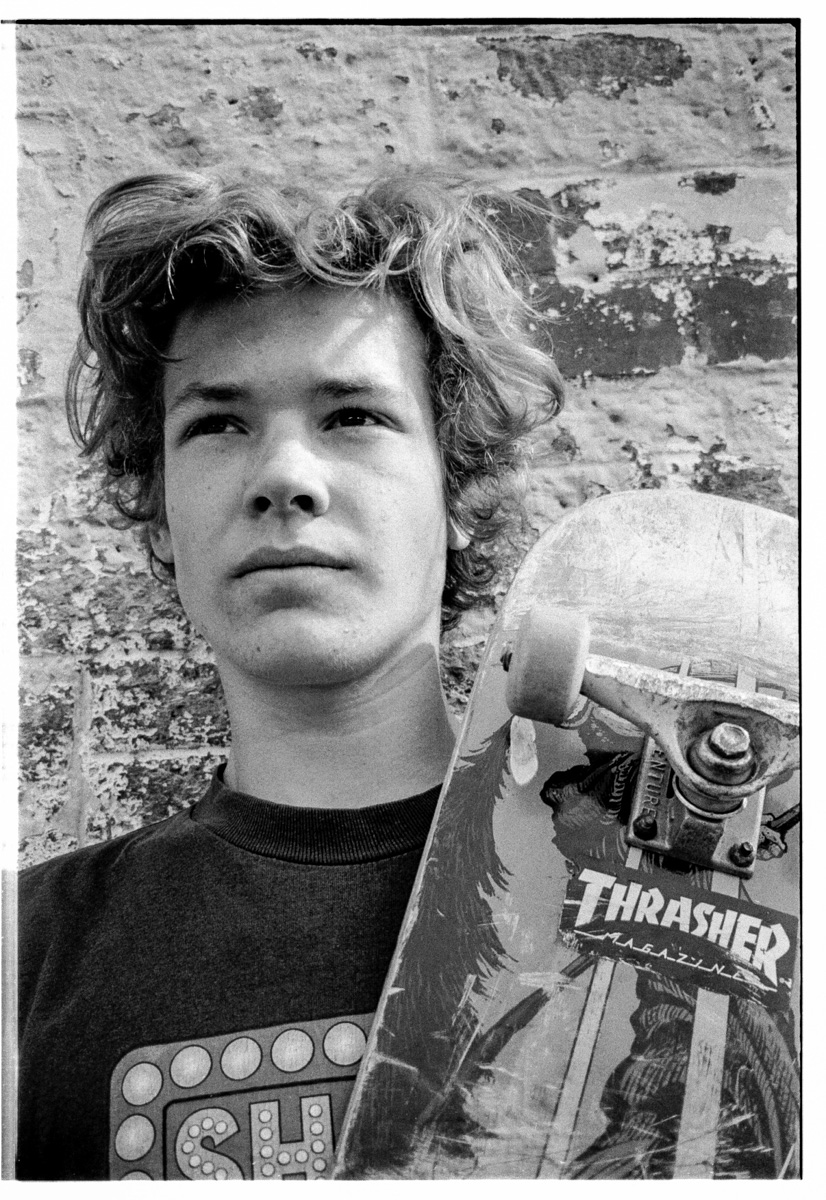
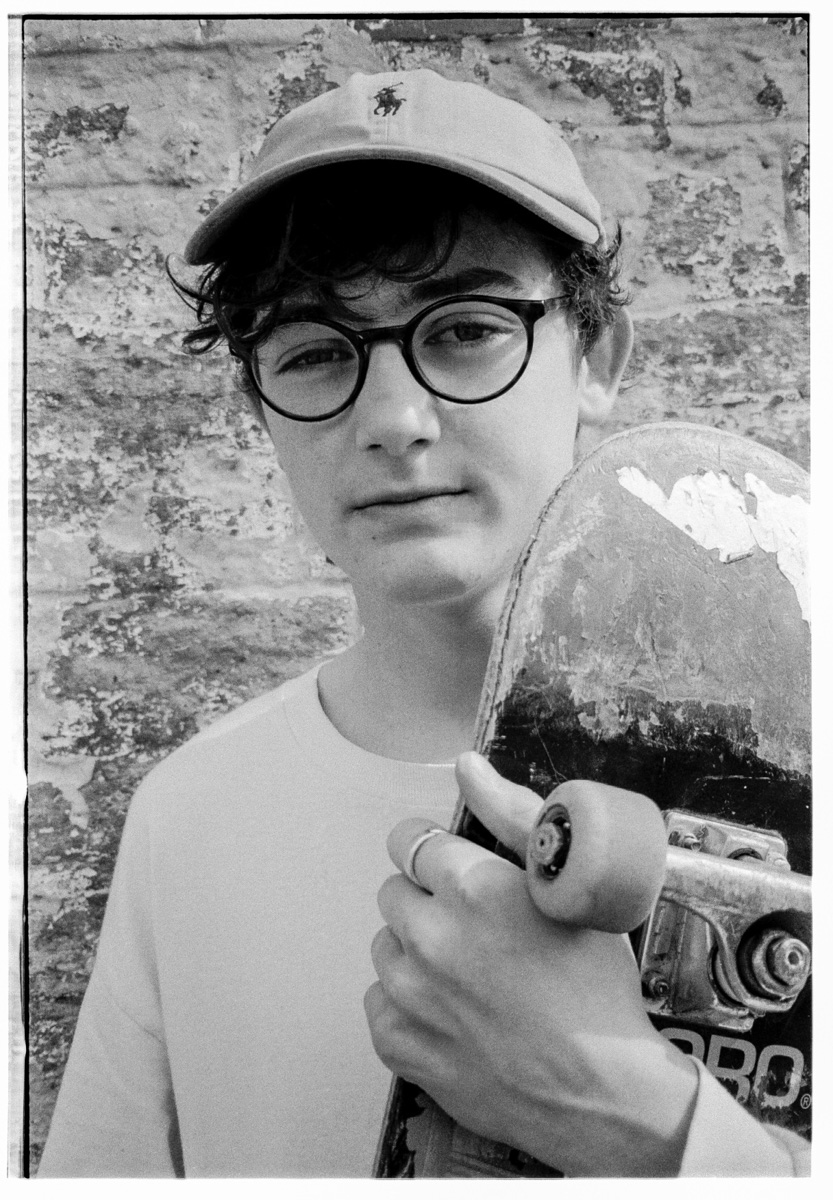
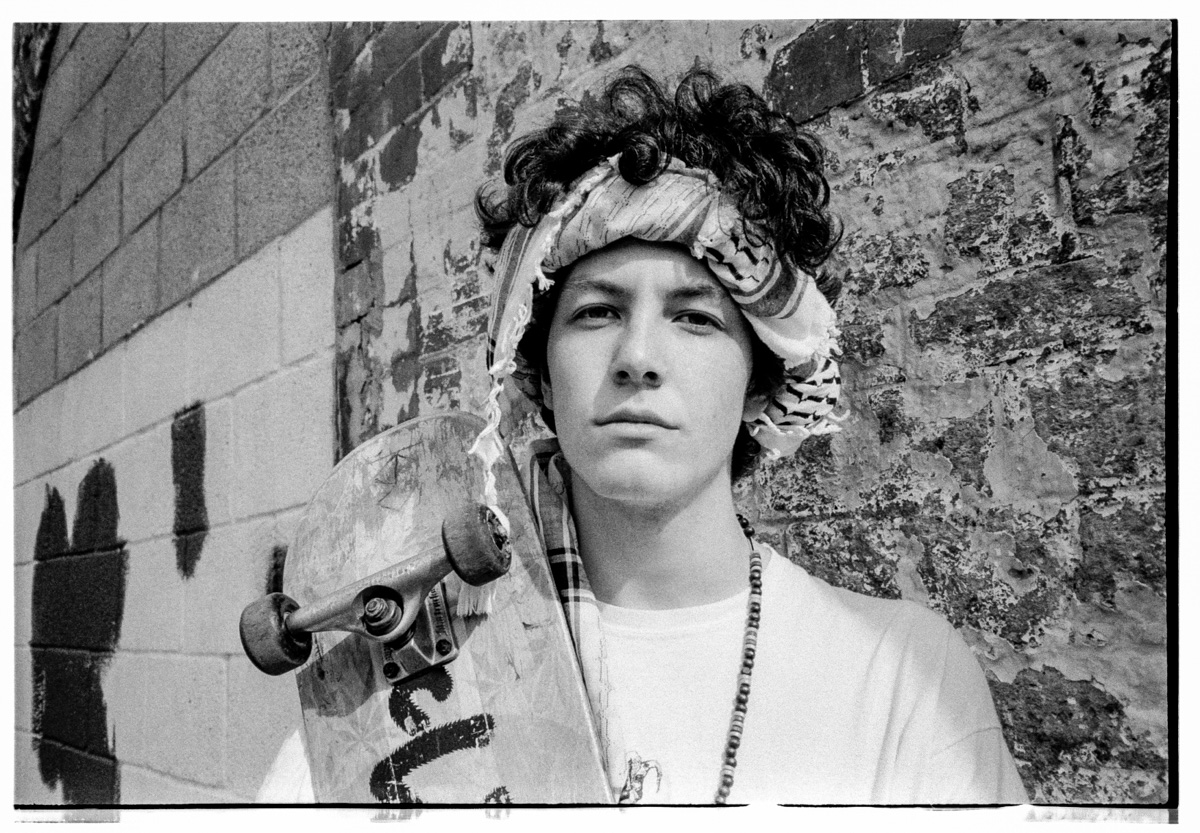
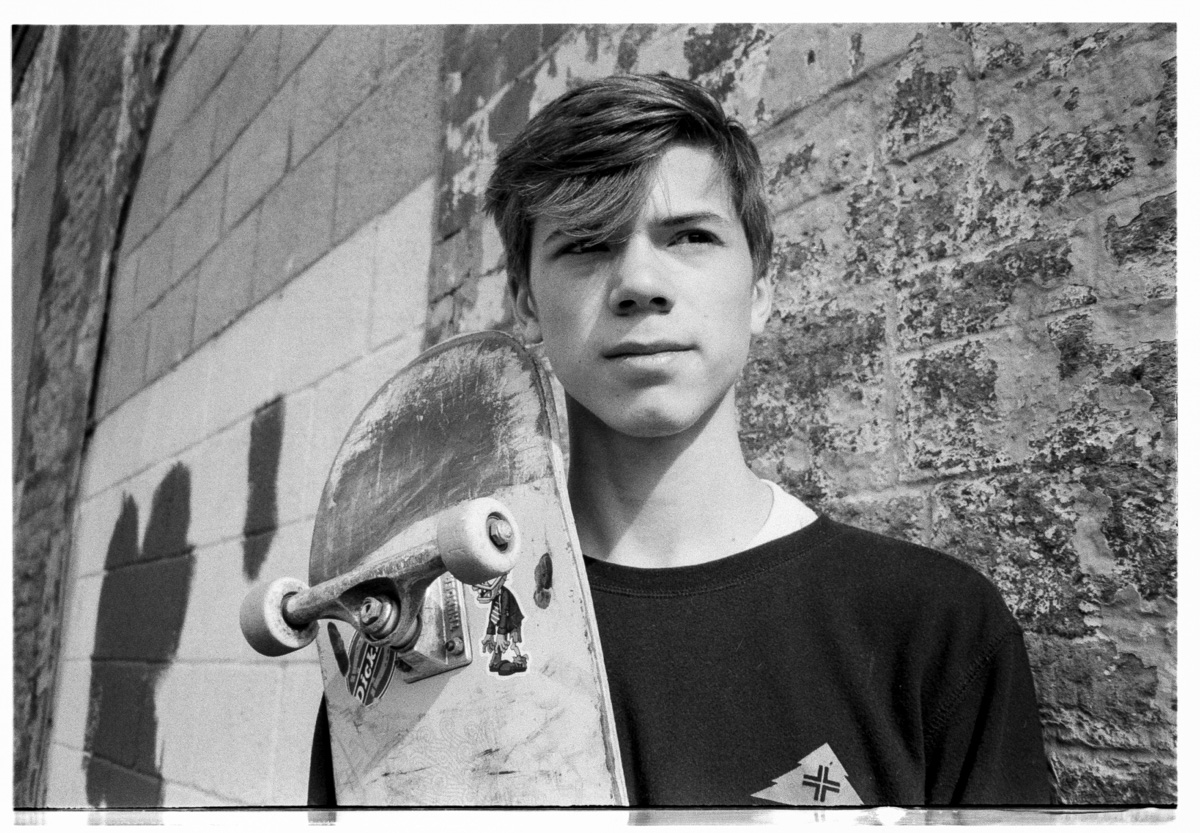
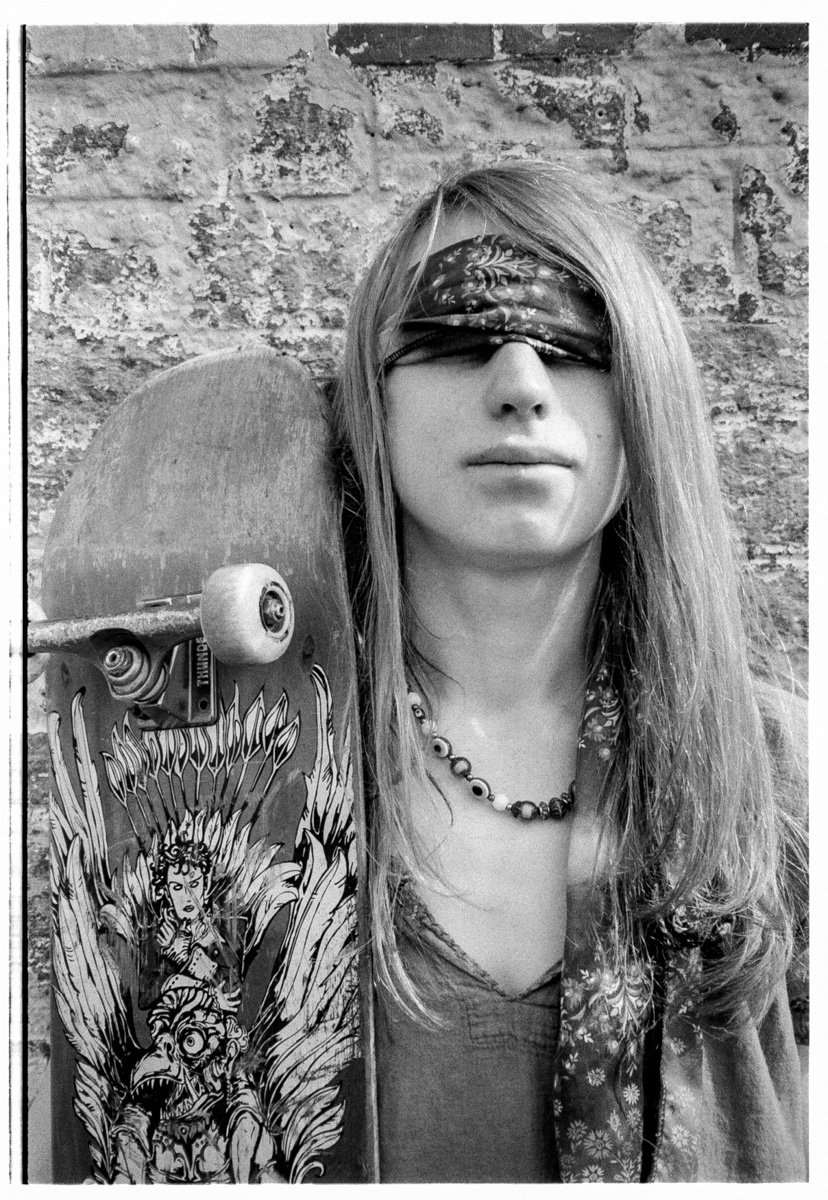
Loaded with a roll of Kodak Tri-X black and white film and with the help of my son Joe and his friends, I set about making a series of portraits that I hoped would make a mini series on skaters and their boards – battle scars and all (the boards more than the skaters).

I tried using the built-in flash in the outdoor setting to see what effect I could conjure with that, but it was pretty horrible, so I went with the daylight-only images in my selection.

My verdict on the camera is it’s not the sharpest lens in the world, but the exposure is good and the overall effect is quite interesting. Not bad for a 30-year-old pocket camera, the current value of which is quadrupled by the loading of a roll of film and a fresh battery.

The result is a series of portraits of these young lads, each standing confidently as teenage boys do with their skateboards acting as shields – to be fair, I asked them to bring the boards up into the frame. But each has their own way of confronting the lens. A couple look away, one would only be photographed blindfolded with his bandana, but I love the unexpected in a photo and if someone chooses to hide their eyes, avert their gaze, or perform some other unexpected motion which reveals something about them, I’m happy to include this as it says more than a straight portrait.

Whatever I like or don’t about these pictures, your opinion is more important and if you’ve a mind to, I’d love to hear what you see in these pictures.

Whether I’ll shoot much on the Sureshot, or just keep it as a museum piece, I’ve yet to decide, but heck, for £2.00 and a roll of film it’s been an interesting exercise.

Thank you to Finlay, Ben, Christy, Joe, Toby and Danni for your help. It probably seemed a peculiar request on the day, but I hope you like the results.


It Isn’t All About The Gear – only a little bit

It’s fair to say, I was never your typical “gear head” photographer. Back in the days of film I learned to respect whatever kit I had and got the most out of it, even if it wasn’t top-of-the-range.

My first professional kit consisted of a Nikon FE2 and a Kiron 28-70mm f/2.8 lens, which I bought secondhand and even that needed a repair before I could use it. I don’t think Kiron exist any more. Nikon? well I think they’re still around, but I use Canon…

To me, my cameras and lenses have always been just kit for the job. I don’t rush out and buy the latest equipment whenever a new camera comes out. There always has to be a good reason to do so, especially since the digital camera market “came of age” and digital SLR cameras got to a stage where there wasn’t really a bad one to be had, just different levels of ruggedness or fancier features at different price points.

Ok, I do get a little excited when I buy a new camera body, but mainly it has to prove itself to me and earn my trust and respect over the course of several assignments.

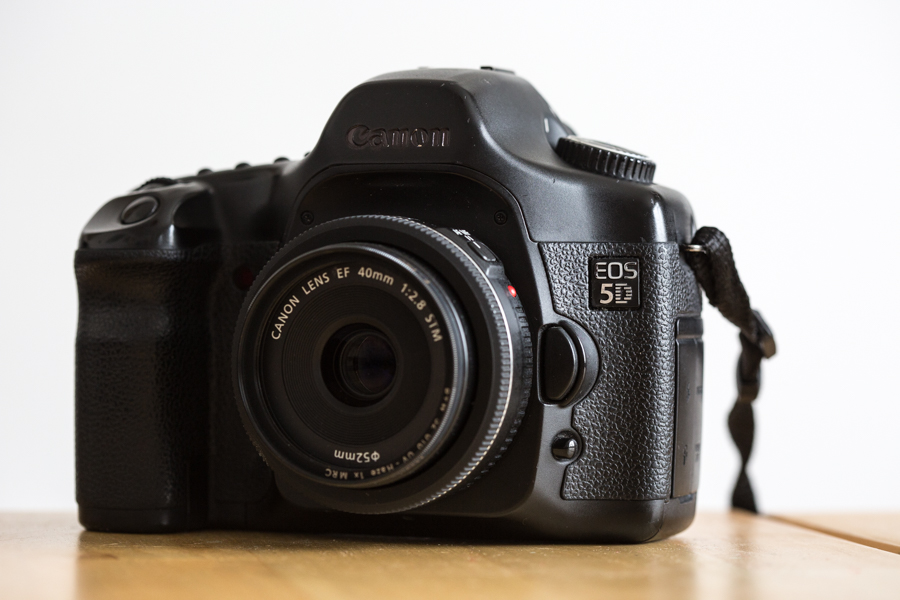
I’d say the Canon 5D MKIII body which I’ve had for well over a year has done that. I had the MKII before it and never liked it. It had too many short-comings for me to warm to it. I usually felt I was getting the shots in spite of the camera, not because of it. Perversely, the 10-year-old 5D original body is a classic and I still own one. I use it in spite of its age because in some circumstances it’s really helpful to use two cameras at once, and it’s always essential to have a backup camera should the main one fail.

In fact I used the MKI body alongside the MKIII on a job last week and it performed exactly as I required. And when I delivered the images, the client didn’t say, “We hate these, they were taken on a 10-year-old camera!” In fact they loved the pictures and will get lots of use from them.

The fact is, a camera built in the days of yore can, in certain circumstances, work better than some of the really high-resolution camera bodies available today. I think the MKIII has more than double the resolution of the MKI, and sometimes this can cause problems. It all comes down to knowing how a particular camera will perform with a particular lens under specific circumstances; something I’m not sure all photographers take note of.

For my assignment this afternoon I’ll probably stick to the MKIII because I know it’ll give me the best results for the circumstances I’m working in. Horses for courses, cameras for… um… well, you get the picture.

Read lens review (not Len’s review)

I’m painfully aware that for the second week running I’ve missed publication day for my blog, which is normally on a Tuesday. For this I am quivering with apologia as I know some of you do little else on a Tuesday than await the publication of my next thrilling article; the truth is I’ve been busier than a bee with a very long to do list, and while I’m not sorry to be working and making a living I genuinely do regret the obvious disappointment caused by the non-appearance of fresh reading fodder for you here.

By way of compensation (or perhaps for some, this is a further slap in the face) I can present you with this lens review wot I wrote and which appears over on the Wex Photography blog. I do hope at least some of you go and read it and that a reasonable proportion of you (maybe 36.5% or thereabouts) might actually enjoy it. Even if 53.284% of those who click the above link actually read beyond the opening paragraph, there is a fighting chance that around 40.7239999 (recurring)% will read to the end. I suspect the larger proportion of those of you who respond positively to the survey question “Did you enjoy reading Tim’s excellent lens review?” will be lying, but that’s ok. I’m interested in statistics, not the truth.

Enough of this nonsense. Move your mouse pointer back to that link… go on… now cli…

My camera review has arrived!

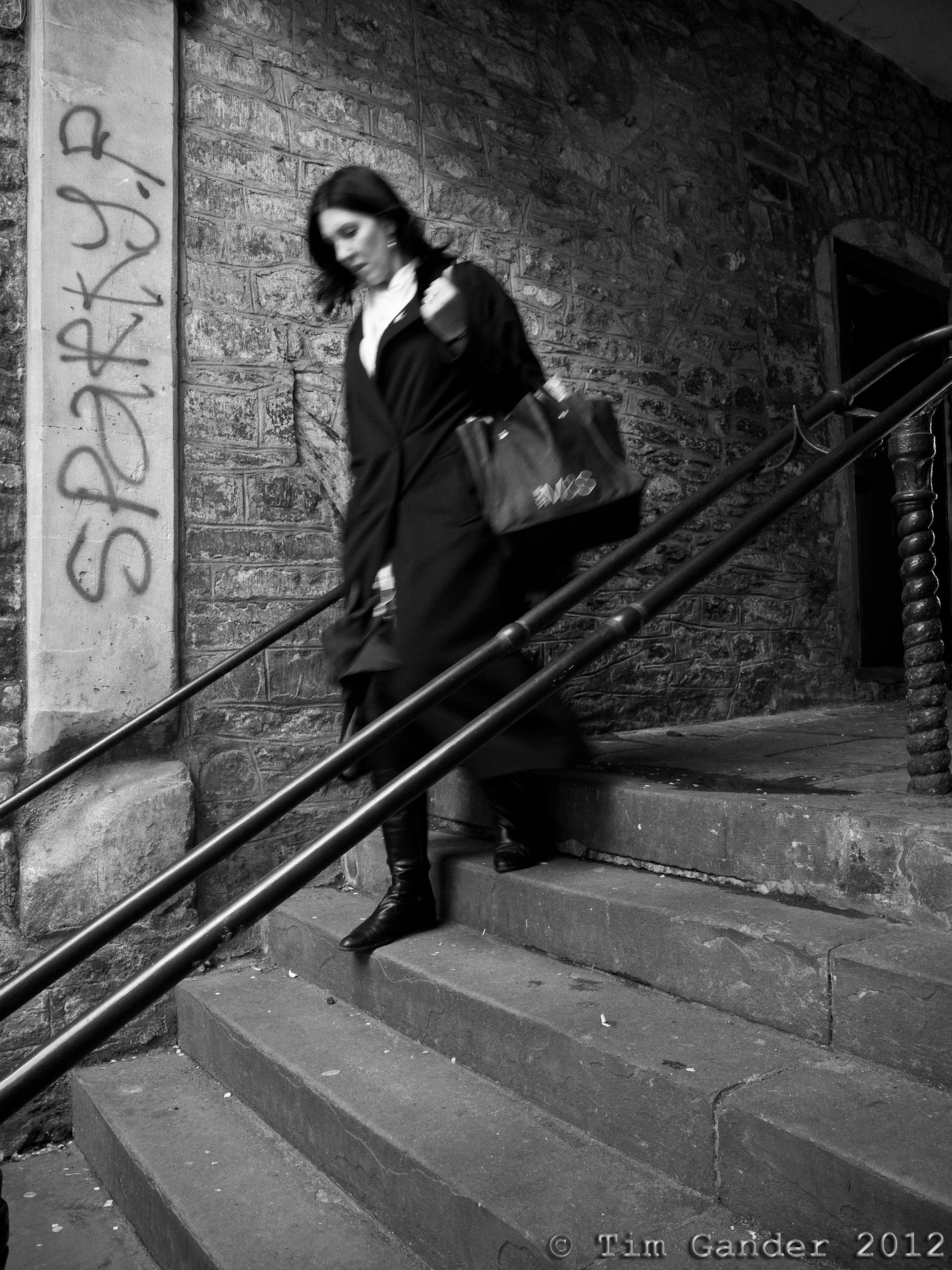
Woman on steps of Shepherds Barton, Frome

I was stunned at the quality from this little camera

To make up for my not publishing a blog article this week, feast your eyes instead on the review I wrote and shot pictures for on the Canon G1 X for Warehouse Express (see here).

I’m really rather excited about the whole process of reviewing a camera, and it’s been an interesting exercise. I wanted to shoot pictures that I would be proud of, in the style of the kind of work I do. Too many reviews just feature colour charts or random photos of pretty scenes on sunny days, and I wanted to push the G1 X to see what it’s really capable of.

Do take a look at the article and I’ll be happy to hear what you think.

Now go. Go on read it… you still here?

How big is the ideal chip?

Which do you prefer? Big, fat, crunchy chips, or crispy, delicate, skinny fries? Personally I go for either, so long as they’re cooked well and not dry and mealy.

Of course this is a clunky metaphor for the chips in digital cameras, a subject I’ve covered before, but this time I’m going to demonstrate the difference between a large chip on the Canon 5D (identical in size to a 35mm film negative) and the smaller chip in the Canon G11 compact camera and how this relates to depth of field in photography (how far behind and in front of the point of focus is also sharp). Now bear in mind I’m not talking about the pixel count, but the physical size of the chip.

Also, this isn’t a camera review. You can read dozens of those on sites such as dpreview.com which do a grand job of organising all the geeky info, doing bench tests and what-have-yous. I merely want to show the difference that chip size has on how pictures look.

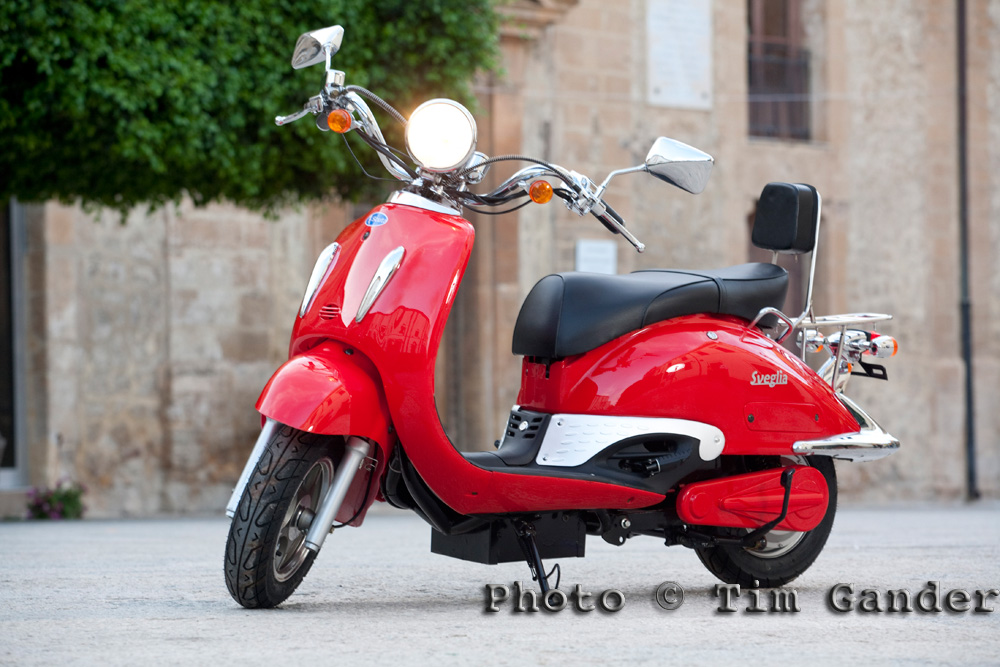
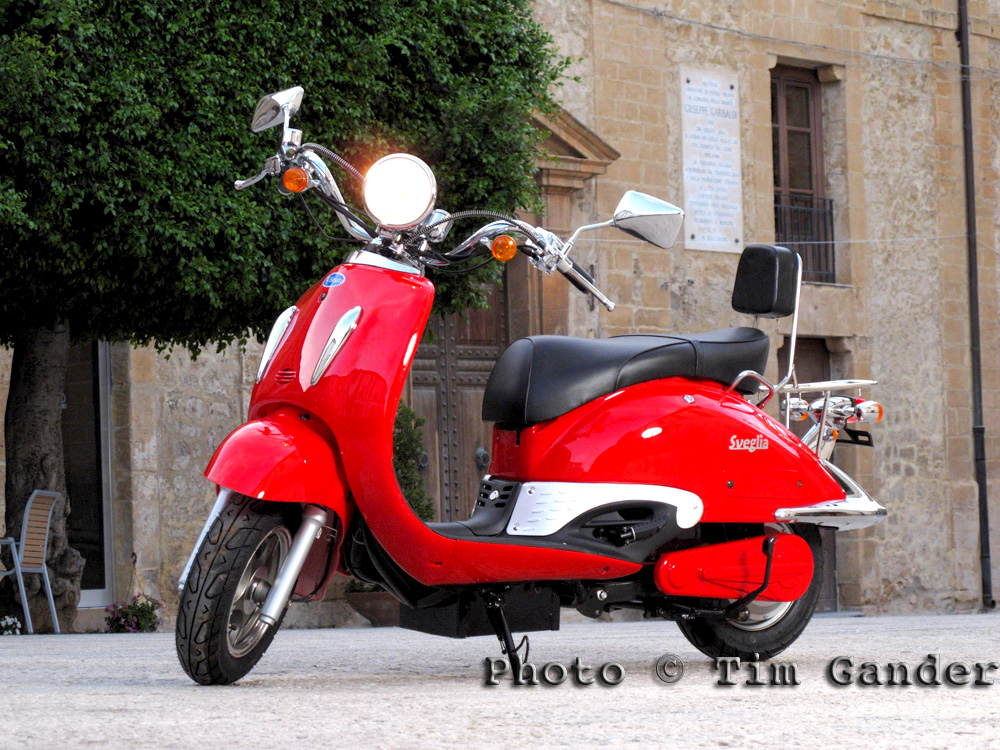
So to continue the foodie theme, let’s get to the meat of the issue. Here you see two very similar photos. One taken with the Canon 5D (a full-frame SLR) and the other with the G11 compact camera.

commercial photo of electric scooter in sicily

Canon 5D background is softer.

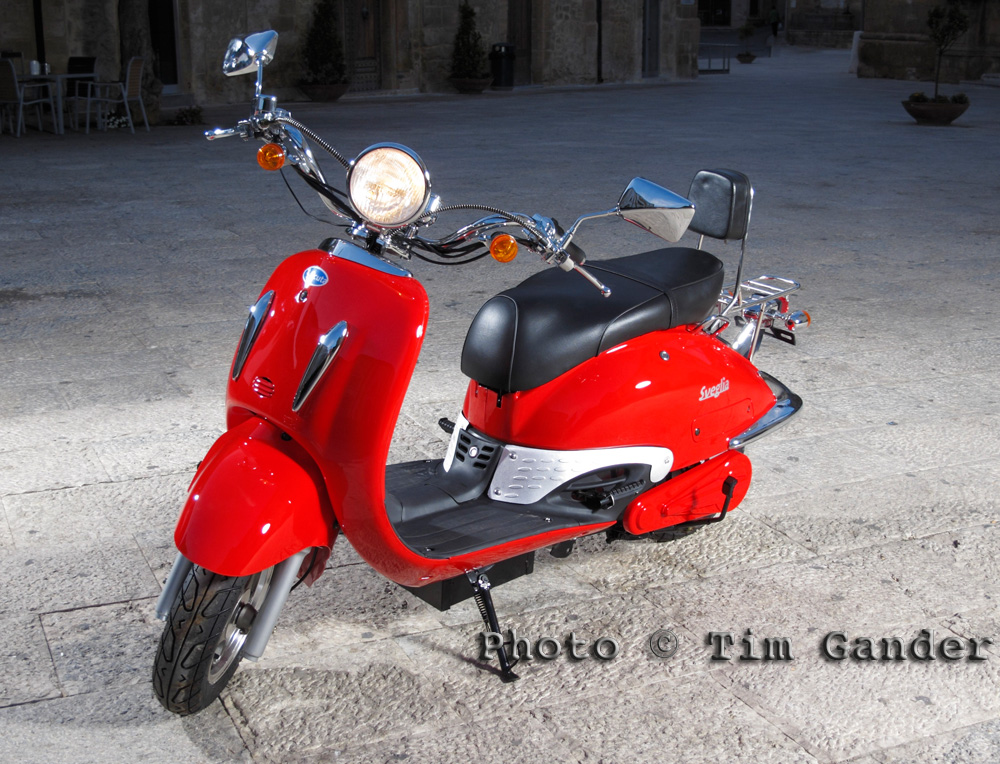
Electric scooter in Sicily

G11: Background is clearer.

What you’ll notice is that the background in the shot taken with the 5D is much more out of focus than the shot taken with the G11. Factors which affect this depth of field are aperture, lens focal length and chip size.

The focal lengths aren’t massively dissimilar; 135mm on the 5D, 115mm on the G11, and the apertures are f5.6 and f4.5 respectively. But the biggest influence on making the bike “pop” out of the background is the effect of the chip size on depth of field, and this is where the D5 has more control. Not necessarily a bad thing that the G11 will always have a deeper depth of field. It means more of the bike can stay sharp, while the lens can use a larger aperture and gather more light to gain the same exposure.

Photographers will use a fine depth of field to emphasise certain elements of an image, but other tricks can be used when you have less control of depth of field, such as switching to a more dramatic lens angle and simplifying the background, which is what you see in the photo below.

electric scooter in sicily

G11: Change of angle + darker background = more drama.

I said this isn’t a camera review, but I have to say I was very impressed with the G11 once I’d learned how to squeeze every ounce of quality out of its tiny chip. It’s not as quick as an SLR, but if you can anticipate well it’ll give you results you’d find surprising. I love that I can trigger my portable studio lighting using wireless triggers on the G11’s hotshoe, and that I can fire flash at higher shutter speeds than are available in normal flash modes on the D5. The only downside is that pulling the image up to 100% on screen shows the quality difference between the G11 with its tightly packed 10 million pixels, and the D5 with 12.8 million with more room to breathe on a bigger chip, but for web images it’s stunning.

Make these pictures move!

Now that camera manufacturers build video capability into their professional camera bodies, the question many photographers are asking themselves is, “why am I so hung over?” Shortly after that they ask themselves if they should be getting into this video malarkey by getting an SLR with a HD video doohickey built in.

It might be helpful to look at why camera makers did this in the first place. Or it might not, but it’s what I’m going to do anyway.

I have heard that the driving force for HD-capable stills cameras was originally the press agencies who wanted their staff to be able to shoot short video clips at news events to offer in addition to stills. I’m not entirely convinced by this, since shooting stills and video simultaneously is rather like juggling turds. It’s all going to get rather messy at some point.

My gut feeling is that the manufacturers decided they needed a new selling point for their equipment, which in every other regard has become about as sophisticated as it’s possible to get short of including a particle accelerator.

Hadron colliders being rather bulky (for now), video was the obvious choice, but they needed a valid reason to go to all the trouble, so suggested it might be a “good thing” to the picture agencies who probably said something along the lines of “knock yourselves out” – a ringing endorsement indeed.

And so it came to pass that Canon, Nikon, and probably some others which nobody bothers to buy much, built video into their pro cameras and said “Lo! for we have given the world of photojournalism the ability to multitask.” Marvellous.

portrait of rebecca adlington

Good luck shooting uprights on video.

But, this wasn’t the real reason for glueing a cine camera to a box brownie. The reality is camera manufacturers want these technologies to trickle down from the higher-end cameras to the consumer range in order that consumers, faced with the annoying fact that newer cameras can do something their poxy stills-only brick can’t, will upgrade to the newest, video-enabled model and consign their ancient, 9-month-old camera to Ebay or landfill.

Going back to the original question for professionals though, should you jump or be pushed into video, my advice is this: Bear in mind that within a few short months, every SLR will have HD video capability to some degree, and what might seem like a business advantage now (shooting high quality, cheap videos for smaller business clients) will quickly evaporate as the World and his spotty nephew equip themselves to do video just like the pro’s. Just like stills, the results will be mostly horrid and useless, but it’ll impress the boss that he can get video for “free” even if it costs him sales (he won’t notice that unless people start telling him how horrid his nephew’s efforts are, but nobody will tell him so he’ll never know).

In the meantime, being professional and understanding what’s required to achieve pro quality, you will spend thousands of Pounds on hardware and software to make video viable; you will spend weeks learning about panning, focus, lighting and sound, then converting, editing and encoding it all, only to find the prize is always just out of reach, and that clients will always want it much cheaper than it costs to produce. All this at the same time as discovering that in the commercial and weddings world, there’s already an army of well-equipped experts already doing what you hope to do. You’ll be trapped between Uncle Arthur with his video-capable Canon 60D (or whatever) shooting for free, and the seasoned video expert who has the technique, workflow and pricing honed to perfection.

Personally, I’d rather wait for the built-in CERN feature.