
Does sex always sell?

Leilani Dowding

A popular pic. Can you see why?

Another trip down memory lane this week, and this time I risk accusations of blatantly fishing for blog hits by featuring this photo of former Page 3 model Leilani Dowding. She’s modeling a bikini which Swatch wanted to promote at the time (no pun intended) as there was a watch incorporated into the design.

There is a reason for this picture being here though, because it’s been fascinating to see that although my website is dedicated to corporate, press, PR and commercial photography, this is the photo which has had the most views out of all the pictures on my site.

I don’t mind revealing that it’s had 138 views to date. That isn’t all the people that have seen it, since you can see it without clicking on the website thumbnail. That’s how many people in about 18 months have gone to the trouble of clicking on the thumbnail image to see it larger.

Bearing this statistic in mind, it’s hardly surprising that Marilyn Monroe comes in second with 103 views, but then my Skinheads picture scores 89 to achieve 3rd place. A slightly worrying top three, but of course the hits aren’t necessarily related.

Now I should be pleased that some of my pictures are so popular, but this rather odd bag of stats highlights that just having a picture seen a lot isn’t going to bring in business. Indeed, I think I can categorically say that none of those three images has ever pulled in a genuine client. My examples of corporate portraits and the like, with much more modest hits in the range of 30-50 have done a better job of bringing in work.

It just goes to show that pretty photos don’t always bring in work. A popular picture isn’t always going to bring in business. For businesses using photography, if it’s shot well and is relevant to your business it’ll have a much bigger impact on income than something which is just “very nice to look at.” This thought should guide how you present your business.

In the meantime, I can’t bring myself to take the Leilani photo down. It’s obviously bringing pleasure to some people, and she certainly adds a splash of glamour to the gallery.

As for Leilani herself, she was lovely to work with. Utterly without pretense, and of course, thoroughly professional. We’d previously done a shoot together to promote a gardening kit giveaway for the News of the World, but that picture isn’t half as glamorous!

I understand she now lives and works in Los Angeles. I doubt she remembers me 🙁
Getty getting bigger

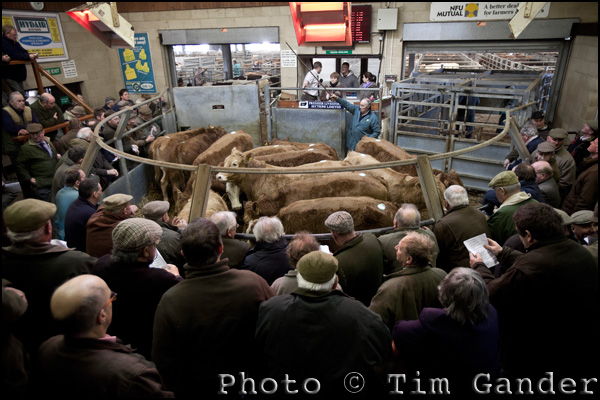
Livestock auction in Somerset

At least in a livestock auction bidding tends to go up, not down.

The parallels between the photographic industry and farming aren’t as obscure as you might think.

Imagine Getty are the Tesco/Asda/Sainsburys of the picture world, where the suppliers of the produce they sell have little control over the price they’re paid for their goods, regardless of the cost of production.

There are only so many outlets for farmer photographers, owned by some very powerful businesses that will set the selling price to wherever they think they need to in order to gain market share and make a profit.

I mention profit, but I’m not sure if Getty (who also own iStockphoto) are in profit for their stock photo portfolio of businesses, and reliable figures seem elusive, but they’re certainly good at spending whatever money they have on expansion plans.

One advantage farmers have over photographers is that they are paid for their produce by the wholesalers or retailers who then sell it on for a profit, while stock photographers give their work to the libraries for free in return for a commission, but only if a photo sells. And a photo might never sell, or might only sell for a few pence, of which the photographer might get a few pennies.

By way of leaving the farming analogy to one side, I’d like to say I have the utmost respect for farmers and I’m glad they do a job many of us couldn’t cope with.

The news that Getty have now acquired the Australian stock image library Photolibrary, close after the announcement that they’ve also acquired image-tracking firm PicScout, means Getty are still aggressively expanding and consolidating their business, but you won’t see photographers jumping for joy and I think in time neither will picture buyers be especially delighted.

Getty will want to see a return on their investments, so it may be we can expect them to switch the PicScout phaser from stun to kill as they target image infringers and recoup their money through either higher or more numerous payment demands.

As for their buying up yet another image library, what possible advantage is there to a business or a designer that they can now choose from an even larger library of the same old same old? Surely once you’ve seen one sterile business picture, you’ve seen them all. Getty can’t claim to have extended buyer’s choice any more than Heinz can claim to have extended our choice of baked beans by making more tins of the same beans.

It also appears that Getty are looking to turn the screws once again on their contributing photographers by introducing terms that mean Getty will be able to move images from Rights Managed to Royalty Free licensing, with no mechanism for contributors to opt-out of such a scheme. This leaves contributors with less control over how their images are used and the prices set. For buyers, it will mean even less exclusivity, making stock imagery even less attractive than it already is.

That final point probably explains the rise in enquiries I’m getting from businesses that are wanting to break free from the herd and be noticed (back to farming!), but I’d rather Getty used less aggressive tactics anyway because they don’t reflect well on the industry as a whole.

It’ll be interesting to see where all this activity leads. If Getty want to take a lion’s share of the market with a view to pushing up stock image prices, they may find this is a very long game indeed. I’m sure they have a plan, but in this world of over-supply and finite demand, it’ll have to be a very cunning plan or a game with infinite budget.

UPDATE: ASMP makes thinly-veiled suggestion to American photographers that if they contribute to Getty, they should consider other means of distributing their images (in other words, quitting Getty). More at PDN.

Sense and Licensibility?

First of all, let me apologise for the tardy arrival of this article. A busy week and writer’s block almost had me not writing anything at all, but I couldn’t let you get off that easily!

What finally shifted my block was a discussion on a Linked In photographers’ group forum about how professional photographers can work to reduce the negative effect of un-trained, low-skilled photographers on the industry, and the thread quickly moved onto whether or not photographers should be licensed to practice. It also descended into something of a flame-fest between some professionals and amateurs (neither side coming off looking pretty), but maybe that’s another blog article.

My personal feeling is that no, there shouldn’t be a licensing system and this article will set out why I believe that. However I do believe there should be minimum standards that clients should seek out before engaging the services of a photographer.

I probably don’t need to re-tread the well-trodden arguments about how the rise in standards of photography amongst amateurs has made the industry tougher than perhaps it ever has been in the last 40 years, though amateurs were being complained about in a book I have which dates from 1944 so it’s not a new argument.

Much of the anguish of professionals centres around what I call “epiphany” photographers. You know the ones who have quite decent jobs, but buy a digital camera at Jessops and decided what they’d really like to be is a photographer. So they either keep their day jobs and moonlight at rates to undercut professionals (and devalue their images in the process), or they leave their day jobs, commercial reality hits them hard and they undercut everyone else just to get work, with no eye on their long-term business prospects.

In these scenarios, some kind of licensing system might seem like a brilliant plan, but I just don’t see it working. What kind of regulator could tell the good photographer from the bad? When I started out I know I took some pretty bad photos, but I worked hard and trained and developed. Should a regulator have ended my career then? The picture editor I was working for at the time could have, but he obviously thought I was worth persevering with.

And at what point in the starting out process would a photographer apply for a licence? What would the conditions of a licence be? And how could a licensing system cover the diversity of disciplines from weddings to editorial through industrial, commercial, corporate…

Far simpler, I think, is if picture buyers, be they wedding couples, families, publishers or commercial businesses or agencies, make sure they check out who they are looking to book very thoroughly before they put down a deposit or commit to a shoot.

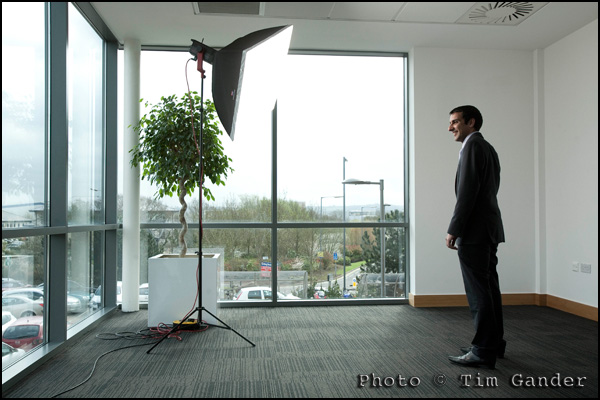
man in suit being photographed in office

Never mind that the photographer is invisible, has he got public liability insurance?

This is my list of essentials, though it can vary from sector to sector and may not be exhaustive:

  • Check out the photographer’s website. Compare it with others at varying price points to get an idea of the level of quality you’re likely to get.
  • Do some digging to make sure the website isn’t just work lifted from other photographers. Not always easy to spot, but one tell-tale sign is when the photographic style and quality varies wildly from one picture to the next.

Talk to the photographer and ask:

  • How long have they been in full-time business?
  • Do they have qualifications or training under another photographer? Either is valid in my book. Self-taught is generally not acceptable.
  • Do they have public liability insurance?
  • Do they have professional indemnity insurance?
  • What are their terms and conditions?
  • What is the licence agreement covering the use of the images?

There could be much to add to this, but perhaps the most important thing is to talk to photographers. See who you’re comfortable with and at the talking stage you should start to get an idea of the level of professional service to expect from any given supplier.

Licensing might sound like a good idea, but it can’t account for creativity, approach, style, or personality. I’m sure there are plenty of views from photographers and buyers of photography, and I’d love to hear what you think.

Changing face of the faceless

Here’s an interesting article in the British Journal of Photography which asks if the recession has affected the style of imagery being requested from stock agencies. It looks specifically at buyers’ preferences when choosing business imagery, and the article catches my eye because business imagery makes up much of what I shoot, though I work directly for end-user clients rather than libraries.

It seems the day of the haughty portrait of the perfect-toothed business man, looking down his nose at you in a “I’m better than you” sort of a pose is going out of favour, to be replaced by “more apologetic body language” as a counter to the general public’s mistrust of large corporations (ok, banks and petrochemical companies to be specific).

Getty Images’ head of European content, Tom Hind, is quoted extensively in the article, but a few of his points stand out for me.

“Believability within business imagery is more and more key,” he says. Yes, well I could have told him that. It’s why my clients come to me instead of buying generic business photos of unbelievably generic business men and women from stock sites. The problem for stock sites is that it doesn’t matter how you shoot pictures destined to sell to a wide market, they will always have that slightly sterile “stockphoto” look.

Hind himself slips seamlessly from discussing generic stock to talk about specific images shot to order for an end-user client (Coca Cola) who commissioned images of the shop-floor staff at their Wakefield plant for a promotional campaign.

Reading the article you might think that the Coca Cola exercise was some ground-breaking formula, but again this is what I do for my clients on a regular basis; natural shots of their own staff and MDs in their real office, looking real.

Senior manager for Creative Intelligence (no sniggering at the oxymoron) at Corbis, Amber Calo agrees with Hind when he says that image buyers “want to see what looks like real people, in real situations.” My simple answer to businesses wanting this look for themselves is simple: commission pictures of real people in real situations within your own (real) business, and not only will you get that polished-but-natural look, but you’ll look more convincing to your clients too.

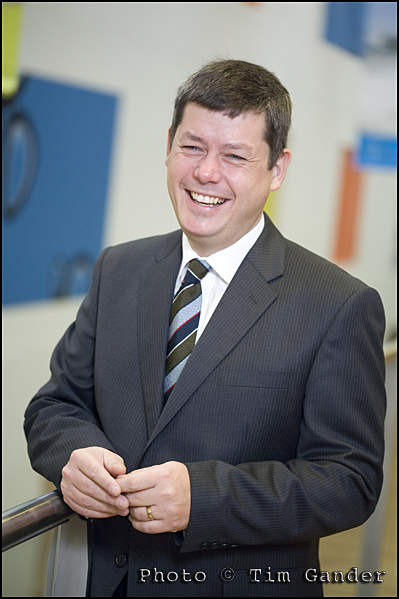
corporate business portrait of a man in a suit

Relaxed, friendly, genuine.

The article does have some useful style pointers, which merely reinforce what I already do for my clients, such as keeping the style loose, not too starchy or posed, and using depth of field to make the subject stand out from what can be cluttered surroundings (Hind talks of shallow depth of field as a shorthand for quality and I’ll not disagree with that).

The concept of believability seems strong in the article, and again I’d say that independent photographers like myself have been far ahead of the stock agencies in this regard for a long time. Mainly because we are shooting real people for real businesses, not models pretending to be chief executives.

I honestly believe that businesses and the better designers are already eschewing stock imagery in favour of presenting their true selves to their clients. I benefit from clients telling their designers they want to open up visually and avoid the “me too” look of stock.

In a world where commercial enterprise is having a bit of a PR crisis, where better to start repairing that damaged image than with the images you use to communicate with your clients?

Case Study: The Rebrand

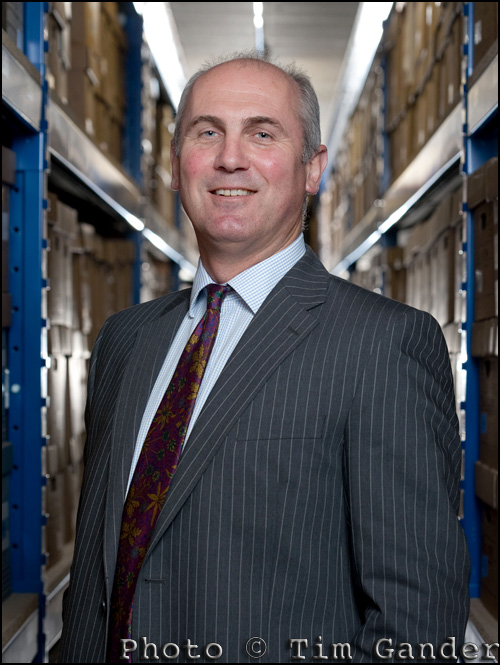
When Somerset-based document storage company Filebase changed its name to Filofile, the time was right for a new website and corporate photography too. And I was delighted to be contacted by an equally Somerset-based design agency Cognique to do the honours with my camera.

I met Filofile’s MD Simon Barber at the premises on a lovely Autumn day last year, he showed me around, and then while he was being interviewed for a video for the new website, I set to work gathering images that would populate the new site as well as promote Filofile through all their printed and electronic media.

When a company consists of not much more than a former cheese storage shed full of boxes and some security equipment, it’s not easy to come up with a wide choice of images, but I managed to pull some interesting shots out of the bag. You can see the finished website here, but I’d also like to show you some of the shots that didn’t make the website, but which will be useful to the company for their other promotional publications.

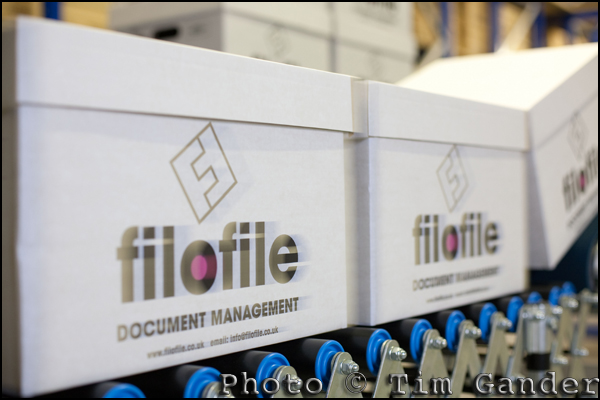
data storage boxes

Boxes on the move (I pushed them to achieve the effect).

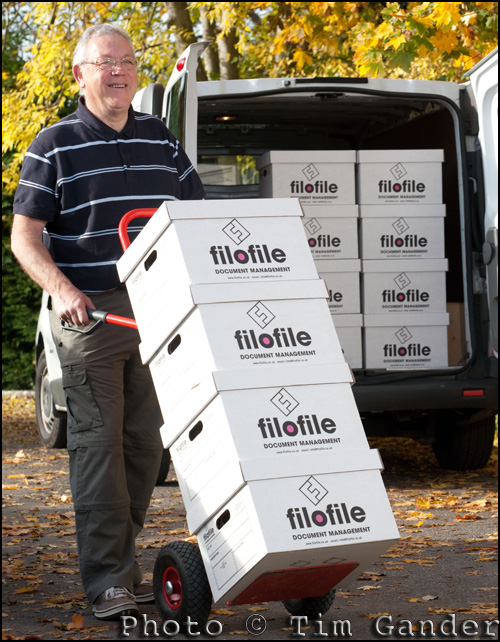
Filofile boxes on trolley

Showing Filofile at work moving documents for clients.

Simon Barber of Filofile

A portrait of MD Simon Barber, but with more of a "business pages" feel to it.

Goldilocks and the photo.

Can brilliant corporate photography save a failing business? No. BUT it will be part of what makes success easier to achieve. Conversely if a business is using snaps or stock imagery, this can be, as an American business guru might put it, a drag coefficient on your success rocket. *blech!*

I don’t pretend that the photos I take will turn you into an overnight sensation and put you in contention for The Sunday Times Rich List, but it’s fair to say that when marketing departments go to the trouble of getting a lively, engaging web design together with compelling text and a user-friendly interface, what often lets the whole project down is the lazy or cheap approach to the accompanying imagery.

call centre staff on telephone

Quality photos say “quality business”.

Head shots of key staff needn’t be cheesy, and they certainly mustn’t be low quality just because they’re going to be used small. You never know when you might need to reproduce one to a larger scale and in print, and that’s when poor lighting and composition as well as poor resolution really start to show up. The purple gargoyle look doesn’t suit anyone. Neither is it helpful if an over-compressed file leaves you looking like you have some kind of skin disease.

Photographs of products and processes, people, places (and all the stuff not starting with p) all require a level of quality. After all, shot once you can use these images over and over again and they’ll pay for themselves in time, whereas low-grade, badly taken images will simply remind potential clients how little you care for quality every time one of these photos shows up.

Equally, if you get great imagery but either don’t use it at all or don’t use it properly, you’ll be wasting your money and you’ll think it wasn’t good value. This comes back to using a quality photographer who can give good after care, and a marketing specialist who knows how to use pictures for maximum impact.

Where’s all this going? Well I believe it’s possible to overstate the importance of photography in business, but what’s happened since the mass-accessibility of digital is that things have swung too much in the other direction. General opinion is often that photography has no, or very little importance. Often I’ve seen web designers refer to the photos in their designs as “eye-candy”. If the photos are just eye-candy, why bother with any imagery at all? And why do I have so many clients if what I do has no impact on their business?

If your business uses photography it should be as a way of communicating something to existing and potential clients. Not just showing that which is in front of the camera, but the quality, composition and presentation of the photo will all be shorthand for the kind of business you are.

Now, that’s not going to save a business which is already circling the drain, but dismissing photography on your website and in your literature as “so much fluff” won’t help you to the top of your market either. As Goldilocks might have said, you need to get the balance just right.

Photo case study: Group work.

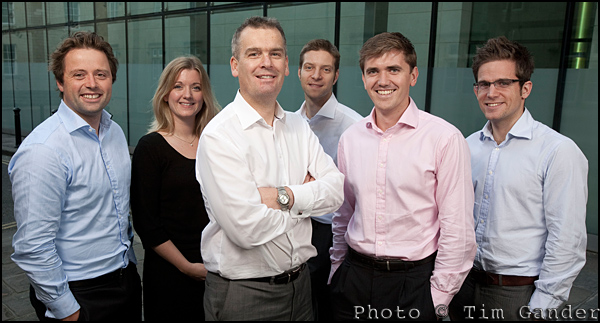
corporate group photo in Bath

The team look relaxed, even though we’re shooting outdoors.

Perhaps the least well-understood area of corporate photography is the group shot. So often the result looks like the subjects have been forced against a wall and are about to be shot for desertion, or they’re lined up like in a wedding photo, minus the bride and groom and not even a slice of cake as an incentive to be there.

There is often no thought to style, composition, lighting or location, or real idea of why the photo is needed in the first place. Just a vague notion that a group shot would be a “good idea”.

Of course the alternative is to buy some random group pic off an internet photo library, but the saccharin smiles, the unrealistically beautiful people – your clients know it’s not you or your business, they’re no fools.

To be fair, the corporate group photo can be quite a challenge because there are lots of busy people to bring together at one time and on one day, and in all likelihood there will be little time to take the photos, added to which; who here likes having their photo taken? No, I didn’t think so.

Then there’s the lighting, location, wardrobe decisions. If not planned properly, it can all get a bit fraught.

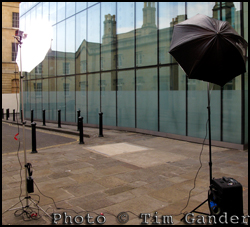
mobile studio photo lighting

Using mobile studio lights gave the photo a more polished look.

So I was pleased to get a call from a long-standing contact, Corrina Cockayne at Target Chartered Accountants in Bath, who was organising a group photo for the corporate finance team. I say pleased, because I knew Corrina would be organised and efficient and would have thought about why this team shot would be useful. In this example, it had been a while since any PR had been done and the team had evolved quite a bit.

The plan was to use an outside location in Bath, and Corrina was already thinking along the right lines – considering what people would wear, what the background should be and getting in touch with the council to check for permissions etc.

My job was to liaise with Corrina, talk over the options for locations and lighting, scope out the location before the shoot and be there in plenty of time to set up and take the photos before the group arrived. I wanted to keep their waiting time to a minimum.

Because of the constraints of the location, I couldn’t spread people about too much or I’d risk all kinds of distractions in the background, but I knew the lighting was going to make this group shot stand out from the usual Crimewatch lineup.

In the event, even though it was “just” a group shot, everyone put in a  good effort and wore their best smiles, and the end result reflects the approachable professionalism of the team. A good example of how a group shot can work and be a useful asset in the client’s photo library.

What price a portrait?

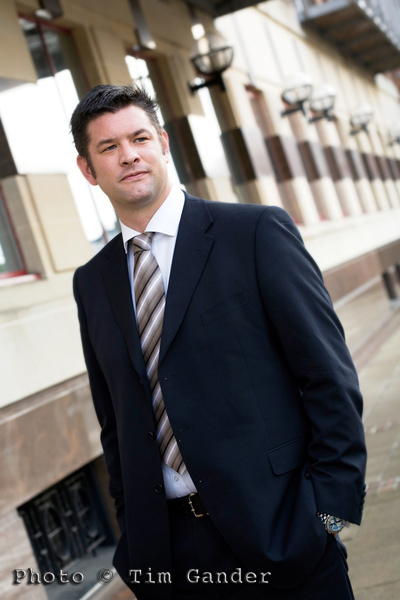
corporate portrait of businessman in Bristol

A corporate portrait can be more than a mugshot.

I should start by explaining that this article isn’t talking about family portraits or photos for the mantelpiece. What I’m talking about here is the business portrait. The corporate headshot for the profile page of a commercial website, newsletter or chairman’s statement in the annual report.

Why is this distinction important? Mainly for licensing reasons. If you go to a high street photographic studio and have photos taken you will probably pay about £30 for a sitting, and £100 for a print to hang on the wall. And personal use is all you’ll be allowed of that photo. Commercial use would require payment of an extra fee, and I suspect most studios wouldn’t be happy handing over an original digital file for that use as you could then get your own reprints done, which would of course breach the photographer’s copyright.

When you have a photographer visit your offices to take portraits for the company website/brochure etc, you’re not paying for prints for personal use (though you can probably buy those if you want), instead you’re paying a licence fee to use the images for corporate use. This is a different kind of agreement with the photographer and the pricing structure is different.

Of course if you book a photographer and then just have a single headhsot done, it can work out relatively expensive. Perhaps £250 to get a small selection of images for use across various media. But if you line up a few headshots to be taken at the same time, the cost will rise but the individual price for each headshot will drop quite dramatically.

It’s often quite difficult to explain this concept to clients who will say “well it’s only some portraits, they shouldn’t take long.” The thing is, in commercial and corporate photography, it isn’t just the time taken to get the shots that you’re being charged for, but also the commercial (as opposed to domestic) value of the photos. Remember, these photos are part of your marketing, and hopefully will help your business make more money. They may not be used as prominently as your product shots, or general photos of your business operation, but they’re all part of the mix and to have any value to your business, they have to be good. Which requires skill, time and equipment to achieve.

In short, you need to give the humble head and shoulders photo some respect and also understand that what you’re paying for is a combination of the photographer’s skill, experience and time on the commission, as well as a fee for the commercial exploitation of the results.

And what is that worth? As I said earlier, if you hire a photographer to take just one headshot you could easily pay £250 for that, maybe more. Get a batch of portraits done in half a day and the rate might rise to around £500, but if 10 portraits are done, that works out at £50 per head. That’s less than you’d pay for a 10-inch print to hang on your wall at home, and your clients can’t even see that photo. Unless they’ve broken into your house.

Make these pictures move!

Now that camera manufacturers build video capability into their professional camera bodies, the question many photographers are asking themselves is, “why am I so hung over?” Shortly after that they ask themselves if they should be getting into this video malarkey by getting an SLR with a HD video doohickey built in.

It might be helpful to look at why camera makers did this in the first place. Or it might not, but it’s what I’m going to do anyway.

I have heard that the driving force for HD-capable stills cameras was originally the press agencies who wanted their staff to be able to shoot short video clips at news events to offer in addition to stills. I’m not entirely convinced by this, since shooting stills and video simultaneously is rather like juggling turds. It’s all going to get rather messy at some point.

My gut feeling is that the manufacturers decided they needed a new selling point for their equipment, which in every other regard has become about as sophisticated as it’s possible to get short of including a particle accelerator.

Hadron colliders being rather bulky (for now), video was the obvious choice, but they needed a valid reason to go to all the trouble, so suggested it might be a “good thing” to the picture agencies who probably said something along the lines of “knock yourselves out” – a ringing endorsement indeed.

And so it came to pass that Canon, Nikon, and probably some others which nobody bothers to buy much, built video into their pro cameras and said “Lo! for we have given the world of photojournalism the ability to multitask.” Marvellous.

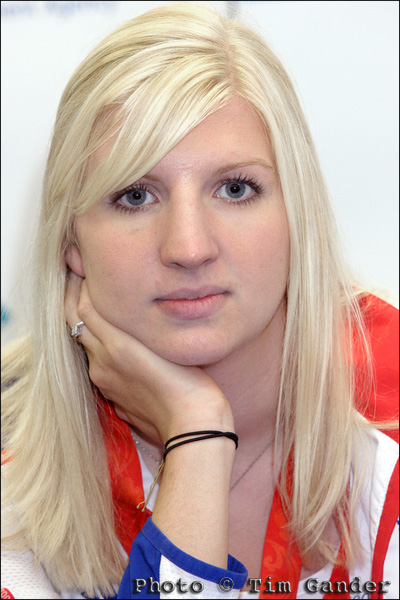
portrait of rebecca adlington

Good luck shooting uprights on video.

But, this wasn’t the real reason for glueing a cine camera to a box brownie. The reality is camera manufacturers want these technologies to trickle down from the higher-end cameras to the consumer range in order that consumers, faced with the annoying fact that newer cameras can do something their poxy stills-only brick can’t, will upgrade to the newest, video-enabled model and consign their ancient, 9-month-old camera to Ebay or landfill.

Going back to the original question for professionals though, should you jump or be pushed into video, my advice is this: Bear in mind that within a few short months, every SLR will have HD video capability to some degree, and what might seem like a business advantage now (shooting high quality, cheap videos for smaller business clients) will quickly evaporate as the World and his spotty nephew equip themselves to do video just like the pro’s. Just like stills, the results will be mostly horrid and useless, but it’ll impress the boss that he can get video for “free” even if it costs him sales (he won’t notice that unless people start telling him how horrid his nephew’s efforts are, but nobody will tell him so he’ll never know).

In the meantime, being professional and understanding what’s required to achieve pro quality, you will spend thousands of Pounds on hardware and software to make video viable; you will spend weeks learning about panning, focus, lighting and sound, then converting, editing and encoding it all, only to find the prize is always just out of reach, and that clients will always want it much cheaper than it costs to produce. All this at the same time as discovering that in the commercial and weddings world, there’s already an army of well-equipped experts already doing what you hope to do. You’ll be trapped between Uncle Arthur with his video-capable Canon 60D (or whatever) shooting for free, and the seasoned video expert who has the technique, workflow and pricing honed to perfection.

Personally, I’d rather wait for the built-in CERN feature.

Oi! Tim! What’s the best photo you’ve ever taken?

I don’t much enjoy trying to answer that question (especially when it’s asked like that), but since it’s a question I get asked, well sometimes at least, I thought it might be an idea to do an article on it.

Probably the simplest answer is that I tend to like whichever was the best photo from my most recent assignment at the time of asking. I do tend to prefer more recent work, perhaps because with every brief, with each new location, there are challenges to be met and overcome and I still love to learn something new from each shoot. And maybe it’s that having a press background, I tend to see older work as having passed its sell-by date.

Of my press photography, I’d still say my favourites are my photo of Tony Blair campaigning in Oldham in 2001 and the portrait of Tony Benn in Bath. Those pictures seem to sum up the evangelical character of the former prime minister, while the other sums up the thoughtful, statesmanlike manner of Mr Benn. More recently, the unguarded shot of Richard Noble of the SSC Project pleased me in its informality and got a decent showing in Director magazine

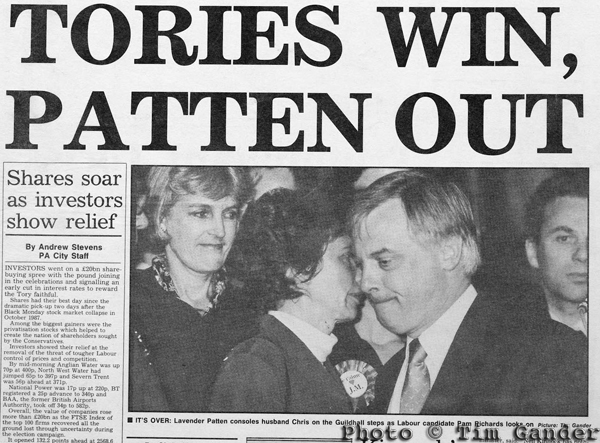
news cutting bath chronicle 1992 election showing chris patten defeat

Capturing a historical moment has a certain buzz.

When I look at my recent commercial photography, I’m often drawn to the simple, relaxed corporate portraits, especially where I’ve captured something of the subject’s character, but I also have a fondness for the beekeeper portrait, which was not only tricky to light, but was tricky to shoot since I was in full protective gear and surrounded by bees at the time. The beekeeper was a decent chap too, and gave me some honey after the shoot. Of course, what’s important is how the photo looks, not what was involved in getting it to look that way, but each picture has an emotional attachment for the photographer, which is why we’re often the worst judges of our own work.

Looking at my gallery of public relations photography, I’d single out the portrait of the barbary lion, partly because he’s so handsome and also because everyone who sees that photo reacts with a “wow” or similar, which is always encouraging.

Apart from the lion, I’m quite fond of the PR photo which I took for the Organic Milk Suppliers Cooperative. The idea of making it look as though the fridges in the middle of a field might actually be working tickles me, and adds an extra dimension of interest to the shot.

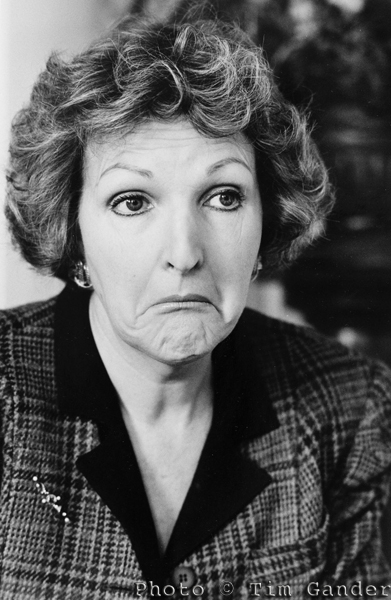
portrait photo actress penelope keith

Actress Penelope Keith in mid-interview. Never published, but still a favourite.

There are many photos and assignments I’d rank as favourites, but going back beyond the last 12 years leads me to that period when I was a staff photographer, so don’t have the copyright in those shots, which means I can’t publish them here.

There’s the shoot I did in Norway with the Royal Marine Reservists, which included a striking shot of a marine bursting up through freezing lake water during a survival exercise, his shocked expression and the water droplets cascading from his hair making it almost uncomfortable to view the photo. Or the single frame I managed to get of HM The Queen arriving at Portsmouth Harbour train station on a drizzly night, simple headscarfe and clearly not expecting a photographer, though smiling all the same.

Delving even deeper into the past, I’ve featured here a couple of favourites from the very beginning of my career, when I freelanced for the Bath Chronicle. Now I think about it again, it isn’t just my recent work I’m happiest with. I think I have some pretty cracking older shots too…

How about you?

Whether you’re a professional or amateur, do you have a favourite of your own? Or perhaps there’s a photographer you admire, or a particular photo that sticks in your mind. Feel free to share your thoughts in the Comments section below.