How Pro is your Profile?

According to 90% of statistics, 75% of all life forms on Earth are either on Twitter, Facebook, Linked In or all three, while the remaining 25% haven’t developed opposable thumbs and don’t have broadband yet.

Ok I just made all that up, but statistically speaking I’m probably right, and anyway it’s fair to say that if you’re reading this article, you’re also (and probably simultaneously) chatting on Facebook, tweeting and maybe updating your Linked In account, or somesuch useful activity.

What you might also be doing is uploading another comical profile photo to one or all of these accounts, but if you’re using any of them as a way of presenting your “professional” self, should you really be uploading that photo of your bottom with the comedy mustache and glasses? Do your clients really want to see you, lobster-like from the beach, wearing a jaunty party hat, a bottle of wikkid, or whatever in your hand?

Even if your photo is more sober, do you look like one of Interpol’s most wanted; or as if you work in a stationery cupboard, surrounded by files, papers, shelves and broken fax machines?

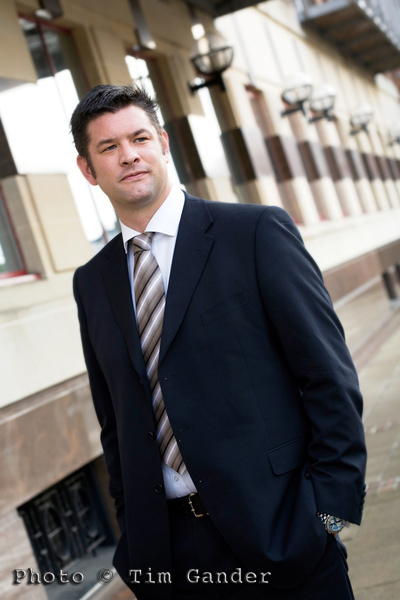
self portrait of tim gander

The model wasn’t much cop, but at least he’s recognisable.

Your profile photo might be just a couple of hundred pixels, but that’s even more reason to make the most of each and every one of those babies. It’ll be the first thing anyone looks at when they see your profile, or any comment you make on a social or business site. So make it work for you; make sure it’s clear and makes a decent impression.

That isn’t to say it can’t be humorous, but remember that your sense of humour isn’t everyone’s cup of tea. My photo is straight and simple, but at least I’m recognisable from it.

So often, that valuable little space on the web page is wasted with a photo that is too detailed to make sense, and the subject of the photo is so small in the frame that their own family couldn’t recognise them. But whether you’re beautiful or have a face like mine, what people want to see is you. They want to know what the person behind the Facebook account or Twitter conversation looks like because normal people engage and do business with other normal people.

Hiding behind an obscure photo, pattern or, perhaps worst of all, a blank space can make your comments on blogs and in discussions look like spam. People want to know you really exist, that you’re not hiding behind a phishing scam. It’s one more opportunity to make an impression and (oh how I hate marketing speak) “build your brand” *gag*.

So do yourself a favour. Get a decent photo, get a friend to take it. If you’ve hired a photographer to take pictures for your business anyway, ask them to shoot you a profile photo with decent lighting. Then stick with that picture for as long as possible, because it will be what people come to recognise you by on all the forums and sites you engage with. Keep changing it, and people will lose track of who you are.

Now go, get it done and don’t let me catch you looking like a drunken party closet terrorist again.

It ain’t Orphan ’till the fat lady sings…

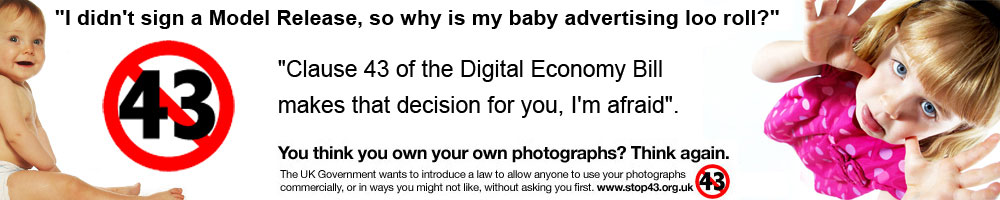
stop43 viral image

If the DEB becomes law with S43 in tact, your photos become fair game.

Today’s the day. Not only will Gordon Brown pay a little visit to Buckingham Palace to ask if he can dissolve Parliament (yes please!), and give us our chance to vote for the frying pan or the fire, the blunt axe or the sharp one, but it’s also the day the Digital Economy Bill gets its Parliamentary debate (such as it will be) and will either be voted through in the wash-up, or dropped. If it goes through, it may or may not include Section 43 which deals with orphan works.

In the Parliamentary equivalent of a smoke-filled room, all the horse trading between vested interests, and personal ambitions of departing politicians with an eye on their post-political careers, will come into play. Forget democracy, this is a seedy little private auction for business and career interests.

There is hope though, even at this late stage. A couple of days ago, the conservatives announced they would oppose Section 43. But of course there is still a risk of a last-minute change of mind (they are politicians after all), and we’re still not entirely sure which way the Lib Dems want to go. They’ve made encouraging noises about how Section 43 should be changed, but no clear commitment to oppose it at this stage. Personally, I hope they have the integrity to oppose the entire DEB on the basis that one afternoon isn’t enough time to debate anything as complicated and contentious as this bill. If they do that, and the Conservatives stick to their announced opposition, the bill would fail to be passed.

We have to believe that at the very least, Section 43 will get dropped. The amount of time and effort expended by my colleague photographers in fighting this ridiculous bill could have been better spent doing our jobs or completing VAT returns and getting our books up together for the end of the financial year. But no, some daft politician somewhere managed to come up with a system of dealing with orphan works which was so insanely un-balanced and damaging to our profession that we had to pour all our efforts into this.

And before you start playing your violins for us, remember that even if you are not a professional photographer, even if you are not based in the UK and even if you only take photos of your drunk pals on a Friday night, if some commercial or political organisation thinks your pictures are worth stealing and using without payment or permission, the orphan works legislation would affect you. If you’re in a photo taken by someone else that gets used without payment or permission, this legislation would affect you.

So let’s wish Gordon a nice trip to the Palace and hope all this effort has paid off.

Read more and keep up with latest developments here: copyrightaction and here: stop43

Jeremy Nicholl’s excellent blog continues to inform on the developments. Click here for more.

The public are getting wise, proceed with caution…

Friday Thought.

Commercial and public organisations are constantly on the lookout for new ways to engage with customers and the general public. This is understandable and very easy to do now that the internet is highly interactive. Done properly, it can work very well.

However, not all such campaigns are successful in attracting positive PR. One popular idea is to engage with your public by asking them to give you free stuff. Most often, for obvious reasons, photos.

A classic example is when some bright PR spark decides that it would be “cool” if customers sent in their best photos for the company to use for free in its web site, advertising and publications. The conditions for giving the business this free stuff will normally be couched in very legalistic terms, with conditions so harsh, unforgiving and one-sided that only the clinically insane would take part in such a scheme. The bigger problem perhaps is that many customers will ignore the T&Cs because they don’t expect their big, cuddly corporate to do anything underhand or greedy, so they tick the “I have read and understood” bit, having neither read nor understood what they were committing to.

If your organisation is looking into trying this kind of customer interaction, let me sound a word of caution. Amateur photographers are getting wise to this kind of exercise. They’re beginning to understand that if somebody wants their photos, their photos must have a monetary value. Just as if you asked them for the keys to their car, or for a few hours free graft, they understand that while any idiot can give something away for free, it takes a special kind of idiot to do it willingly. And amateur photographers aren’t idiots.

Several organisations and businesses have already bought themselves some negative publicity trying this kind of exercise. The UK’s Environment Agency recently put out a call for graduates, keen on photography, to become free labour suppliers of photos. The BJP wrote an article about it, the EA had to take their Facebook page down at one point, and then finished with a spectacular U-Turn.

Other organisations currently fighting a backlash from photographers include the publisher Archant with their Great British Life photo competition, and Greater London Authority wanting free photos for their new web site. I know there are many more examples, but you get the picture (for free!)

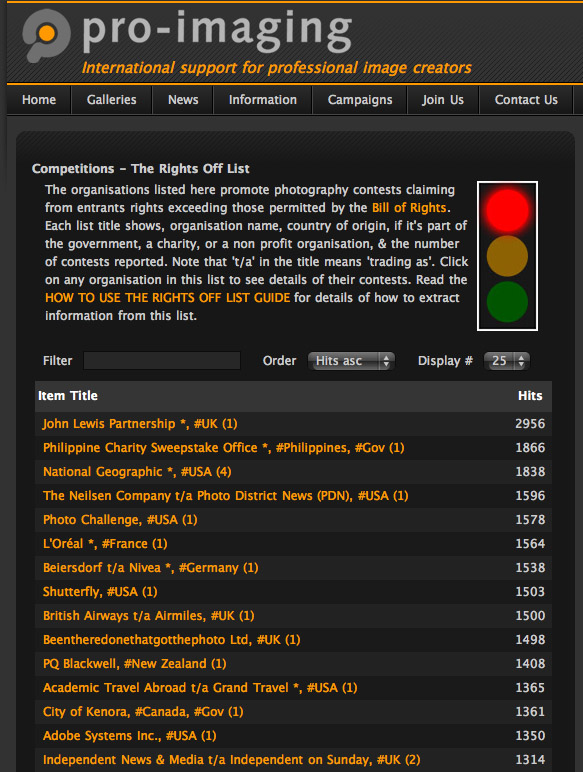
pro-imaging website screen shot

Pro-Imaging advertise competitions as Rights On or Rights Off. Click to see the full list.

Photo competitions which hide rights grabs are another example where photographers, both amateur and professional, have forced a change of terms and conditions, but only after much negative publicity.

The examples of companies which have attempted this particular wheeze and then had to change their T&Cs to be more like a photo competition than a phishing trip is too long to list here, but you can check out the Pro-Imaging web site to see what makes a competition fair, and see which organisers have adhered to the Bill of Rights which has been drawn up through industry-wide consultation.

These schemes and scams keep popping up, and most get battered down by hobbyists and professionals working together for the better ineterests of photography. Why companies and organisations continue to make the same mistakes time after time is a mystery, but I do see the tide turning against this trend for what has been described by others as “loser-generated content”.

So use the internet to interact with your clients and your audience, but don’t ask too much because your clients can quickly swamp the message you intended to broadcast with the ugly sound of protest at unfair practices.

Top 11 Tips for booking a photographer.

A couple of blogs ago I promised a quick guide to choosing a photographer for your project. Then I forgot and instead wrote something terribly witty about Leonardo da Vinci and infinite monkeys. I know it was witty because somebody said so. “That’s witty”, they said.

Getting back on track, here is the blog I originally promised. As a bonus I’m doing it in a top ten list sort of a form. As a double bonus, and in the style of Spinal Tap, my top ten list goes to number 11, so it’s one better than all the other top ten lists.

So here, in roughly the right order are your top 11 tips to finding, briefing and booking the right photographer for your project. This is only a rough guide of course, but it should help you with the basics.

1. You need to start by defining what the project is, and what style and quality you’re looking to achieve. From this you should be able to construct a rough brief, even if it needs adjusting later.

2. Start by looking for the photographers who can help you; specialists in the kind of photography you’re after. With each field of photography well catered for, there’s little point looking for a wedding photographer for a corporate shoot,  or an interiors photographer for press shots. It just happens I don’t shoot underwater pet weddings, so please don’t ask.

3. Talk to a few photographers and get an idea of the different rates and approaches they have.

4. It’s only fair to get firm quotes based on a clear brief, so whittle down your choice and start to talk about fees, either with a couple of photographers or with the one who shoots to the style and quality you need. I went into more detail about how rates work in the last-but-one blog. The photographer can often help develop the brief at this stage.

5. A brief consists of the date, time, location, what the pictures are to be of, how many pictures are required (approximately if necessary), your contact name, email and mobile number.

6. The brief also includes what the pictures are to be used for. This also helps define the likely fees, as well as informing the photographer on certain technical and artistic considerations.

7. You will need to know the photographer’s terms and conditions. These should be pretty standard, but check them all the same. Mine stipulate a bowl of M&M’s* on arrival.

8. Allow the photographer to liaise with your designer (if you’ve hired one). It can save a lot of time if the photographer knows how the images are to fit within the design.

9. Agree how the pictures are to be delivered, what file sizes are required (the photographer will advise you on this) and how soon after the shoot they are required.

10. Make sure you liaise on any special instructions that will help the photographer – props, access to the building, parking. It’s easy to forget that photographers need equipment, some of it heavy, so a nearby parking space makes us feel valued. We have such simple pleasures. Oh and don’t forget the M&M’s.

11. Finally, you should enjoy the day. It’s a break from the office routine, and I promise I’ll share the M&M’s. Mmm M&M’s…**

*Apostrophe police, please note the apostrophe in M&M’s is there because the manufacturer put it there, though it begs the question “M&M’s what?”

**I am not paid by Mars confectionary (manufacturer of M&M’s) to promote M&M’s, however if Mars would like to make a donation of M&M’s to me, they should contact me first for my address.

Article and photos © Tim Gander. All rights reserved 2009

Still images, still powerful.

Photography is everywhere, but nowhere is it more prolific than on the internet, where it is sprayed over web sites like candy from a smashed piñata, often with no thought to quality, relevance or placement. It’s just a way to break up text, and the general approach is that the cheaper this can be done, the better.

Of course the internet is a visual medium; nobody relishes reading acres of dense text, and the interspersion of text with pictures is more pleasing to the eye, but the over-use of low-cost stock imagery means that the images have become almost invisible, and their impact is lost.

Dark Light

Even a stock-style photo can be exclusive to one client.

The easy availability of this low-cost imagery on the web has caused another problem. Businesses, usually unknowingly, are using the same imagery as their competitors. This often happens because web designers will resort to using micro-stock sites such as istockphoto to source images, using the same search terms for similar clients. The result is a kind of Stepford Wives look to sites across the web and businesses look indistinguishable from their competitors.

If the imagery a business uses doesn’t set it apart from its competitors, what is the value of that imagery? What power will the images have to entice the prospective client to spend money with one business over another?

This ubiquity of imagery has diluted the power of photography on the web, but this isn’t photography’s fault, nor the fault of photographers. It’s just a stage internet design is going through. A bit like stages children go through on their way to becoming adults. Internet design is at the spotty teenager stage. It’s not pretty, not always useful around the house, and doesn’t know what it wants to be. However, this apparently ugly scenario can be made to work in favour of businesses who want to retake the initiative.

What businesses can do, and from my recent experiences are starting to do, is commission more bespoke photography and use less non-exclusive stock imagery. They’re presenting themselves as real businesses with real people, not the West Coast American-looking androids favoured by stock libraries for their blandness and interchangeability. Putting a genuine face to the public instead of hiding behind a sterilized façade means photography can be powerful again.

Designers I speak to are also starting to realise that their wonderful designs tend to lose impact once the generic stock images are plonked in, or they’re having to build the design message around whichever cheap pictures they have to hand. Designers are having to learn how to sell real photography to their clients again or face their designs simply costing their clients money, instead of bringing in sales.

So as the internet emerges from its teenage years, will business once again discover the power of genuine, bespoke photography? In the days of the printed brochure, you rarely had to suffer seeing photos taken by the boss’s nephew, and businesses paid good money to keep their identity unique from their competitors. As the internet goes from teenage to adulthood, so business web sites must mature into truly professional platforms for marketing, not just concentrating on site structure, graphics and text but the imagery too. Those that embrace exclusive imagery will find the extra investment creates a greater return.

It isn’t easy to shoehorn all these concepts into a blog, but if you would like to know more about how genuinely unique photography could help your business, drop me a line. Maybe I can help get your business through puberty relatively unscarred by acne.

Article and photos © Tim Gander. All rights reserved 2009