Changing face of the faceless

Here’s an interesting article in the British Journal of Photography which asks if the recession has affected the style of imagery being requested from stock agencies. It looks specifically at buyers’ preferences when choosing business imagery, and the article catches my eye because business imagery makes up much of what I shoot, though I work directly for end-user clients rather than libraries.

It seems the day of the haughty portrait of the perfect-toothed business man, looking down his nose at you in a “I’m better than you” sort of a pose is going out of favour, to be replaced by “more apologetic body language” as a counter to the general public’s mistrust of large corporations (ok, banks and petrochemical companies to be specific).

Getty Images’ head of European content, Tom Hind, is quoted extensively in the article, but a few of his points stand out for me.

“Believability within business imagery is more and more key,” he says. Yes, well I could have told him that. It’s why my clients come to me instead of buying generic business photos of unbelievably generic business men and women from stock sites. The problem for stock sites is that it doesn’t matter how you shoot pictures destined to sell to a wide market, they will always have that slightly sterile “stockphoto” look.

Hind himself slips seamlessly from discussing generic stock to talk about specific images shot to order for an end-user client (Coca Cola) who commissioned images of the shop-floor staff at their Wakefield plant for a promotional campaign.

Reading the article you might think that the Coca Cola exercise was some ground-breaking formula, but again this is what I do for my clients on a regular basis; natural shots of their own staff and MDs in their real office, looking real.

Senior manager for Creative Intelligence (no sniggering at the oxymoron) at Corbis, Amber Calo agrees with Hind when he says that image buyers “want to see what looks like real people, in real situations.” My simple answer to businesses wanting this look for themselves is simple: commission pictures of real people in real situations within your own (real) business, and not only will you get that polished-but-natural look, but you’ll look more convincing to your clients too.
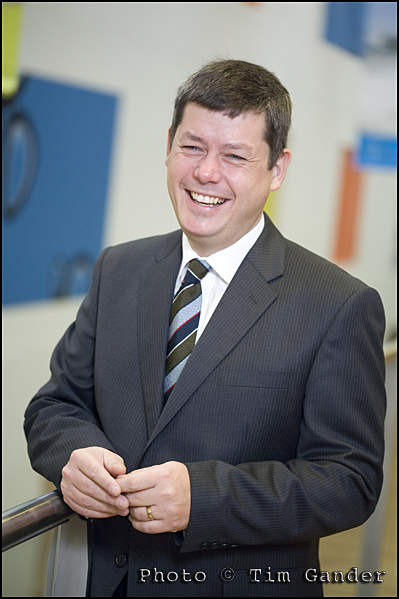
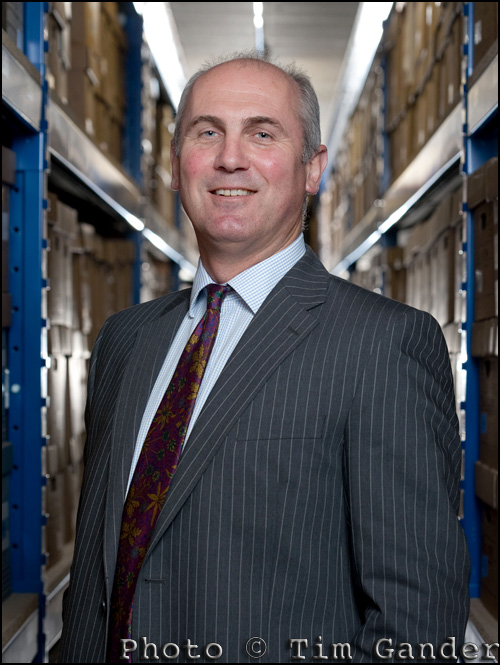
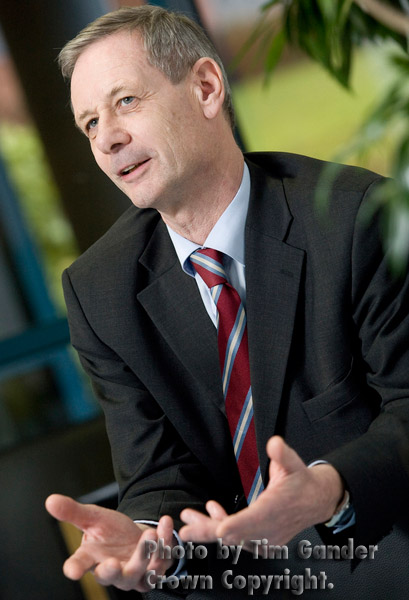
corporate business portrait of a man in a suit

Relaxed, friendly, genuine.

The article does have some useful style pointers, which merely reinforce what I already do for my clients, such as keeping the style loose, not too starchy or posed, and using depth of field to make the subject stand out from what can be cluttered surroundings (Hind talks of shallow depth of field as a shorthand for quality and I’ll not disagree with that).

The concept of believability seems strong in the article, and again I’d say that independent photographers like myself have been far ahead of the stock agencies in this regard for a long time. Mainly because we are shooting real people for real businesses, not models pretending to be chief executives.

I honestly believe that businesses and the better designers are already eschewing stock imagery in favour of presenting their true selves to their clients. I benefit from clients telling their designers they want to open up visually and avoid the “me too” look of stock.

In a world where commercial enterprise is having a bit of a PR crisis, where better to start repairing that damaged image than with the images you use to communicate with your clients?
Case Study: The Rebrand

When Somerset-based document storage company Filebase changed its name to Filofile, the time was right for a new website and corporate photography too. And I was delighted to be contacted by an equally Somerset-based design agency Cognique to do the honours with my camera.

I met Filofile’s MD Simon Barber at the premises on a lovely Autumn day last year, he showed me around, and then while he was being interviewed for a video for the new website, I set to work gathering images that would populate the new site as well as promote Filofile through all their printed and electronic media.

When a company consists of not much more than a former cheese storage shed full of boxes and some security equipment, it’s not easy to come up with a wide choice of images, but I managed to pull some interesting shots out of the bag. You can see the finished website here, but I’d also like to show you some of the shots that didn’t make the website, but which will be useful to the company for their other promotional publications.

data storage boxes

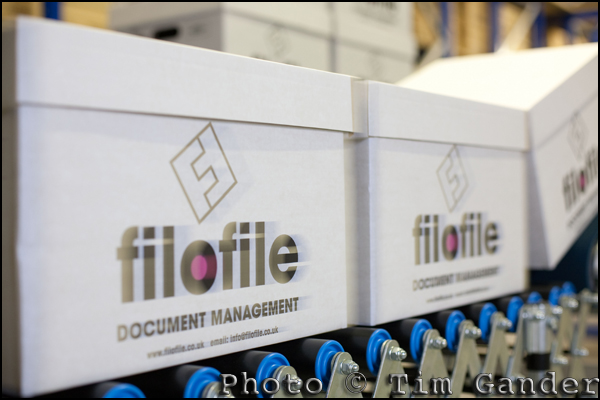
Boxes on the move (I pushed them to achieve the effect).

Filofile boxes on trolley

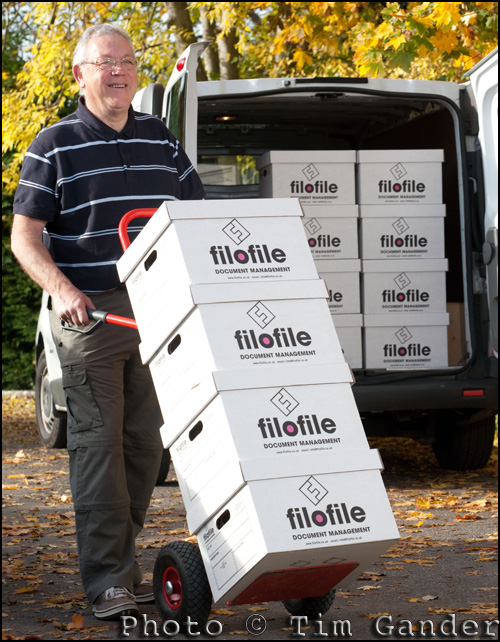
Showing Filofile at work moving documents for clients.

Simon Barber of Filofile

A portrait of MD Simon Barber, but with more of a "business pages" feel to it.

Goldilocks and the photo.

Can brilliant corporate photography save a failing business? No. BUT it will be part of what makes success easier to achieve. Conversely if a business is using snaps or stock imagery, this can be, as an American business guru might put it, a drag coefficient on your success rocket. *blech!*

I don’t pretend that the photos I take will turn you into an overnight sensation and put you in contention for The Sunday Times Rich List, but it’s fair to say that when marketing departments go to the trouble of getting a lively, engaging web design together with compelling text and a user-friendly interface, what often lets the whole project down is the lazy or cheap approach to the accompanying imagery.

call centre staff on telephone

Quality photos say “quality business”.

Head shots of key staff needn’t be cheesy, and they certainly mustn’t be low quality just because they’re going to be used small. You never know when you might need to reproduce one to a larger scale and in print, and that’s when poor lighting and composition as well as poor resolution really start to show up. The purple gargoyle look doesn’t suit anyone. Neither is it helpful if an over-compressed file leaves you looking like you have some kind of skin disease.

Photographs of products and processes, people, places (and all the stuff not starting with p) all require a level of quality. After all, shot once you can use these images over and over again and they’ll pay for themselves in time, whereas low-grade, badly taken images will simply remind potential clients how little you care for quality every time one of these photos shows up.

Equally, if you get great imagery but either don’t use it at all or don’t use it properly, you’ll be wasting your money and you’ll think it wasn’t good value. This comes back to using a quality photographer who can give good after care, and a marketing specialist who knows how to use pictures for maximum impact.

Where’s all this going? Well I believe it’s possible to overstate the importance of photography in business, but what’s happened since the mass-accessibility of digital is that things have swung too much in the other direction. General opinion is often that photography has no, or very little importance. Often I’ve seen web designers refer to the photos in their designs as “eye-candy”. If the photos are just eye-candy, why bother with any imagery at all? And why do I have so many clients if what I do has no impact on their business?

If your business uses photography it should be as a way of communicating something to existing and potential clients. Not just showing that which is in front of the camera, but the quality, composition and presentation of the photo will all be shorthand for the kind of business you are.

Now, that’s not going to save a business which is already circling the drain, but dismissing photography on your website and in your literature as “so much fluff” won’t help you to the top of your market either. As Goldilocks might have said, you need to get the balance just right.

Case Study: Conference Photography

Conference venues have had a rough time in recent years. Events can be expensive to run, and sometimes they’re expensive to attend, so where businesses have dared spend the money at all, they’ve often seen photography as a luxury bolt-on.

In my role as conference photographer I noticed a decline in appetite for this particular service in 2008/2009, but looking back over 2010 I’d say demand has increased again.

Getting quality photography at a conference has often been pretty low on organisers’ lists of priorities – that is until the conference is over and someone wants to “PR” the event. At which point they discover that all they have are some iPhone snaps which aren’t much use for anything at all except maybe viewing on an iPhone.

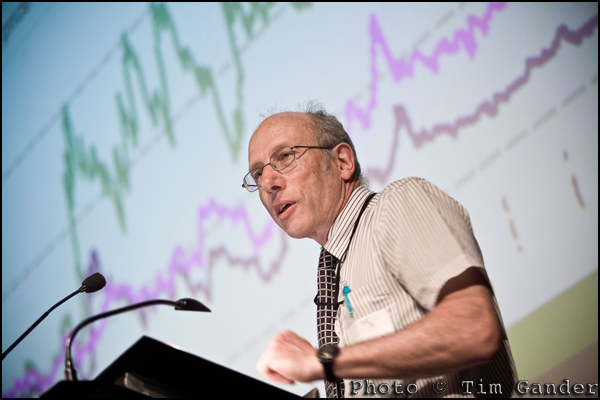
scientist delivering conference presentation

Balancing lighting on the speaker and their presentation takes some effort.

I can tell a client hasn’t given too much thought to photography prior to the event when I get the call the week before it’s due to happen to ask if I’m available and what the cost would be. They booked the venue about a year in advance. They booked the speakers, sound, lighting, video, staging, caterers, cleaners door staff etc etc. And (relatively speaking) at 5 minutes to midnight, somebody thought: “Oh! I think we might want some pictures from this event!”

Now I applaud these people for thinking so far in advance because as I said, some don’t think of it until the event is over, by which time it’s a bit too late to go back in time to shoot what should have been shot in the first place.

So if your organisation is considering a conference, which after all can reap great benefits in public relations, client relations and exchange of ideas with partners and clients, I would urge you to consider the benefits of getting coverage, and of getting that coverage done professionally.

Conferences can be very useful in that unlike most other events or times of the working year, they tend to be the one time when a significant number of staff and executives are in one place at the same time. So think about getting fresh headshots done – a small setup in a side-room or quiet corner is ideal for this.

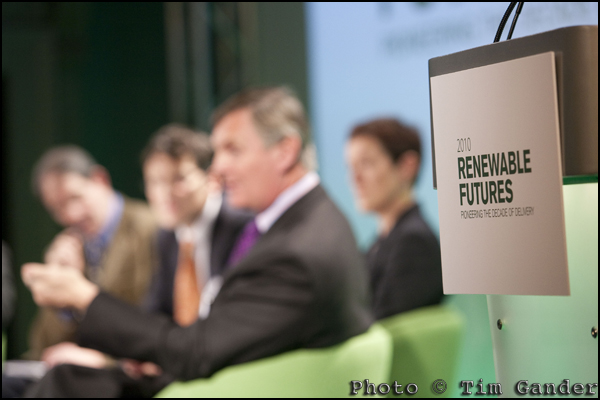
Regen SW conference debate in Bath

More obscure shots can be useful later on.

A conference with industry-wide or even public interest, has scope for extensive PR. Pictures of key speakers talking passionately at the lectern, or as a panel of experts can add spontaneity to what might otherwise be a dull PR shot. For other PR uses it’s handy to get a relaxed portrait of key speakers at the venue, perhaps with relevant props visible in the shot.

Employing a professional (like wot I is) means not only will you get the vital shots you need, but you’ll get quick turnaround and you’ll also get the shots you never even realised you needed. Those little details that others would walk past, but which come in handy for future uses such as brochures, annual reports etc.

Of course you might find you have a keen photographer amongst your staff, but do they know how to handle the difficult lighting at these events? Balancing light on the speaker with the slide behind them isn’t always easy. They’ll also tend to miss the details I mentioned, and they often can’t turn the work around quickly. Finally, using a member of staff is all very well, but shouldn’t they be paying attention to the conference rather than the settings on their camera?

I cover conferences of all sizes, taking pictures which clients can then use for internal and external communications, press releases, websites, brochures, future presentations; the list is limited only by one’s imagination. In terms of cost, the photography has to be one of the better value ingredients of a good conference. The food can only be eaten once, while the photography can be used again and again, long after the taste of plastic ham sandwiches and greasy tea has passed.

Photo case study: Location portrait.

I’ve written before on the subject of Photoshop, the pitfalls, dangers and terrors, but “meh”, nobody listened so I thought I’d show a recent example of where I have used some photo manipulation to benefit the final photo.

You see when I shoot for corporate clients, I prefer to get things pretty much spot-on in the camera, rather than taking any old muzzy smudge and hoping I can sort it all out later on the ‘puter. I have heard tales of “professional” photographers who work this way, and it tends to end in tears and a lot of wasted CEO/staff time, not to mention the wasted marketing budget, because by the time somebody has spotted that the Emperor’s new clothes are in fact a figment of the imagination, the cheeky little monkey with the winning smile and the expensive looking camera has caught the next plane to Rio with the company cheque already safely banked.

I digress; back to Photoshop, or to use the verb form, “photoshopping”. Not to be confused with the act of shopping for photos.

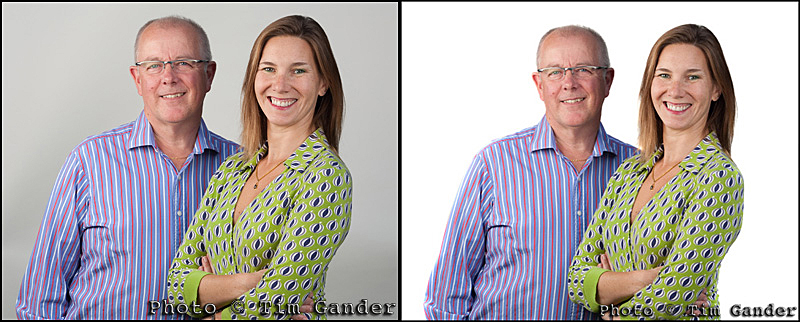
In the case where I was asked to get a website cover shot for Clucas Communications the brief was to get a double portrait of Peter and Sibylle Clucas against a white background so the designer could either leave the subjects against white or undertake a cutout more easily. In the event the final shot is used as a cutout against a white page, which works well.

That would seem easy enough, except that the shooting conditions were tricky (to get enough space we ended up setting up the shot outdoors with portable background and lights), so these were not perfect studio conditions. My one compromise then was that I knew I could get the background white-ish, but it wouldn’t be fully white as if we were in the studio with perfect lighting.

Below are the results, and the sharp-eyed among (amongst? amo amas amat?) you will notice that pretty much all I’ve done is go at the background with the dodge tool to lighten the highlights (only affecting those areas which are already almost white) to achieve a perfect whiteness any soap manufacturer would be proud of.


before and after photoshop examples of corporate portraits

Spot the difference. Can't see it? Oh well...

And despite the fact that most weeks I’ll have to listen to some smart Alec or Alice telling me what I can fix in Photoshop, I still stick to the principle that for my work, Photoshop is great for removing the dust spots that are the curse of the digital SLR and correcting the odd colour cast and generally preparing an image so that it is technically viable for either print or web. I’m not going to make a rainy day sunny, or drop the Taj Mahal into the background to make the view from your office window look more interesting. If that’s what you’re after, you’ll be wanting a different breed of photographer. One that will probably be in Brazil by the time you realise those “interesting” photos are in fact junk.

Photo case study: Group work.

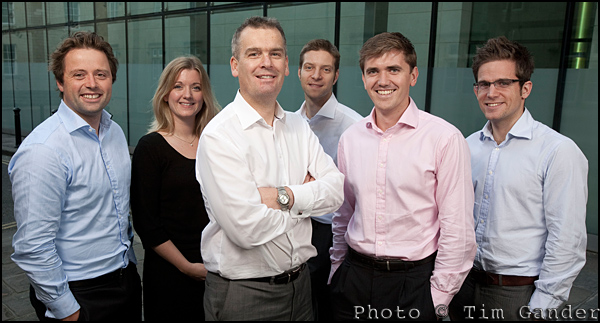
corporate group photo in Bath

The team look relaxed, even though we’re shooting outdoors.

Perhaps the least well-understood area of corporate photography is the group shot. So often the result looks like the subjects have been forced against a wall and are about to be shot for desertion, or they’re lined up like in a wedding photo, minus the bride and groom and not even a slice of cake as an incentive to be there.

There is often no thought to style, composition, lighting or location, or real idea of why the photo is needed in the first place. Just a vague notion that a group shot would be a “good idea”.

Of course the alternative is to buy some random group pic off an internet photo library, but the saccharin smiles, the unrealistically beautiful people – your clients know it’s not you or your business, they’re no fools.

To be fair, the corporate group photo can be quite a challenge because there are lots of busy people to bring together at one time and on one day, and in all likelihood there will be little time to take the photos, added to which; who here likes having their photo taken? No, I didn’t think so.

Then there’s the lighting, location, wardrobe decisions. If not planned properly, it can all get a bit fraught.

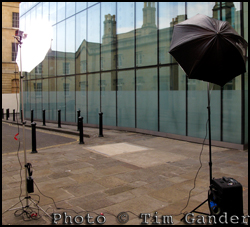
mobile studio photo lighting

Using mobile studio lights gave the photo a more polished look.

So I was pleased to get a call from a long-standing contact, Corrina Cockayne at Target Chartered Accountants in Bath, who was organising a group photo for the corporate finance team. I say pleased, because I knew Corrina would be organised and efficient and would have thought about why this team shot would be useful. In this example, it had been a while since any PR had been done and the team had evolved quite a bit.

The plan was to use an outside location in Bath, and Corrina was already thinking along the right lines – considering what people would wear, what the background should be and getting in touch with the council to check for permissions etc.

My job was to liaise with Corrina, talk over the options for locations and lighting, scope out the location before the shoot and be there in plenty of time to set up and take the photos before the group arrived. I wanted to keep their waiting time to a minimum.

Because of the constraints of the location, I couldn’t spread people about too much or I’d risk all kinds of distractions in the background, but I knew the lighting was going to make this group shot stand out from the usual Crimewatch lineup.

In the event, even though it was “just” a group shot, everyone put in a  good effort and wore their best smiles, and the end result reflects the approachable professionalism of the team. A good example of how a group shot can work and be a useful asset in the client’s photo library.

Case study: Just say cheese!


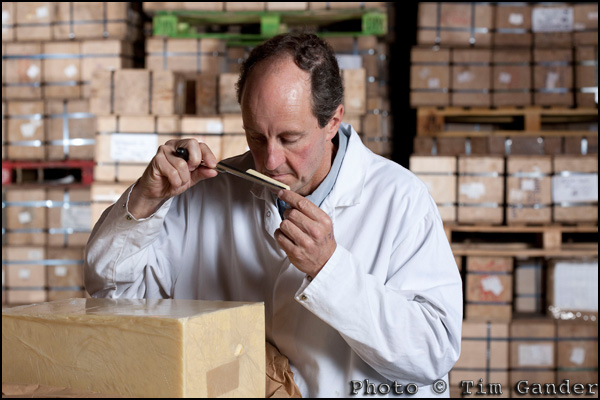
cheesemaker taking sample from cheese block

Dairy products director Simon Clapp takes a cheese sample.


Mostly I use this blog to “air my views” on whatever has occurred to me that week, but this week I’d like to offer you a case study from an assignment I shot earlier this year.

Corporate and commercial photography doesn’t always have to consist of serious suits looking stern, important or entrepreneurial across a boardroom table.

As this set of pictures shows, sometimes I can be called upon to take pictures of a different kind of entrepreneur. It might not be obvious that that is what they are, but although the Clapp family business has been farming this site on the Somerset Levels for generations, they continue to pioneer new working methods and products while keeping their cheeses very traditional and authentic.


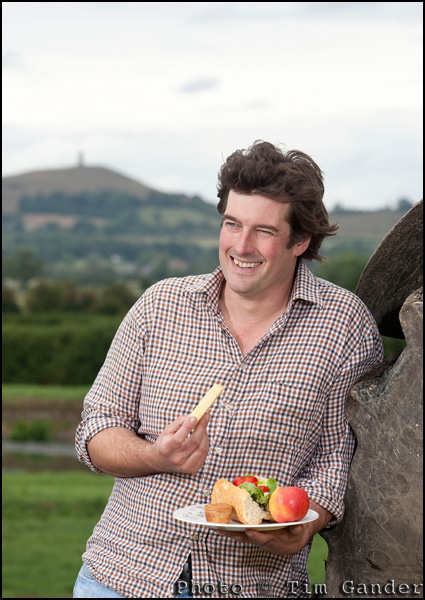
cheesemaker eats cheddar in view of glastonbury tor

Farm and dairy herd director Rob Clapp enjoys a ploughman's with a view of Glastonbury Tor.


For this shoot I was asked to produce a small set of images suitable for inclusion in food and lifestyle magazines and general press releases. The brief was to create a “hero shot” of each of three key players in the operation; the brothers who own the business and the head cheesemaker. Of course I would have happily photographed everyone involved, because in this kind of business every member of the team is vital, but we only had limited time and only so many images would get used.

The purpose of the pictures wasn’t to record the daily working lives of the cheesemakers in a strictly photojournalistic way, but to represent them in more of a magazine style, where I had freedom to choose settings and use additional lighting to give the pictures a more polished look.

I couldn’t have been more thrilled to work with these people. I had a warm reception from the start, a chance to watch cheese being made, and got to taste some of the most fantastic Cheddar cheese ever to pass my lips – I’m a sucker for a proper mature Cheddar, not the stuff imported from Canada which just has the word “Cheddar” written on the pack, but the kind that comes from local producers who know how it’s done. The taste is incredible as it evolves in your mouth.


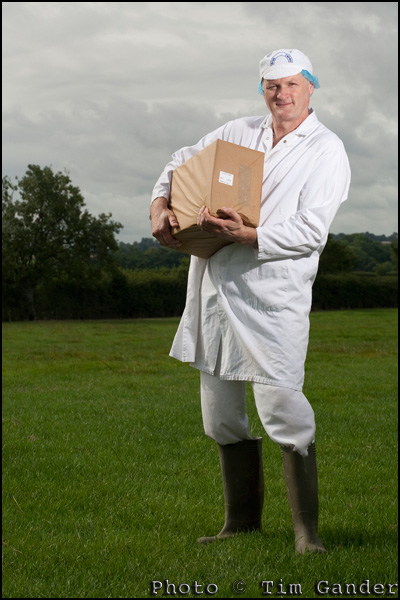
cheese maker holding cheddar cheese

Cheesemaker Billy Melluish does well to pose holding a 20kg cheese.


Anyway, back to the photography. I won’t bore you with details, but in essence it involved choosing suitable locations, getting the portable lights set up and adjusted and getting the shots done as efficiently as possible so as not to disrupt the working day too much. Plus I had to work fast as the weather was threatening to turn moist so I needed to get all the outside shots done before I could turn to taking pictures in the warehouse where the cheese is matured, tested and stored until it’s ready for despatch to the shops.

If you like good cheese, I strongly recommend seeking out some Brue Valley Cheddar at Marks and Spencer, or you’ll find it as Pilgrim’s Choice Farmhouse Reserve in Tesco’s.

If you enjoy seeing case studies, let me know and I’ll do more.

Face Up to Portrait Fears

Recently I’ve been asked to shoot a lot, and I mean A LOT, of corporate portraits for many different clients. It tends to go like this; slightly nervous office staff shuffle into the broom cupboard I’ve been assigned to as my portable studio for the day, and I have to stop them hyperventilating with fear at least until I can get a nice photo of their smiling face, preferably with eyes open and a minimum of sweat shine on their noses.

I understand the fear. I too am not delighted when someone points a camera at me, so I feel their pain. That’s why I try to settle the sitter, crack some bad jokes, and be as quick as possible.

However, there is another way. Not to say that the standard portrait isn’t important and useful, but if you’re trying to arrange a photo shoot for a collection of colleagues who break out in hives at the thought of looking into my dead, glassy eye, perhaps the candid portrait would be a better option.

In this scenario you can gather a selection of people around a table and get them chatting while I work around the group, capturing smiling, positive expressions. Lay on some coffee, biscuits (cookies for our American friends), or water and let people chat, relax and forget that I’m there. They might use the time to discuss some project that they’re planning, or just have a bit of a social. Within minutes they’ll forget I’m there, and it’ll show in the photos.

relaxed corporate portrait

Chatting to a colleague takes the mind off being photographed.

Another option is to have colleagues come to me in pairs. One of the pair will be photographed while the other chats to them, tells jokes and makes them laugh and interact. They won’t be looking into camera, but as with the round-table discussion shots it’s a way of relaxing people into the photo session. It creates more dynamic images which can be useful for more than just the About Us section of the website, and you’ll have a broader choice of angles and expressions so pictures on the website can be periodically refreshed, and pictures in a brochure can be different from those on the website.

In any event, I can always finish off with a final shot to camera, by which time the sitter should be relaxed enough to give a more natural smile.

I’ve blogged before about why decent portraits are important, but at the risk of repeating myself, these photos are generally used on business websites in the About Us section, or in corporate literature. They are the World’s window on the people that make up the business and those photos are the first impression anyone gets of the business. The photos will be used repeatedly and different contexts, each time making a first impression on someone new. So if you’re going to spend good time, money and fear on corporate portraits, consider the options I’ve set out. It really doesn’t need to be as painful as route canal work. At least not always.

Ah, the jet-set lifestyle…

Being the top-end commercial and corporate photographer that I am, you can imagine all the pampering I get.

My clients delight in sending me chauffeur-driven cars to take me to the heliport so I can be flown in style and at the greatest possible speed to my next assignment. The girls on-board the flight spoon feed me the finest caviar while massaging my temples so that I arrive relaxed and ready for anything.

If only…

Of course the reality is much more down-to-earth, but you know I wouldn’t enjoy knowing that my mode of transport was powered by liquidized baby Pandas while the inflight meal was the result of nine-year-old girls squeezing eggs out of fish for a penny a day (and that’s the middle-management wage for the fish-squeezing industry).

So I pootle along to my assignments in my trusty, and actually rather economical, diesel Ford Focus. Another Panda gets to live, a fish gets to lay its eggs where fish eggs should be laid, and the circle of life remains largely un-interrupted by my activities (until I hit a pheasant on a B road, which is always a bit distressing).

I’m the kind of person who is pathologically early to assignments. I’m either ten minutes early (rare) or, more commonly, an hour early. Well, it gives me time to find the last parking space in the universe and work out the mathematics of 20p for every 12 minutes at the parking meter, discover I need a small mortgage and a hundred weight in £1 coins to park the car long enough to cover the hour that I’m early, plus the 4 hours I need to do my job, at which point I discover the maximum stay is 3 hours with no return allowed before the next equinox at which point my head explodes and I start to daydream of helicopters, caviar and temple lobe massages.

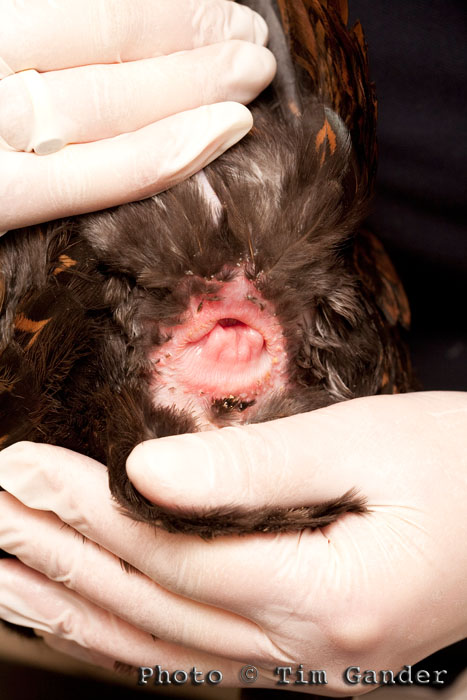
chicken's arse

I’ve photographed some weird things, including a chicken’s bum for thechickenvet.co.uk

All this stress is more than made up for though by the joy of making pictures and pleasing my clients (aw). And even if most of my work seems routine when described in terms of portraits, people at work, processes and the like, believe me nothing is ever routine. It may not all be glamour and excitement, but receiving an enthusiastic response to my photos makes it all worth while. And sometimes I get to do some really fun stuff too. I get to see things not many people see. Some of which I would tell you about, but it’s top secret and it would take me too long to kill you all.

So next time you want to lavish me with helicopters or First Class travel, save your fish eggs, dancing girls and gift boxed Rolex. A parking space will do nicely.

I’ll be away next week, but will return refreshed and ready to blog again.

Take care, each and every one of you…

How big is the ideal chip?

Which do you prefer? Big, fat, crunchy chips, or crispy, delicate, skinny fries? Personally I go for either, so long as they’re cooked well and not dry and mealy.

Of course this is a clunky metaphor for the chips in digital cameras, a subject I’ve covered before, but this time I’m going to demonstrate the difference between a large chip on the Canon 5D (identical in size to a 35mm film negative) and the smaller chip in the Canon G11 compact camera and how this relates to depth of field in photography (how far behind and in front of the point of focus is also sharp). Now bear in mind I’m not talking about the pixel count, but the physical size of the chip.

Also, this isn’t a camera review. You can read dozens of those on sites such as dpreview.com which do a grand job of organising all the geeky info, doing bench tests and what-have-yous. I merely want to show the difference that chip size has on how pictures look.

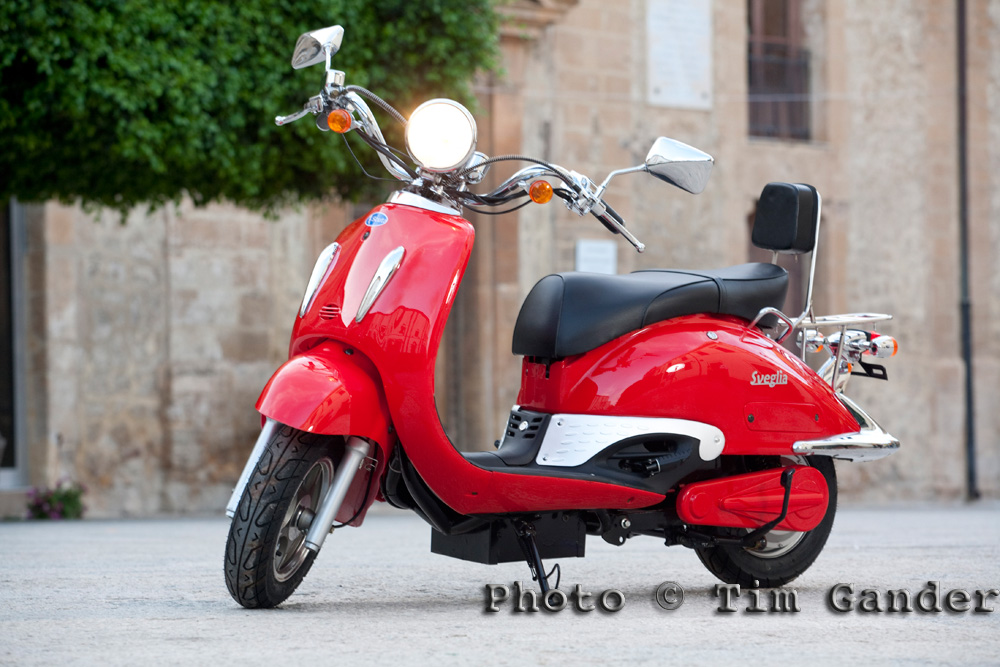
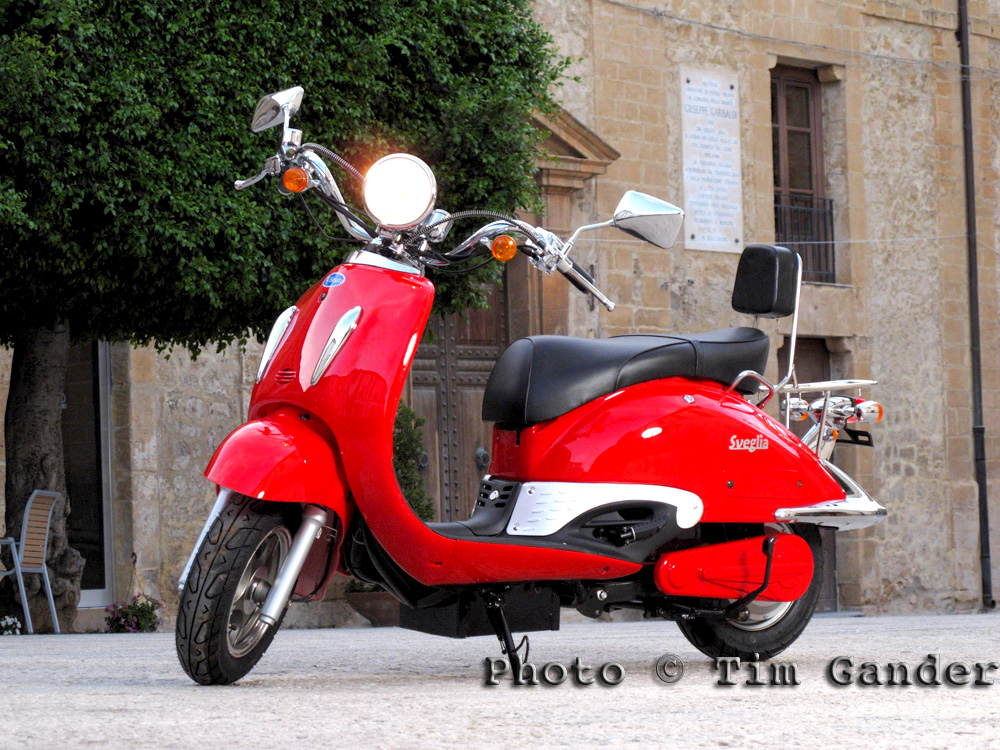
So to continue the foodie theme, let’s get to the meat of the issue. Here you see two very similar photos. One taken with the Canon 5D (a full-frame SLR) and the other with the G11 compact camera.

commercial photo of electric scooter in sicily

Canon 5D background is softer.

Electric scooter in Sicily

G11: Background is clearer.

What you’ll notice is that the background in the shot taken with the 5D is much more out of focus than the shot taken with the G11. Factors which affect this depth of field are aperture, lens focal length and chip size.

The focal lengths aren’t massively dissimilar; 135mm on the 5D, 115mm on the G11, and the apertures are f5.6 and f4.5 respectively. But the biggest influence on making the bike “pop” out of the background is the effect of the chip size on depth of field, and this is where the D5 has more control. Not necessarily a bad thing that the G11 will always have a deeper depth of field. It means more of the bike can stay sharp, while the lens can use a larger aperture and gather more light to gain the same exposure.

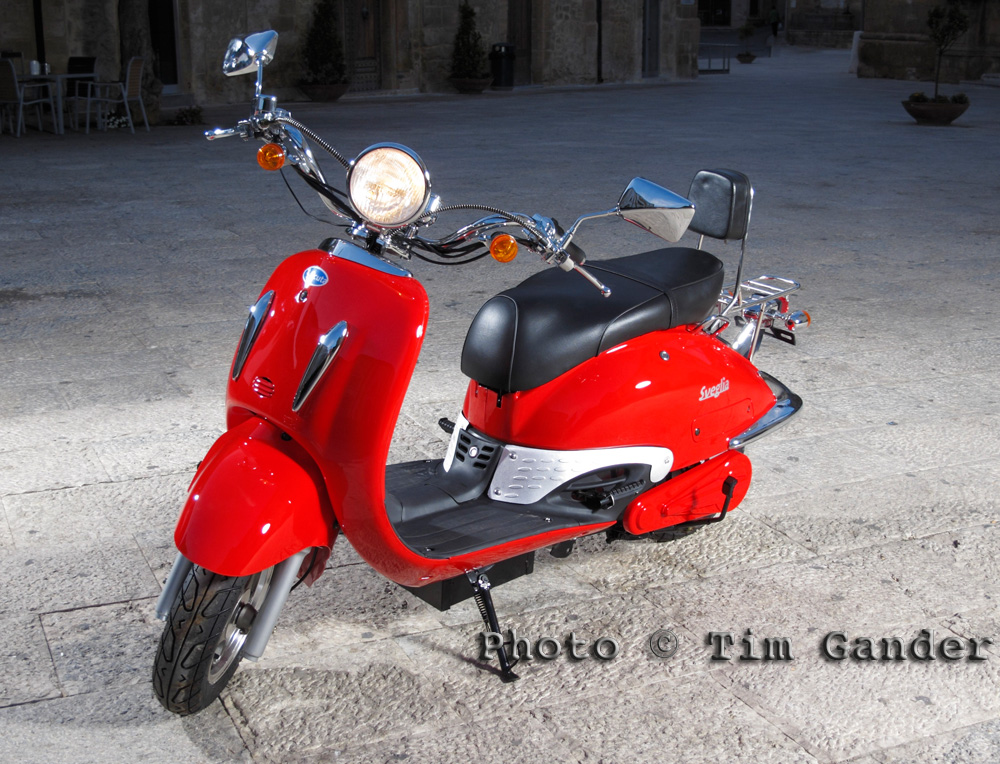
Photographers will use a fine depth of field to emphasise certain elements of an image, but other tricks can be used when you have less control of depth of field, such as switching to a more dramatic lens angle and simplifying the background, which is what you see in the photo below.

electric scooter in sicily

G11: Change of angle + darker background = more drama.

I said this isn’t a camera review, but I have to say I was very impressed with the G11 once I’d learned how to squeeze every ounce of quality out of its tiny chip. It’s not as quick as an SLR, but if you can anticipate well it’ll give you results you’d find surprising. I love that I can trigger my portable studio lighting using wireless triggers on the G11’s hotshoe, and that I can fire flash at higher shutter speeds than are available in normal flash modes on the D5. The only downside is that pulling the image up to 100% on screen shows the quality difference between the G11 with its tightly packed 10 million pixels, and the D5 with 12.8 million with more room to breathe on a bigger chip, but for web images it’s stunning.