Back to the Future

While Marty McFly’s time-traveling DeLorean might still be a thing of science fiction, there’s still plenty of scope for Doc Brown-style WOWs! at IAAPS, including a gull-winged test car. This time though, it’s a BMW. Probably somewhat more reliable than a DeLorean, albeit lacking a flux capacitor.

Instead of Doc or Marty though, it was the turn of Helen Godwin, West of England Mayor, to be wowed by the work going on at the propulsion systems research centre near Bristol.

No Need for Roads

The purpose of Helen’s trip was to discover more about how IAAPS and University of Bath work to connect research with industry, creating real-world benefit from what could otherwise be siloed into pure academic study. Also to then explore how this work can be used to help promote the region to the wider country and indeed the world.

My humble task, as I have done on previous occasions, was to document the visit and generate media-ready images to help get IAAPS’ and the Mayor’s message out there.

With this kind of event it isn’t always easy to encapsulate the entire message into a single image, or even a handful of them, but it’s also not good enough to just hang around with a camera and hope something presents itself.

So my strategy on this kind of job is to be the fly on the wall, but with an eye for an opportunity to step in and arrange (with the lightest possible touch) a picture which looks natural, includes key people while also helping to tell the story.

Of course moments such as when Helen was in the driving simulator always make for a good photo, but it’s in the test cells that the story becomes somewhat clearer, visually at least.

Back to the Future, or Back of the Heads?

The only problem with taking photos of people looking at things is that you either end up with photos showing the the they’re looking at (but you just get the backs of heads of the on-lookers), or you see the people doing the looking, but now you can’t see what it is they’re looking at.

On this occasion I stepped in and asked that for a few moments at least, they discuss the car and the test cell, while pretending there was something more interesting than an observation window behind me. With the cell and test vehicle behind them, I could get a photo that made it look as though they were engaged in lively discussion, I could see their faces and gesticulations, but also that sense of what it was they were talking about because the background is part of the illustration.

Beware the Brand Hammer™

There was also a handy bit of branding in there too (note the number plate), but the branding is there without being ‘in your face’. Too often PRs will insist on plastering their client’s branding all over a photo, but this often dilutes the impact, and a picture without impact will be ignored. So beware the Brand Hammer™!

All of this is to say that with an event such as a VIP visit, it’s worth thinking ahead about how key images might be engineered to happen. Of course you can’t always plan things to the smallest detail, and sometimes I’ll need to step in and gently guide people to make a more complete picture, but having a key moment or two when the proceedings can be paused and adjusted to make more compelling images is never a bad thing.

It’s always a balance between micro-managing and under-planning, but if in either case the pictures don’t happen, you can’t get into your DeLorean to zoom back and do the job again. Even IAAPS aren’t working on that!
 

A Long but Fascinating Day of Acronyms

If it seems like I’ve gone a bit quiet lately, it’ll be because I’ve been anything but quiet lately.

A prime example is last Wednesday, when the UK Government’s Chief Scientific Adviser (CSA) Professor Dame Angela McLean visited University of Bath to see how their research is achieving real-world impact across a range of sectors.

Beyond a handful of set-up group photos, my role was largely as a fly-on-the-wall (FOTW) photographer recording Professor McLean’s visit through the day – and boy, was it a long day!

It started at the Institute for Advanced Automotive Propulsion Systems (IAAPS) at Emersons Green, Bristol. In short, IAAPS is where engineers and designers can examine new forms of propulsion, or improve traditional ones (for example, improving fuel efficiency in internal combustion engines). There’s a lot of exciting work into hydrogen propulsion going on there, and Professor McLean got a good look behind the scenes at the state-of-the-art facility.

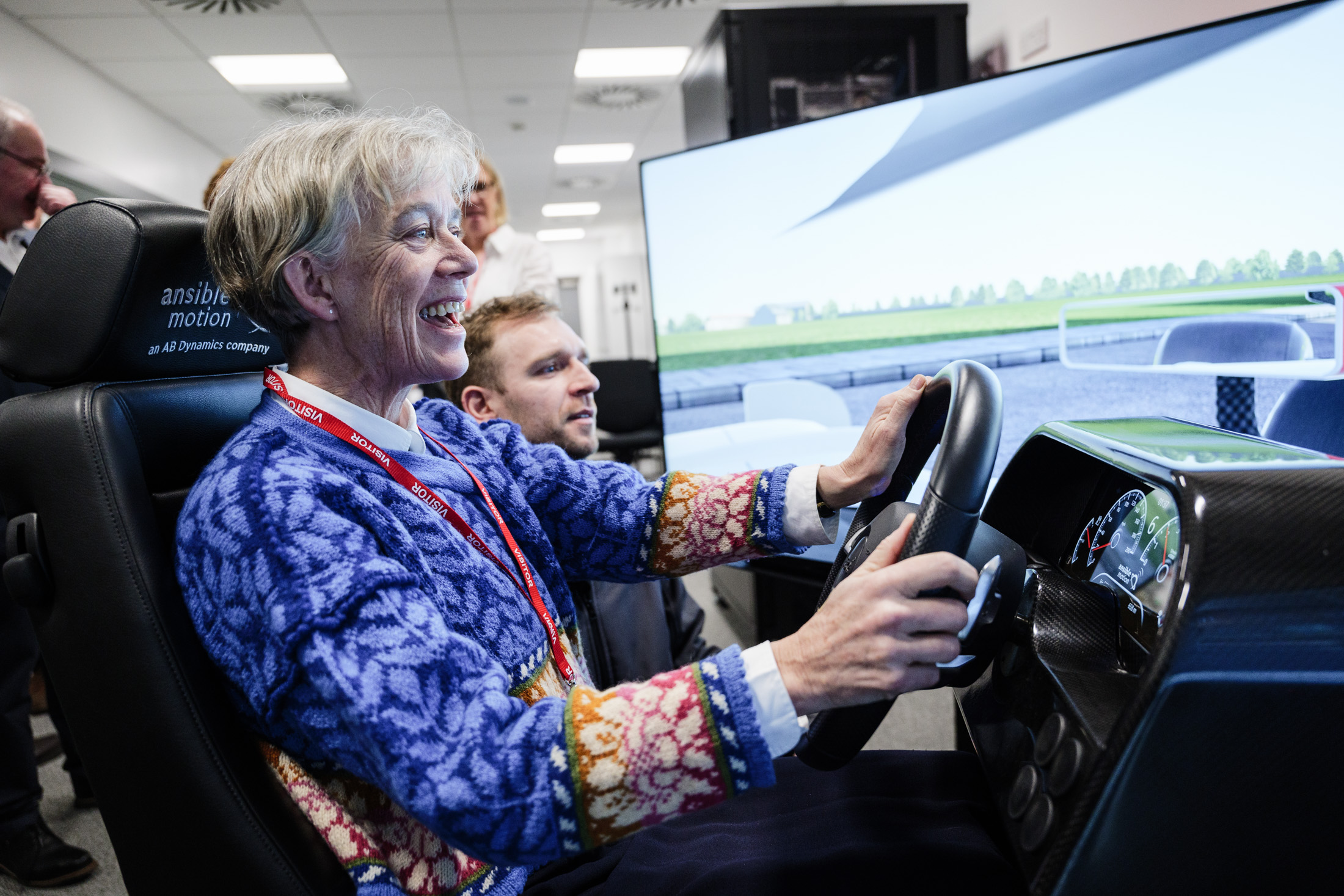
In fact, it resulted in one of my favourite images from the day, with Dame Angela clearly having a hoot on the driving simulator.

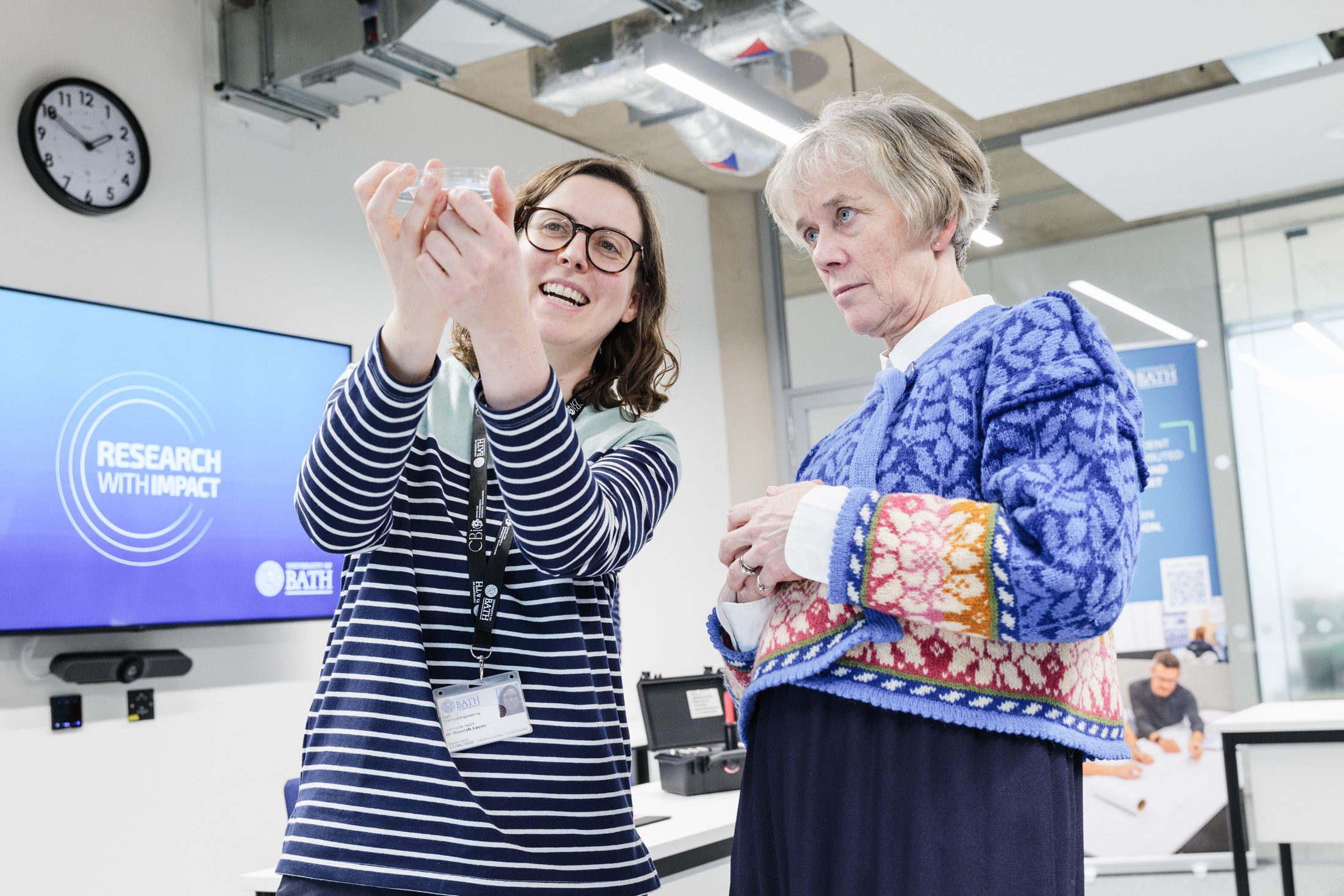
After a couple of hours at IAAPS, the visiting party moved to the University of Bath’s Claverton Down campus for a whistle-stop tour of a variety of laboratories and research demonstrations. Again, one of these resulted in another favourite image of the day, that of Dr Hannah Leese, a Reader in the Department of Chemical Engineering whose research covers nanostructured membranes and nanofluidic transport (you asked!).

As she shows Professor McLean a dish of microneedles, you can see the excitement and pride in her work.

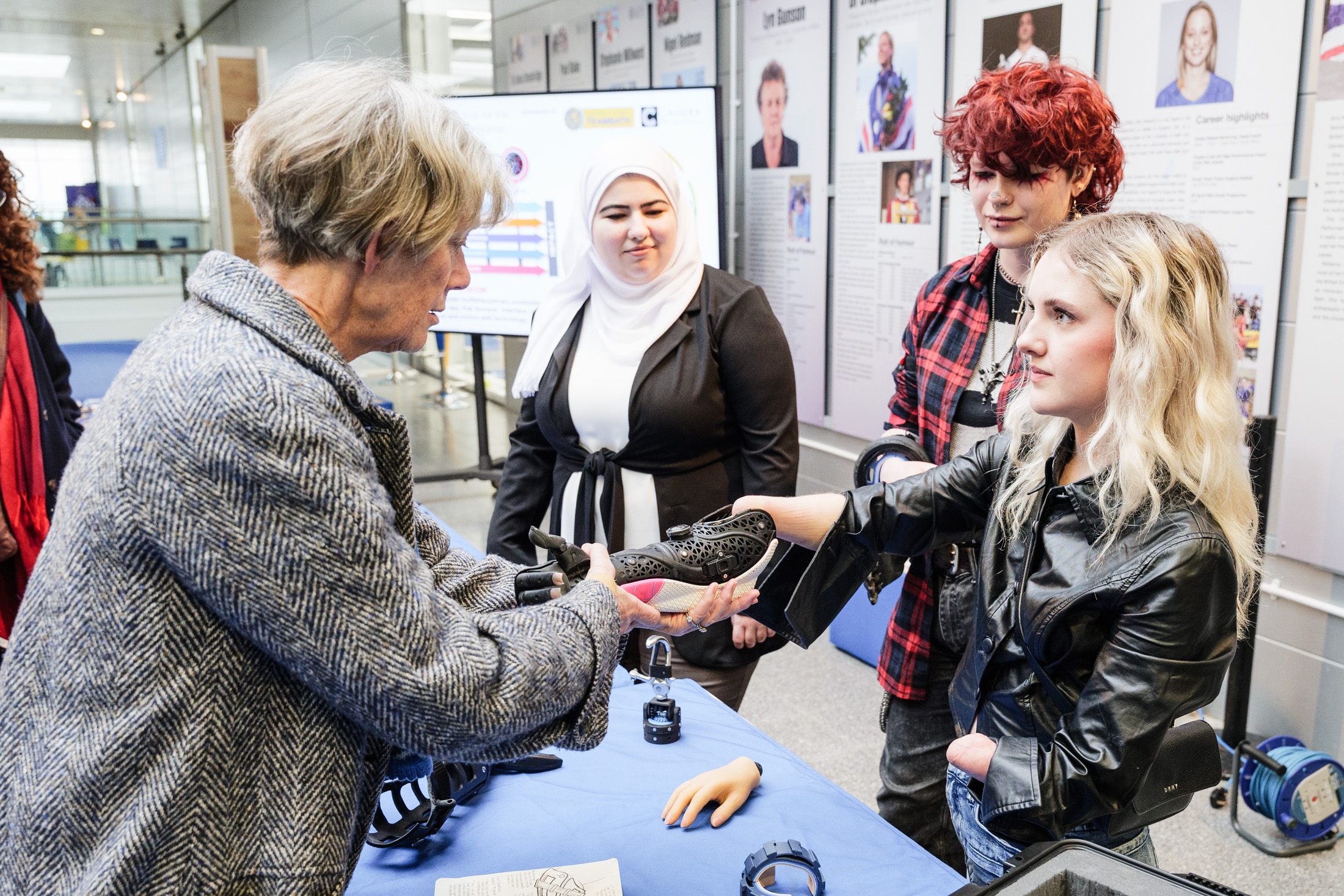
There were further tours of incredibly impactful research, including that into the augmented human where Professor McLean was shown (amongst other things) the huge advancements in prosthetic limbs, such as hands which respond to users’ commands.

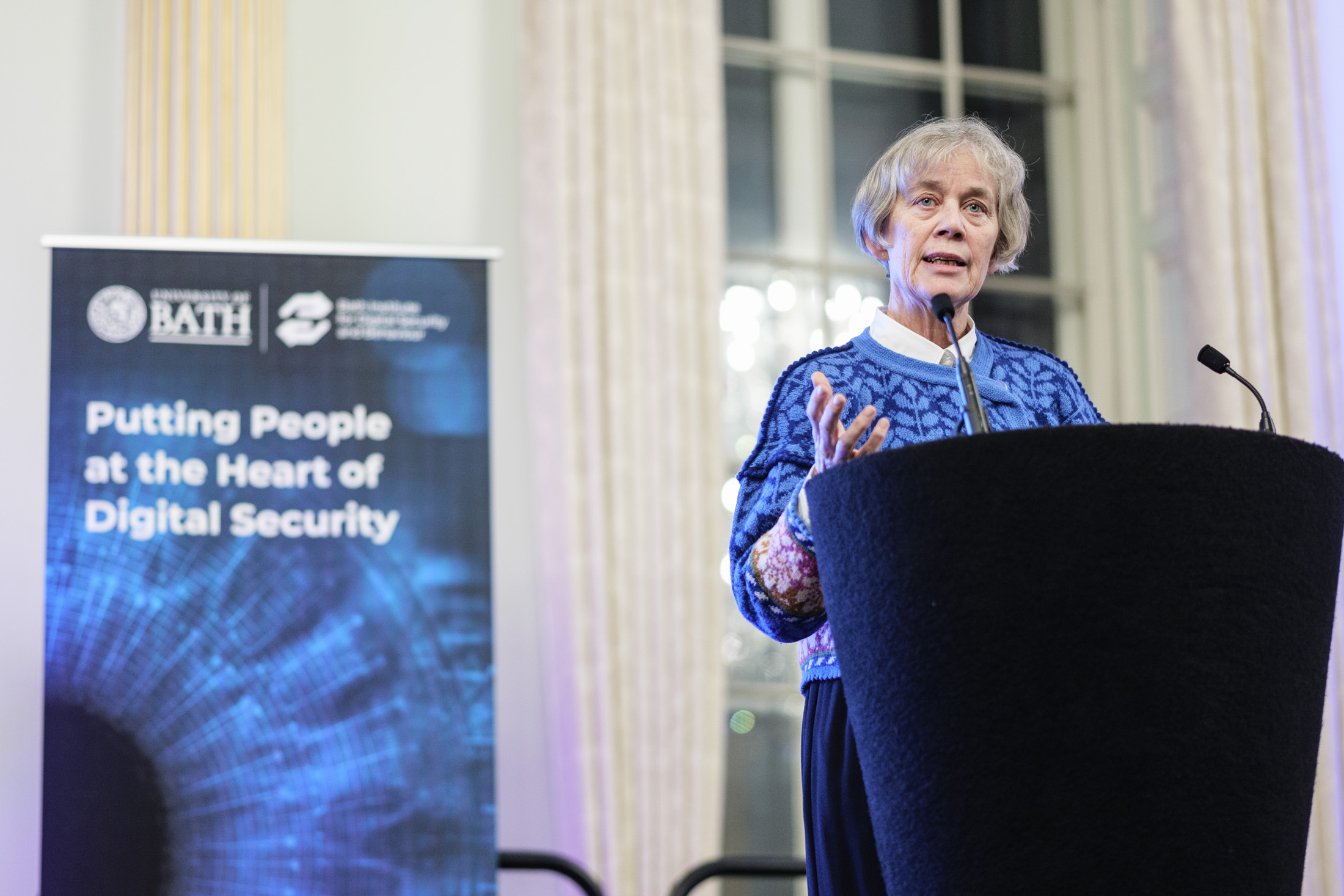
Also part of Dame Angela’s itinerary was a tour of the labs at the Institute for Digital Security and Behaviour (IDSB) and a round-table discussion on Climate Resilience and Adaptation. But as if that wasn’t enough, she went on to officially launch IDSB that evening at Bath’s Guildhall.

In IDSB’s own words, “The primary objective of the Institute for Digital Security and Behaviour at the University of Bath is to respond to the evolving security risks to – and from – digital technologies from a socio-technical perspective.”

For this segment I needed to get usable pictures of the various speakers, some group photos, plus the general flavour of the evening.

On reflection it was a pretty long day, but fascinating, and I could see that in spite of having travelled from London that morning (and the prospect of having to travel back that evening), Professor McLean had thoroughly enjoyed the experience.

My work didn’t quite end at The Guildhall as I needed to turn images around for various communications teams at IAAPS and the university so they could get their social media feeds updated first thing the following day. So the evening stretched on a bit, but it was good to get the image files securely backed-up anyway. The following day I completed the full edit and delivered the rest of the images for on-going corporate communications purposes.

So a long day for all involved, but while I could have passed the evening segment to another photographer, I wanted to see the job through from start to finish and bring continuity to the coverage. It also meant one less complication for the organisers!

Royal Visits Invictus in Bath

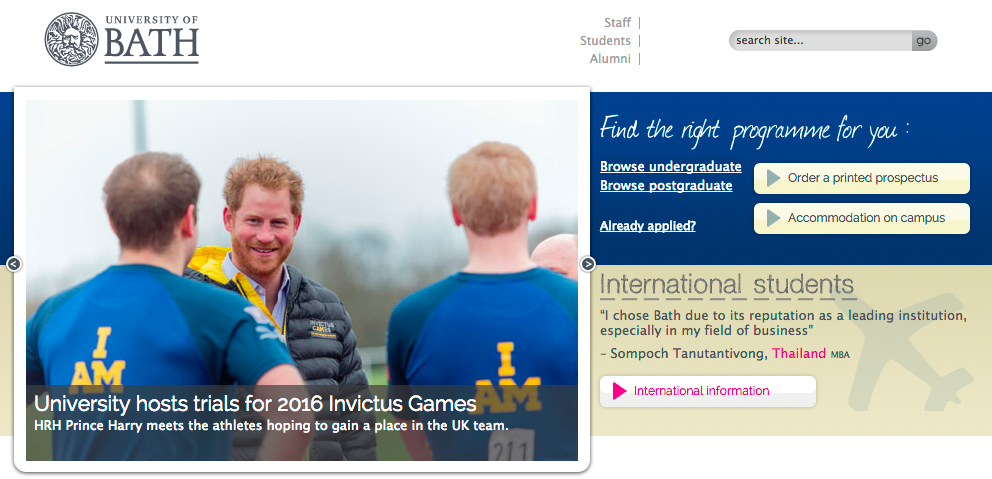
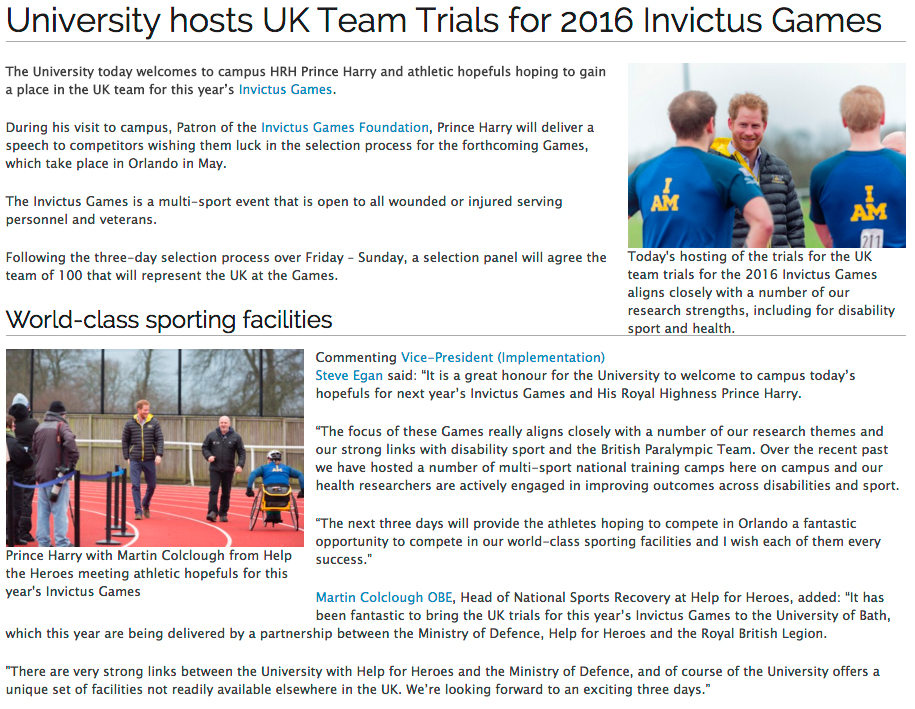
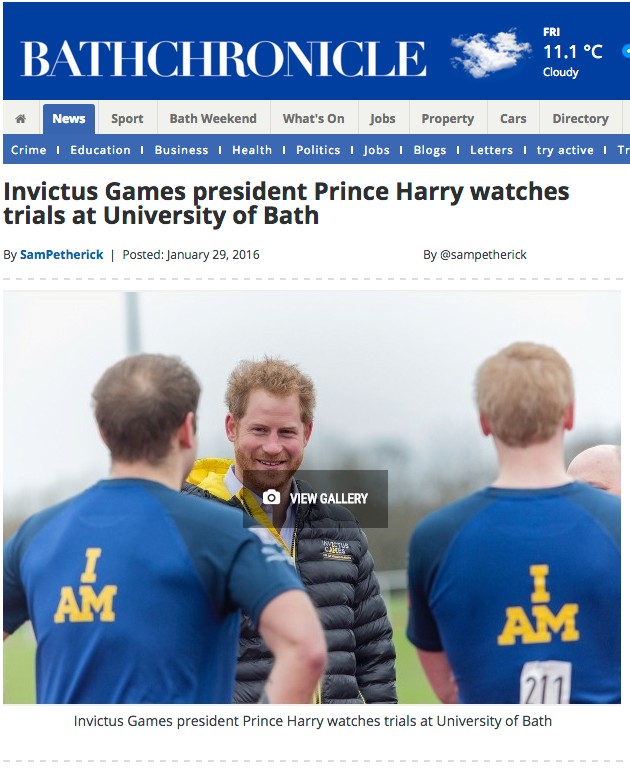
Royal visits are a unique kind of photographic assignment, as I was reminded when Prince Harry visited University of Bath on Friday for the trials of the Invictus Games which take place in Orlando, Florida, in May.

I stepped into the assignment at fairly short notice due to the university’s staff photographer being laid low by a stomach bug – you really can’t cover an event like this if you’re feeling queazy!

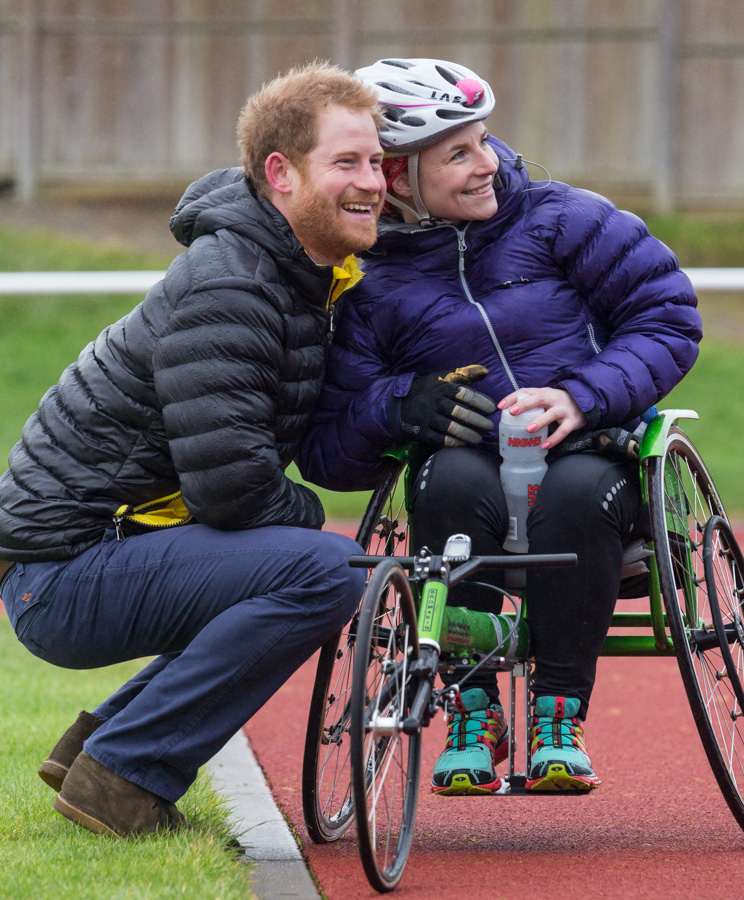
Prince Harry was visiting to see UK athletes taking part in the trials and of course help to raise awareness of the games which were founded to give injured, wounded and sick military personnel a chance to test their sporting skills to the highest standards.

My role in covering the visit was to get pictures the university could use the same day on their website and for press release to showcase the fact they were hosting the trials at their excellent Sports Training Village.

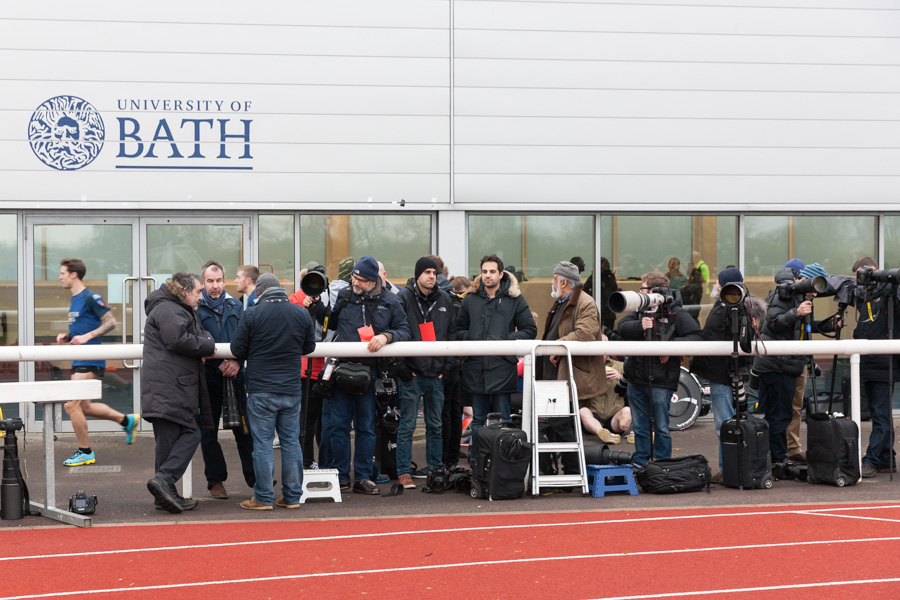
I wasn’t sure what to expect when I arrived at 9am, but pretty soon a fairly large contingent of press photographers had gathered in the briefing area. Harry was due to arrive just after 11am, so once all the press photographers had gathered, we headed track-side for further briefing and to choose our positions.

Please click photos for a larger view:

My pass was for the outdoor fixed positions, which meant I could move about within certain areas. Other photographers had Rota passes, which is the Royal press office system for ensuring an event doesn’t become clogged with photographers. Those carrying a Rota pass will often have greater, or extended access to an event, but they will be required to allow use of their pictures by any legitimate media outlet that requests them.

Even before the arrival of the Prince I made sure I was getting on with fulfilling my brief; getting shots of the gathered media to show the wide interest and shots of athletes warming up or taking part in trials.

The weather was blustery, sometimes raining and not fantastically warm, so it was a relief when the Prince arrived on schedule. The Royals tend to be fairly prompt unless they’re coming from another event. If that overruns, you just have to be patient and ready.

To cover the Royal visit as he moved around the Sports Training Village running track, chatting to officials and athletes, I worked two camera bodies; one with a wide zoom on and the other with a telephoto zoom (with a 1.4x extender attached for extra reach). Since most of the action was happening at quite a distance away, the long end of my telephoto lens was a godsend. I could see plenty of the other photographers had their huge 500mm and 600mm lenses and were using them a lot, while I had to make the best of my zoom and just make sure I had clean shots I could crop into. I really didn’t need to see into Prince Harry’s soul for my purposes, so it was all fine.

I took my last frame around midday when the facility for Fixed Position passes ended and the Prince went indoors to continue the tour. That was my cue to get my laptop and edit a selection of images for the university homepage news feed and a news article. The rush pictures were chosen, captioned, edited, delivered and added to the website well within the hour. I could then leave the campus, head to my office and do a more considered edit on my large monitor and the job was done.

Royal visits are often a case of “get what you see.” Not much tends to be set up specifically for stills and this leaves you looking for compositions which are tidy not because you set them up, but because you’ve chosen a good position and the composition happens to come together nicely. Expressions will be fleeting and you have to be ready with your camera to capture them, which is why it often looks like Royal photographers never take their eyes from their cameras – they can’t afford to miss a shot.

On this occasion I was surrounded by photographers who shoot a lot of Royal events. Some travel the world with the royals and have built entire careers doing this. For my part, I’ve covered a few Royal events over the years, but it always makes a refreshing, adrenaline-fuelled change from the norm. I shall look forward to the next one.


Dairy Diary Date

Saturday 12th September was blessed with surprisingly kind weather, even more surprising because I had an assignment which very much relied on being outdoors, which of course normally means torrential rain has been predetermined.

On this particular day though, I arrived at Littlewood Farm in the village of Frampton, near Dorchester, in brilliant sunshine to cover a sort of open farm event. I say sort of because this was open farm by invitation. Dairy farmer, George Holmes, invited suppliers, retailers, fellow farmers and politicians to see the operation at his farm so they could gain a broader understanding of how a modern dairy farm works, the products its milk goes into and to air the issues faced by farmers as milk prices come under pressure from falling world prices.

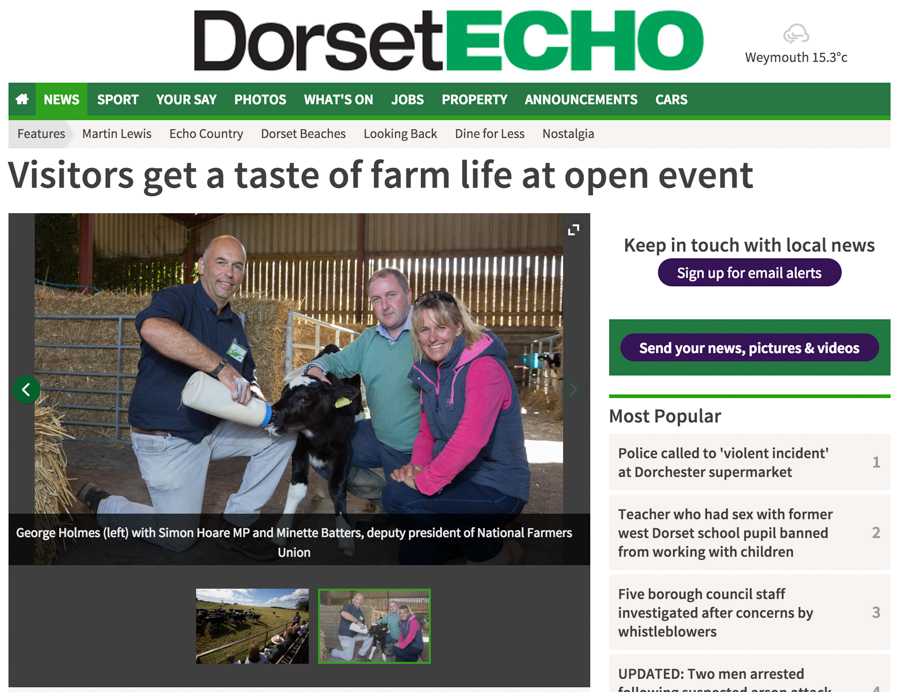
My task was to document the event for pictures to be featured on twitter as well as to capture a PR image for local press which would show George, the local MP Simon Hoare and Minette Batters of the National Farmers Union with a cow.

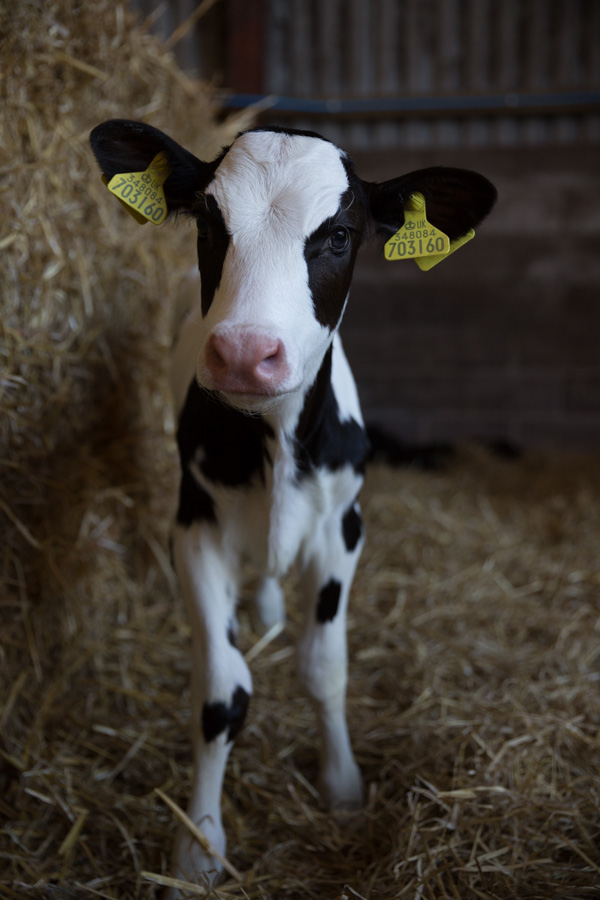
The cow part of the brief troubled me a little because they’re big beasts and not always easy to arrange for a photo, but when I saw the pens of young calves in the calving shed, I knew we had an opportunity for a picture that would jump right into the local press, carrying the story with it – which is the point of a PR piece after all.

I was on-site for a couple of hours, and in that time I built up a collection of images featuring people enjoying the tractor trailer tour of the farm, watching the cows being milked and interacting with the calves as well as getting a few stock images of cows for the client to use later.

The PR picture worked and made its way into the Dorset Echo as well as a good range of industry publications, which goes to show that a well-considered photo really can get useful coverage and exposure for an event and the brand behind it.