What no post?

Indeed, I must apologise to my regular readers that I was unable to post last week and already it’s Wednesday of this week and again I’ve not posted anything . Until now.

The reason for this interruption in service has been the sheer volume of work I’ve had on. This is indeed to be welcomed, but has left my fans somewhat neglected. Some possibly bewildered and upset. I suppose Justin Bieber fans must experience similar disappointment when the wunderkind of muzak stops tweeting for longer than 30 seconds, but since this has never happened I guess we’ll never know.

Which brings me not very neatly to the subject of this week’s post, which is the fulfilment of a promise I made to give the Frome Wessex Camera Club National Salon of Photography 2013 a plug as well as the camera fair on November 3rd. I reported on the April fair this year and I’m sure the November event will be another good chance to grab a bargain, drool over old Leicas and people watch.

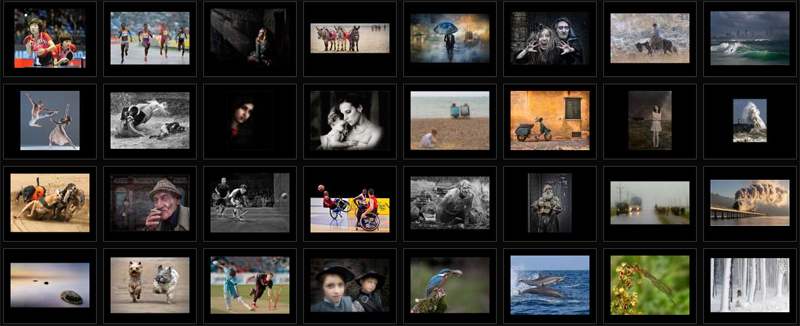
Last year's Frome National Salon of Photography brought in a great variety of entries

Last year’s Frome National Salon of Photography brought in a great variety of entries

I must confess I’m less up to speed with the photo salon, but looking at last year’s entries there are some impressive results there from sports action, to portraiture and wildlife. I’m not a fan of the more processed images, but have a look around the various categories and judge for yourself. Maybe you’d like to enter this year? Best get your skates on because the closing date is October 31st 2013.

On that closing note, I hope I shall be back and publishing on time next Tuesday. You have to admit the uncertainty is pretty gripping.

A Welcome Comparison

The inspiration for this week’s blog comes courtesy of my good twitter friend Lau Merritt (@lau_merritt) who happened to mention she thought I looked rather like the late Mexican photographer Manuel Álvarez Bravo. I note two things in Lau’s comparison. Firstly that it is my looks and not my style which is reminiscent of the father of Mexican photography, and secondly that having been born in 1902 most portraits of the artist himself are of a much older man. I’ll not take it personally because if I have such an incredible face by the time I’m into my 80s I’ll be happy and when it comes to my work, I know I move in more prosaic circles. Besides which I know Lau well enough to know she only means it in the kindest sense.

I’m grateful that she mentioned this chap because I hadn’t come across Álvarez Bravo’s work before, and I’ve not had time to research it much beyond his official website, but I highly recommend a look and I’ll be seeking out more of his work in due course because it really is fascinating.

Álvarez Bravo’s archive stretches from the 1920s to as recently as the 1990s and what strikes me is how broad his themes are and yet how little they change over time. His work encompasses landscapes, still-life, portraits, nudes, photojournalism, portraiture, from the political to the fanciful, but always with a style which might remind you of Cartier-Bresson or Werner Bischof, but which is definitely his own voice.

I’m not much cop at talking artsy fartsy stuff about photography, but I’ll happily share some impressions here. Álvarez Bravo’s work is of a very particular type; some simple studies of light and shape, the use of lines, shapes and motion to draw attention to whatever it is we’re meant to take note of in a photo and expansive landscapes designed to make us realise our own insignificance and mortality.

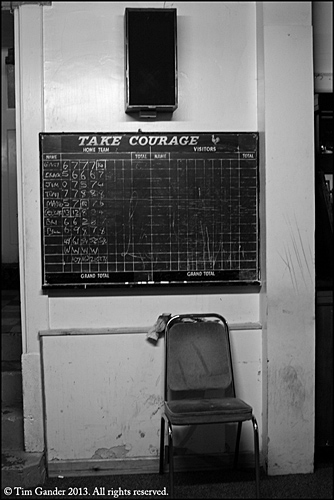
Pub skittle score board hangs on the wall above a chair, music speaker above that

“Take Courage” The closest I get to Álvares Bravo’s style

Like Bresson, Álvarez Bravo’s archive includes photos we would find difficult to take and distasteful in today’s society (see Boy Urinating, 1927 in the 1920’s archive). He deals a lot with death through depictions of the dead and the paraphernalia of death, even symbolic representations of death in the shape of subjects unrelated to death itself. His nudes rarely show the model’s face, also suggesting the the body as separate from the being and therefore subject to ageing and decay.

I’m really glad Lau brought my attention to Álvarez Bravo, and I’ll take any comparison as a compliment. In the meantime I’m going to have to get cracking if I want to leave such a powerful photographic legacy as his.

Missing My Baby

Slim, petite, cute and so nice to touch… but I miss my Fuji X20. She’s in New York as I write this, being shown the sights by another man and I’m jealous as hell.

In fact I miss her so much I was compelled to go back to the review I wrote in July for Wex Photographic just to have a look at photos of her pretty, sleek lines and see the pictures I’d taken with her back then. I’m glad I did because there was a new comment on the article I hadn’t seen before, and I do enjoy responding to the comments and helping where I can. That’s just the kind of guy I am.

It’s also interesting to see the different view statistics between the various articles I write; a camera review will get lots of views in a short time. Write a review about pretty much anything else and the numbers climb much more slowly.

Fuji X20 review photo

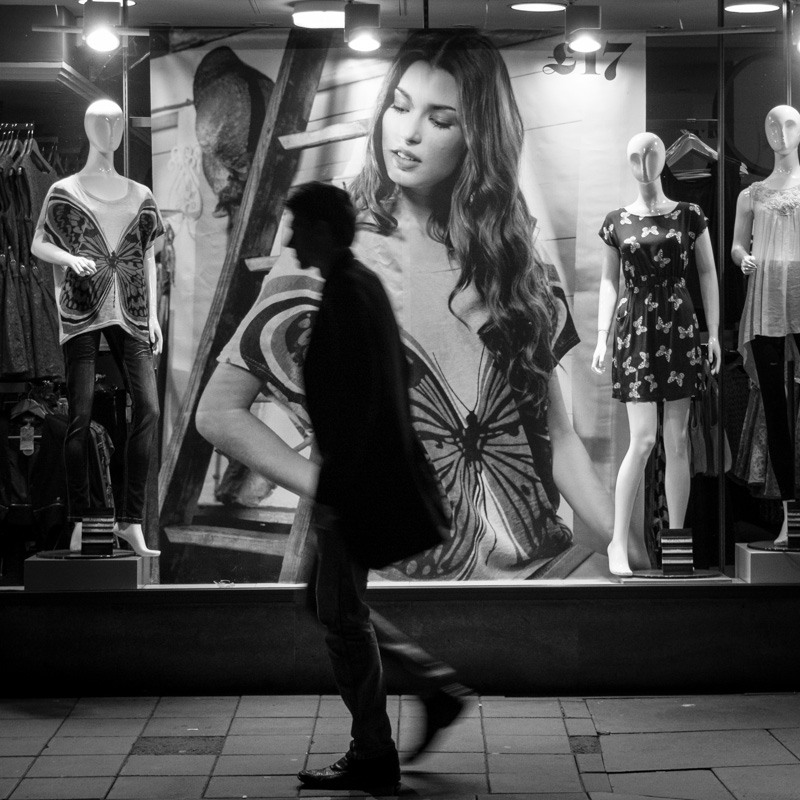
I enjoy using the X20 in black and white as a street camera

With the X20 in particular I have noticed that in addition to healthy numbers of clicks on the article, it’s probably had more comments than just about any other review I’ve written for Wex. People really engage with this camera, which is after all just a camera, but then people engage with cars, coffee machines, just about anything shiny really.

The difference with some of the things I’ve reviewed is that, unlike the X20, they are not usable in isolation. Let me explain that better; when I reviewed the Canon 16-35mm zoom lens, that’s a bit of a niche lens, very expensive, and requires a camera to make it do what it does. Design-wise it’s hard to make a lens beautiful because it has to perform certain functions well and within fairly standard design constraints.

When I reviewed the LowePro Transit Sling 250 camera bag, that was also destined not to get thousands of views because bags are a bit dull. They aren’t what takes the pictures, they’re not at the glamorous end of photographic kit, and like lenses they’re functional rather than aesthetic.

I think what the X20 has achieved though is something extra. Fuji have tapped into the retro trend in the design of this camera, but as I think I’ve said elsewhere it’s not retro for the sake of it. The design works as well as it is attractive. Design and function coming together in a dinky package that’s easy to engage with and love. I do miss her…

When you’ve nothing else to do

Occasionally I’m asked to work for a fee the client sets, a fee far below what it costs me to do the work and certainly far less than the benefit the client would get from the images I would make for them.

The client will try to justify this by arguing that the work is flexible and I can do it “when you’ve nothing else on” as if when I’m not shooting pictures I must be sitting around, twiddling my thumbs waiting for the phone to ring or desperately wishing I was working for less than it costs me to do the job.

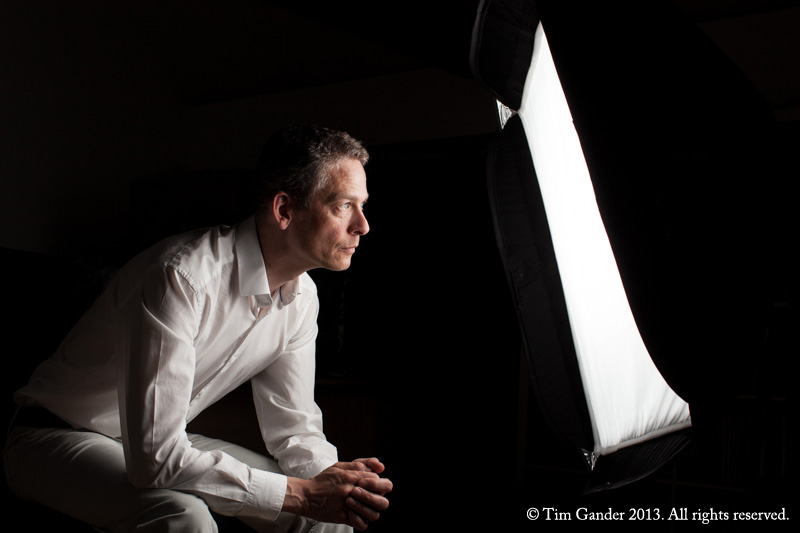
Tim Gander sits before a strobe softbox looking into the lit panel

Spare time to take selfies? No, testing a new lightbox before a big assignment.

In practice, the work isn’t always that flexible either. It might be weather dependent, or rely on the availability of other people, or it might even be on a set date. This kind of “opportunity” also ignores the after-shoot processing and administration which is attendant to doing any assignment at all, regardless of the fee involved.

In any event, if a client requires photography, booking a date when I haven’t anything else on is kind of how my business works. There isn’t a single assignment I do that gets booked into a slot when I’m already working, being that I am not omnipresent or master of quantum physics and thereby able to occupy two dimensions at once.

If I happen to have assignments which will clash I let the client know and offer to take on the administration of the job but pass the work to one of a network of trusted colleagues. That way the client gets to deal with me, the job gets covered by a trusted photographer and everyone is happy.

Conversely to being double-booked, what happens on days when I’m not shooting? Surely that’s a day off isn’t it? No. Anyone who runs a proper, grown-up business will know the astounding amount of administration which is attendant with keeping things running smoothly, or in my case just keeping them running.

I’ve spent much of August doing my end-of-year accounts. When I’m not keeping on top of the books, I’m backing up work, archiving it to my searchable database, updating my website, improving my SEO, making contact with clients to keep in touch, setting up meetings, shooting test images to try out new techniques, writing blog articles… I’m just scratching the surface here, and all this happens around assignments which are booked by clients willing to pay my fees.

Every day of every week I’m putting in the hours. Sometimes I’ll scale back the time I work in order to remain sane; I might even take a day off, but this year I haven’t managed a proper holiday. I haven’t been away anywhere, because so far it’s been my busiest year since I left the Portsmouth News to go freelance 15 years ago. And after the struggles I experienced at the start of the credit crunch (one day I’m going to invent a biscuit with that name) I’m determined to make the most of the resurrection I’ve experienced over the last two years.

That has been and will continue to be a lot of hard work; work I’ll be doing when I’ve nothing else to do.

If you’re good at your job, you should be paid properly

That sentence, unremarkable in its state-the-bleedin’-obvious sort of way, came from the mouth of Sir Stephen Bubb, chief executive of the Association of Chief Executives of Voluntary Organisations. Suddenly, knowing who uttered that sentence makes it rather more remarkable because in many cases the charities which his organisation represents believe that photographers should be made to feel less of themselves if they refuse to work or supply pictures for free. Pictures which would help the charities raise funds far greater than the cost of paying someone to take or supply them.

Sir Stephen was on the BBC defending the high salaries paid to some charity chief executives. Salaries which in some cases are over £180,000 per annum. He was rather cross, putting it mildly, that The Telegraph had made a story of these high sums and said categorically that the charity CEOs should not be expected to work for free. Why, then, are photographers so often expected to work for free? Are they not professionals too? Do they not have families to support? Mortgages to pay? (Voluntary) charitable donations to make?

It goes without saying (usually a prequel to “I’ll say it anyway”) that I do believe charities, on the whole, do a good job. It’s also fair to say not all professionals working for charities get large salaries, even at chief executive level, but this story is extremely timely as I was chatting to an old photographer friend the other day who told me that, yet again, he had been asked to take photos for a charity for free. When he checked on that charity’s website and discovered that they did indeed have paid staff he declined on the basis that he shouldn’t be the only professional working for free for that organisation.

And his story isn’t an isolated incident. Charities tapping up photographers for freebies is a regular gripe on forums. I’ve also been asked to work for free or been told that my fees far outstripped the budget. Quite who sets the budgets is never clear; presumably a monkey with a broken abacus, because the budgets never make any sense.

The Telegraph story raises a serious question for charities: Do high CEO salaries damage the credibility of the charities they work for? Could this damage donations? I’ll answer one question for any charity which cares to listen and that is you already do a great deal of damage amongst large groups of photographers by constantly rattling your tin for free, highly skilled professional services by people who often live precarious lives themselves.

It does a charity no favours to make a photographer feel guilty for turning them away or by making them feel they’re being arm-twisted into making a donation often worth hundreds if not thousands of pounds in the form of free work.

And I’ll add that it upsets me that I even have to speak up on this issue because many do difficult and good work, but good images should not be expected for free and asking for them does very much harm the credibility of a charity.

This week, read something else!

I honestly thought I would get to write a post today, but work is absolutely full-on this week (next week too, so we’ll see if I can get something together for then). However, for those of you itching to know why the Government’s changes to copyright law are a VERY BAD THING, I highly recommend this article by photographer Tony Sleep:

ERRA: You could not make it up (short version)

I’m giving you the link to the short version, but the long version is available here for those wanting a more in-depth analysis.

Which reminds me, in amongst trying to do my job I also have to write to my MP again because from what he’s told me already, he hasn’t grasped the full import of what’s happening. I’ll write that up once I’ve had more correspondence with him.

Thank you and have a good week.

Fact – Myth-busting requires facts

There has been much a-do about the Enterprise Regulation Reform Act (ERRA) and I’ve written about it before and shall no doubt have to write about it again. Much to my irritation.

In response to the many millions of words written about it and an e-petition on the Number 10 website, which currently stands at almost 27,000 signatures, the Intellectual Property Office has issued a statement which it hopes will calm the fears of photographers.

The problem with the document is that writing the word “Fact” in bold lettering at the start of a sentence doesn’t make that sentence irrefutable. There are still too many variables, too many vague answers to specific points and the act has as yet no regulations applied to it, which is why so much that has been written can only guess at what the real purpose of the act will be.

Reading the statement, what kept jumping out for me was the idea that orphaned works could be licensed and licensed “at the going rate.” I’d very much like to know how a government-appointed agent will decide the “going rate” for any particular photo. How will they know whether or not consent for the proposed use would have been granted without the author having been contacted? How will they know what the rights holder would have charged for the use of that image if they were given the choice?

How will anyone not connected to the image or its author know if any people in the photo would be happy for their likeness to be used in any given context? Who will even know which country the image originated in? Or whether the original client for that photo is happy for others to use it? Many images (most of the ones I take for my living) are supplied on an exclusive basis.

I quote here a typical paragraph from the IPO’s response:

“Myth – anyone can use my photos without my permission

Fact – Anyone wishing to use a work as an orphan must first undertake a diligent 

search for the rights-holder which is then verified with permission to use the work 

granted by the Government appointed independent authorising body. If the work is 

not genuinely orphan then the rights-holder should be found, if the search is not 

properly diligent, no licence will be issued.”

Presumably though, if it is decided the search was diligent, but the rights-holder was still not found, the image can be paid for at an un-specified “going rate” and used with permission of the governing body. Therefore, without the rights-holder’s permission. That paragraph, like so many others in this document should read simply:

“Fact – anyone can use my photos without my permission

Fact – Maybe. There will be some kind of procedure as yet unspecified and you might lose control of your image, but don’t worry your silly little head about that.”

It will be interesting to know how on the flip-side of this, the rights-holder is supposed to discover their work has been used and then claim whatever money (or Green Shield stamps or bellybutton fluff) has been held in safe-keeping for them. Are creators expected to constantly check an ever-expanding register of works for use of their images? If the granting of licences is an exception rather than a rule, this might even be possible, but it’s still not ideal and still rides roughshod over the basic tenets of copyright.

IF the IPO had come straight out and said “this act will ONLY apply to works held in recognised historical archives” a lot of fears might have been assuaged, but they didn’t.

The IPO also makes no mention of any plans to strengthen moral rights – the right to be identified as the author of a work, the right not to have one’s work mis-attributed and in particular, the right not to have identifying data stripped from one’s images. Simply by re-enforcing the the creator’s right to have their identity kept with the work would be a start.

The problem with the IPO’s statement is it’s lack of clarity, either through insufficient understanding of their own subject, or because there is unseen industry pressure to keep things vague until the great reveal of the guidelines by which time it will be too late for photographers to properly and comprehensively defend their rights.

Given tight enough regulation, the ERRA could be a good thing for photographers by making it clear our works, even where their identifying data has been removed, are not orphans, but until the guidelines are published we have no idea of the intention of the legislation. By the time we do know, it’ll be too late to do anything about it. I have a terrible feeling we’re being inched towards a goal that was decided upon long before Hargreaves set up his review.
The sky hasn’t fallen in, but it’s looking decidedly dodgy

On February 26th I wrote about the Economic Regulatory Reform Bill and its likely effects on the ability of photographers to control where and how their work is used and whether or not any payment is exchanged for that use.

Sadly I must tell you the ERRB, including the clauses on orphan works and extended collective licensing, is now law. I say sadly because this has happened even though the moral rights of the photographer to be identified as the creator of their work has not been reinforced ahead of this change in law.

In case you’re not aware, an orphan work is any creative work of which the author cannot be found. Extended collective licensing is the selling of the use of orphan works without the creator’s knowledge or consent.

In relation to photographs, the problem with orphan works is they’re being created every second of every day on the internet. The problem with ECL is that it takes away the photographer’s right to set or negotiate their own fees based on the value of the work, or to limit use of the work, especially where exclusivity has already been sold to a client. It also ignores the rights of people within photographs not to be associated with businesses or causes with which they do not agree.

Now, before we all hit the panic button, the ERRB is primary legislation and will be subject to regulations which are yet to be drafted. In an ideal world, the orphan works and ECL clauses of the ERRB will be regulated to only encompass works held in historic archives, of which there are many and whose archivists would like the ability to digitize and ultimately make money from works held in storage whose authors have long since passed on or vanished.

Even within that framework there will be grey areas, but to gather in ALL orphan works wherever they reside would be a grave mistake, and would almost certainly result in legal actions, especially from photographers in the USA who are allowed to claim exemplary damages for breaches of their copyright. In short, it could get very messy and very expensive very quickly.

Photographers both professional, amateur and occasional all need to be very wary of what follows. It would be a good idea to write to your MP in the first instance asking what the intention of the regulations will be and whether it means any photo you take can ultimately be used by all and sundry, without your say-so and with no opportunity for you to say no or negotiate a fee.

Another area of the law which needs attention is the moral right to be identified as the author of your work. This is currently part of the Copyright Designs and Patents Act (1988), but it is weak and with too many exceptions. To be fit for the digital era it is imperative that identifying data, either in a watermark or as data embedded within the image file is protected by law.

Of itself the ERRB could be benign, but that we don’t know what the regulations and restrictions will be and the fact it can be amended without recourse to Parliament are dangerous factors and should worry everyone concerned with protecting their own creative property.

I’ve merely outlined the issues here. Far more detail needs to be worked out to ensure the ERRB doesn’t cut off the ability of creators to make a living, nor to exploit the works of amateurs in ways they could never have imagined or wanted. The creative industries in the UK are too important to our economy, and too easily harmed by badly-framed legislation.

Keep an eye on sites like EPUK.org and BJP online to keep up to date with developments, but remember also to contact your MP to make sure they’re aware of what’s at stake here.

The kind people have a wonderful dream

I must admit I was struggling for a topic this week. Then Margaret Thatcher died, which threw me into a quandary. I knew if I wrote about her it wouldn’t have much to do with photography; many great photos were taken of her, she was a great subject for press photographers, but I never got the opportunity to photograph her so can’t regale you with fascinating (snore) stories of the time I met Maggie.

Equally, I can’t bring myself to write about a corporate portrait session the day after such a big news event, so I find myself putting down a few, brief thoughts on Thatcher. I cannot deny, writing a political piece on my photography blog makes me nervous, but nothing else seems appropriate right now.

Ok, I never was a fan, but I won’t gloat over her death. And perhaps it would be trite to observe that she passed away at The Ritz. You may detect I’m struggling to not just “come out and say it”, so perhaps I should just say it.

The inescapable fact is she destroyed industries to an unnecessary degree. Granted, the country was a mess when she took over. I remember the power cuts, the terrible cars, and I’ll accept that British Rail was a basket case, though I was too young in 1979 to remember much about public transport, the steel industry and so on, but the headlong rush to lay waste to everything that could have given this country a sound future was frankly distasteful in its zeal, shortsighted in its goal.

Likewise, the unions were in dire need of reform, but now we’re left with very little in the way of organised help for workers finding themselves in need of a protective hand when they need it. Unfortunately, the unions were their own worst enemy and gave Thatcher the perfect excuse to have them crushed.

We could have replaced the broken, semi-Soviet economy with compassionate capitalism. This would have been achievable with patience and care, but what we’re left with 23 years after she left Downing Street is capitalism without a care, just the individual pursuit of personal wealth, resentment of success, resentment of failure, resentment of the disenfranchised and the poor.

I don’t rejoice at the passing of Margaret Thatcher because her death won’t change the route we’re on. The industries she broke can never be repaired, but maybe the next prime minister to be called genuinely visionary will be one that finds a way to nurture genuine industries and innovation (as opposed to the making of money by moving money around), make us all more understanding of each other, more genuinely compassionate and less self-absorbed… and I include myself in that criticism. There isn’t anyone in the current political class with such potential, so we’ll just have to hope hard for a future generation and spend the meantime striving to be better people despite the prevailing climate.

Goodwill Hunting

I’m thinking it would be too easy to write yet another tale of woe about a small business getting caught with unauthorised images on their website, and if you read my blog regularly you won’t need me banging on about copyright yet again so I won’t. Of course if you want to know more about this, read The Guardian consumer column which will enlighten you further.

Instead I’m going to tell you a new and surprising fact; Photography is more crucial to the promotion of business than it has ever been.

That I’m saying this isn’t perhaps all that surprising. What IS surprising is that it’s been said by John Owens in PR Week. If you’re a photographer, you might be peeling your eyebrows off the ceiling after reading that. Yes, an organ of the public relations industry is extolling the virtues of photography in brand awareness. I utterly commend the article as essential reading to all PRs who either don’t know, or who might need a reminder of the importance of good quality, engaging imagery for their campaigns.

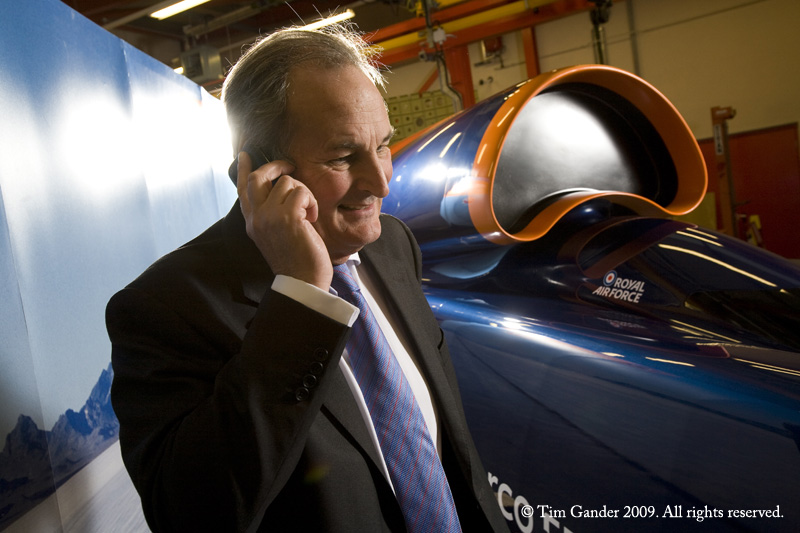
Richard Noble of Bloodhound SSC project on the phone

Behind the scenes, un-staged photos (such as this one of Richard Noble of the Bloodhound SSC project) are championed by the PR Week article.

The piece even concludes with an immensely useful check list written by Matthew fearn, picture editor of The Daily Telegraph, for PRs wishing to get exposure in national newspapers, but which is also a perfect outline of good practice for PRs sending images to trade and local press too.

There are one or two points in the article where I would advise caution, as you would expect me to (knowing what a cynic I can be), but I think they’re worth a little extra consideration.

The author sites a couple of examples where big name brands have engaged the goodwill of their customers to help with social media campaigns on Facebook and Twitter. In one case Lego asked customers to send in creative images of their models for use in what was a highly successful Facebook campaign. Lego’s head of social media Lars Silberbauer says, “At Lego, we are at a stage where we would rather build a stage around our customers’ content than a campaign using fixed assets.”

I say, “Yuhuh I bet you would.” Fixed assets are expensive and customer-supplied content is free. I’m not actually saying brands shouldn’t do this, but it must be done in good faith and brands need to be aware that crowdsourcing can backfire.

In the case of Lego, where customers knew exactly how their images would be used, the campaign was a success. In the case where Instagram wanted to grab rights from its users for unspecified use, the exercise blew up in their face. I wonder how many times a brand loved even as much as Lego could use this exercise. People are increasingly aware of the commercialisation of their non-commercial photos, and while I don’t condemn crowd participation per se, I would urge brands to ensure their use of freely-offered images is circumscribed and boundaries are clear.

You might conclude I’m worried about the public taking PR work away from me, but that isn’t such a concern. As long as the public aren’t being taken for fools and brands play fair, I’m comfortable with this. Any business doing PR properly will have a range of different avenues for exposure, including social media and low-end imagery alongside higher-end imagery, press PR and advertising. It shouldn’t be treated as a one-or-the-other equation.

PR is vital to any business of any size. It’s bad PR to use other people’s images without permission, it can be good PR to ask for pictures if the deal is fair, and a good photographer with real newspaper training and experience can help you get exposure at a fraction of the cost of advertising. So go hunt goodwill, just don’t shoot Bambi’s mother in the process.